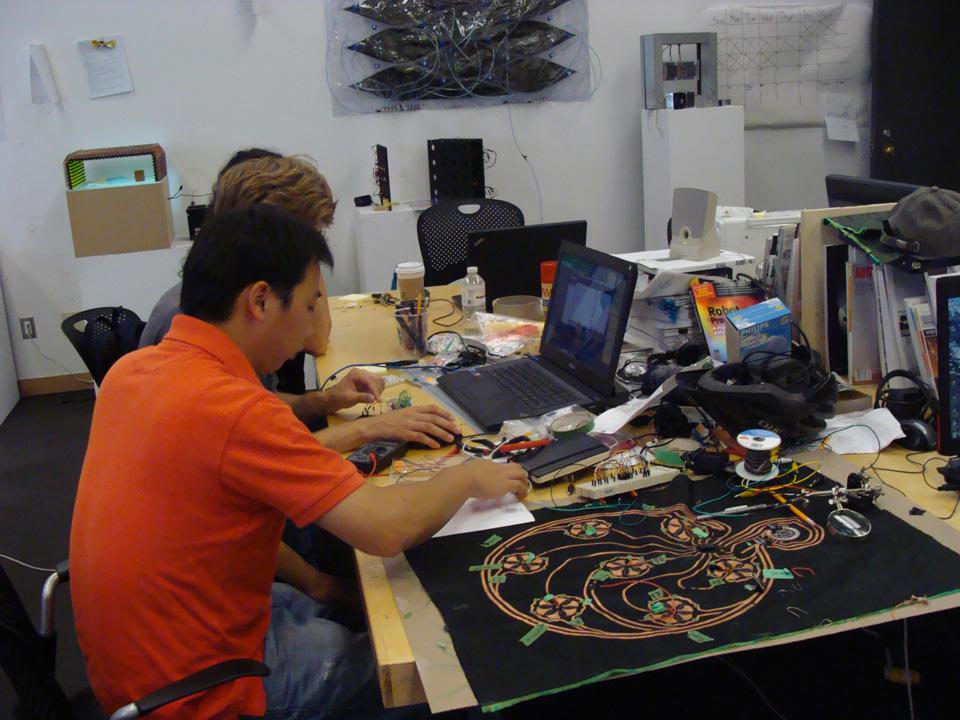
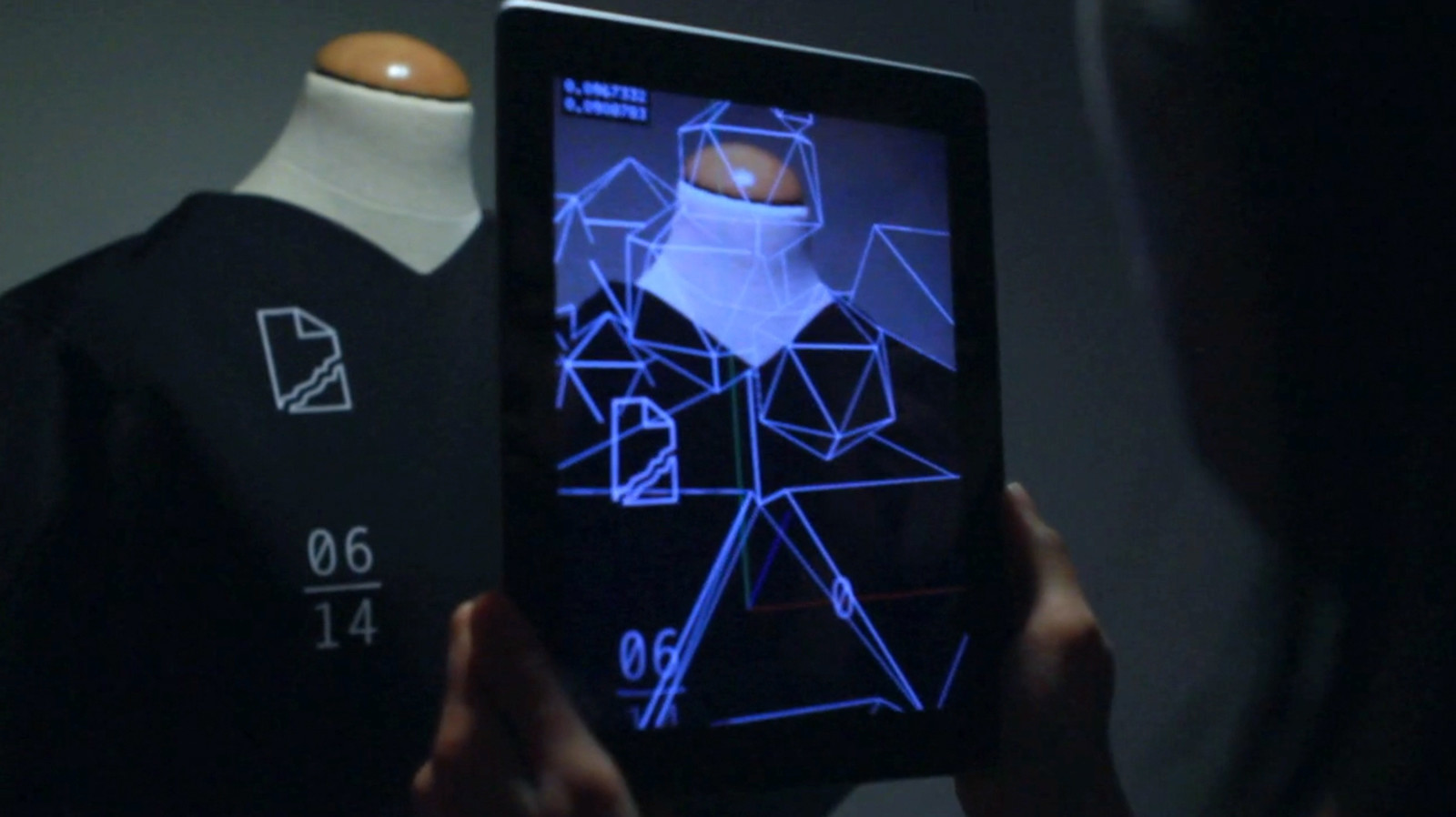
Created by Studio NMinusOne at the University of Toronto (Responsive Architecture at Daniels), IM Blanky is a self-positioning and representing blanket. The blanket is capable of generating awareness of one’s own body and by draping it over an object the blanket reproduces digitally and in real time that which it covers.
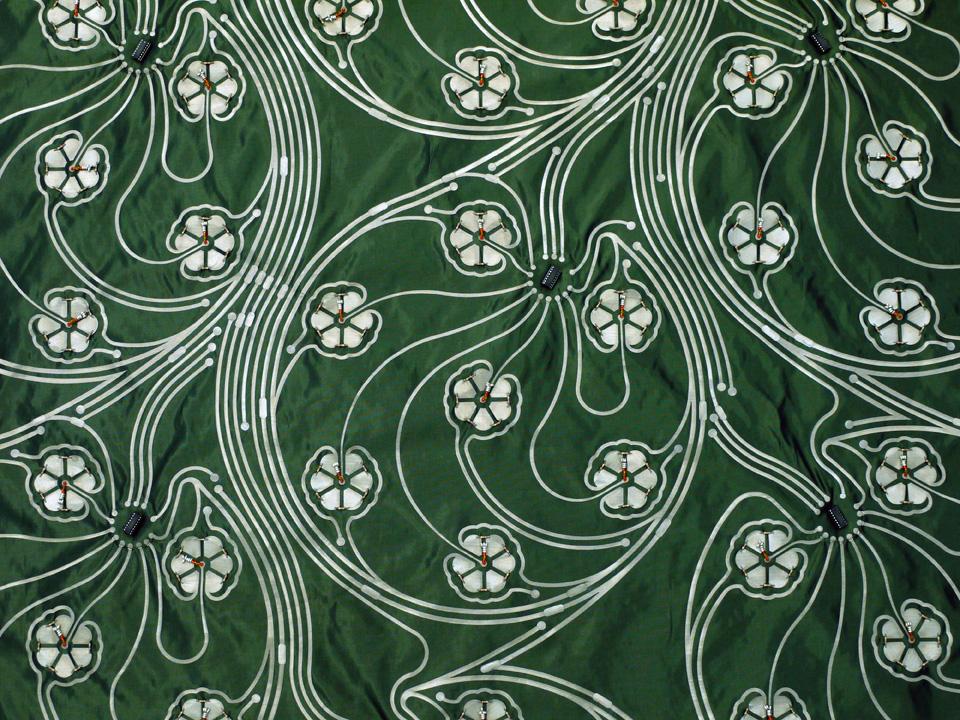
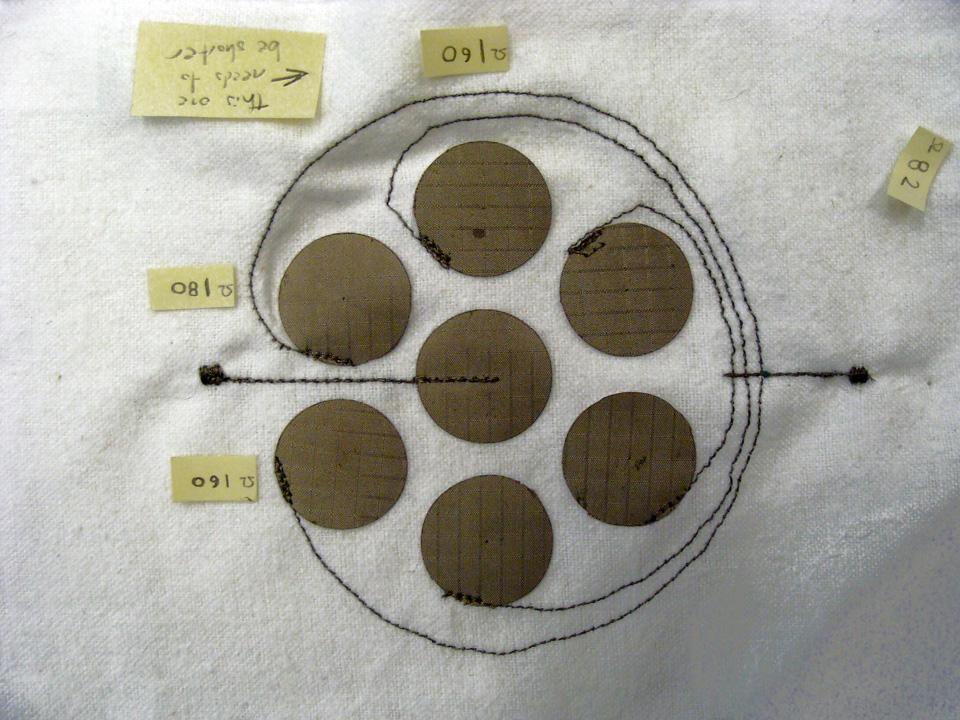
The project takes on the techniques and figurative traditions of embroidery, by stitching an array of sensors with conductive threads onto a base fabric. The blanket measures 7’7” x 4’2” and is composed of a distributed field of 104 soft tilt sensors. The flower consists of 6 conductive petals, linked by resistors, and a conductive tassel in the center. The flowers are grouped together into 14 larger configurations or clusters and 2 half clusters. Working as a directional marker, the tassel’s contact with a petal registers a specific orientation or tilt of the blanket. The flowers are arrayed around the circular double power circuit, and their stems plug into a computational hub (Multiplex). The clusters are then linked together, into a larger network of clusters, each relaying the position of its flowers to a micro-controller stitched to the back of the blanket.
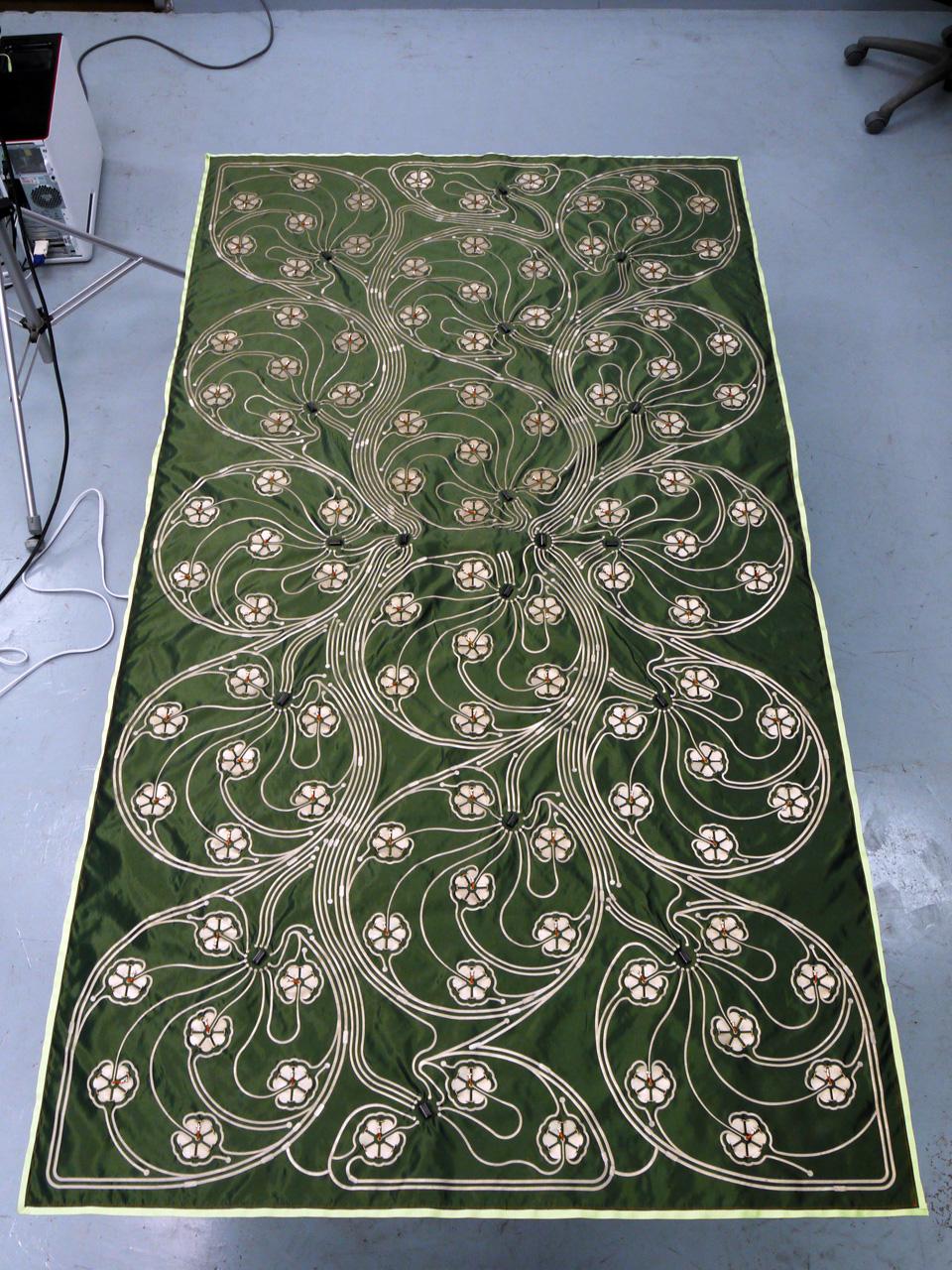 The distribution of sensors is based on an underlying hexagonal structure. Each flower occupies a hexagonal cell, surrounded by six neighbours. Processing software receives directional (N,S,E,W) input from a cell, it is able to reconstruct a slope based on the position of that cell and its immediate neighbours, generating essentially a surface of peaks and valleys.
Credits: Rodolphe el-Khoury, Christos Marcopoulos, Carol Moukheiber, with Valentina Mele, Sebastian Savone, Yie Ping See, Jonah Ross Marrs, Samar Sabie, Dina Sabie
Source rad.daniels/ via Domus