Created by Lauren Walker at the Bauhaus-Universität Weimar (Interface Design), Residual Lines is a redaction machine that visualizes the loss of new knowledge tied to recent research grant cuts.
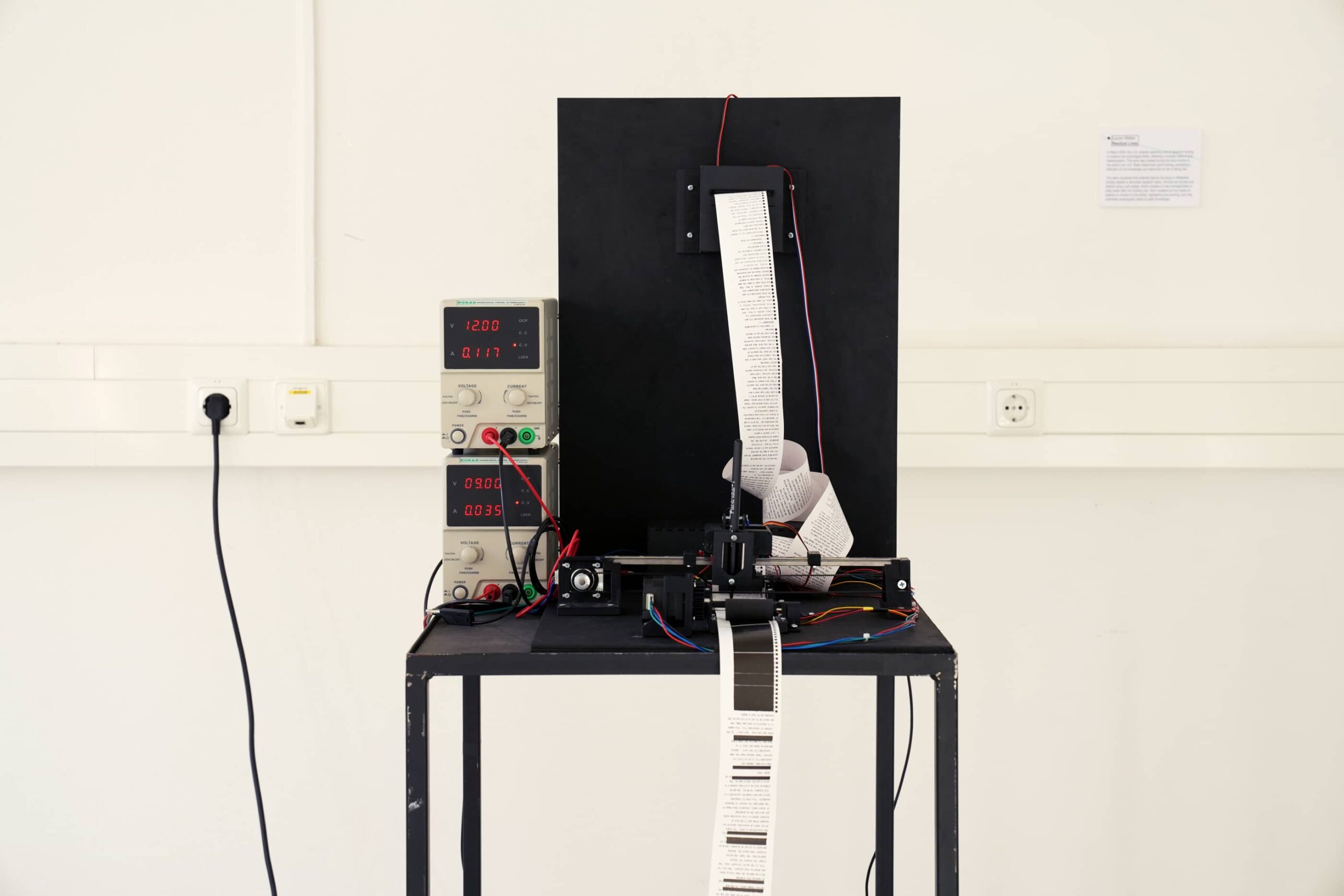
The work focuses on Wikipedia articles related to defunded research topics, printing and altering them in real time. A pen plotter crosses out text corresponding to edits made after the funding cuts, with each crossed-out line marking an addition or revision—highlighting an evolving, and now potentially endangered, body of public knowledge.
In March 2025, the U.S. government enacted spending cuts to research funding in medical and sociological fields, reflecting a broader cultural wave of government-backed anti-intellectualism. This work was created during the final months of the artist’s own U.S. State Department grant, prompting a reflection on the intangible and often unknowable consequences of withdrawing support from emerging research.
Lauren Walker
Using the Wikipedia API and a custom Python script, edited lines are marked with full-block Unicode characters (██). These markers trigger a mechanical redaction process. As the thermal receipt printer outputs article text, a motorized roller feeds the paper through a sensor system composed of two small PCBs: an always-on SMD LED above and a photoresistor below. When the photoresistor detects the (██) block through a change in light, the system pauses the printer and roller to begin the redaction cycle.
A CNC-based mechanism then lowers a pen to strike through the flagged line. The motor moves left to redact, the limit switch is reached, the pen lifts, and the system resets. Because edits often appear in dense clusters, the cycle may repeat across 20–50 lines, producing long bands of censored text.
Visitors interact by attempting to read the articles before redaction and by examining the growing pile of discarded receipts. The installation underscores the fragile and ephemeral nature of information platforms, revealing how quickly access to knowledge can vanish.
Lauren Walker | Interface Design at Bauhaus-Universität Weimar
| Software | Hardware | 3D Printed Parts |
| Arduino IDE, Python, Wikipedia API | Dev module ESP 32, Thermal Printer (57 mm receipt paper), Linear Rail, Linear Bearings, SMD LED, Photoresistor, Limit Switches ×2, 9g Servo, Nema-17 Stepper motors ×2, TMC2209 Stepper motor drivers ×2, 12V and 9V Power Supply | CnC Machine, Paper Rollers, Receipt Reader, and Thermal Printer Case. |
| Dimensions: 60 × 38.5 × 54 cm |