Currently on display at RCA as part of Design Interactions “work-in-progress” show is the Known Unknowns, a project by Steffen Fiedler and Jonas Loh that questions our relationship to randomness. The project investigates if randomness exists or if it is just a lack of knowledge which makes things appear random to us.
On a daily basis random numbers are essential elements in operations and simulations like Monte Carlo predictions i.e. economics which rely on a large amounts of random numeric sets. For security encryptions true random numbers are needed to encode data.
This first part of the project seen at the exhibition, focuses on the generation of random numbers using two different seeds:
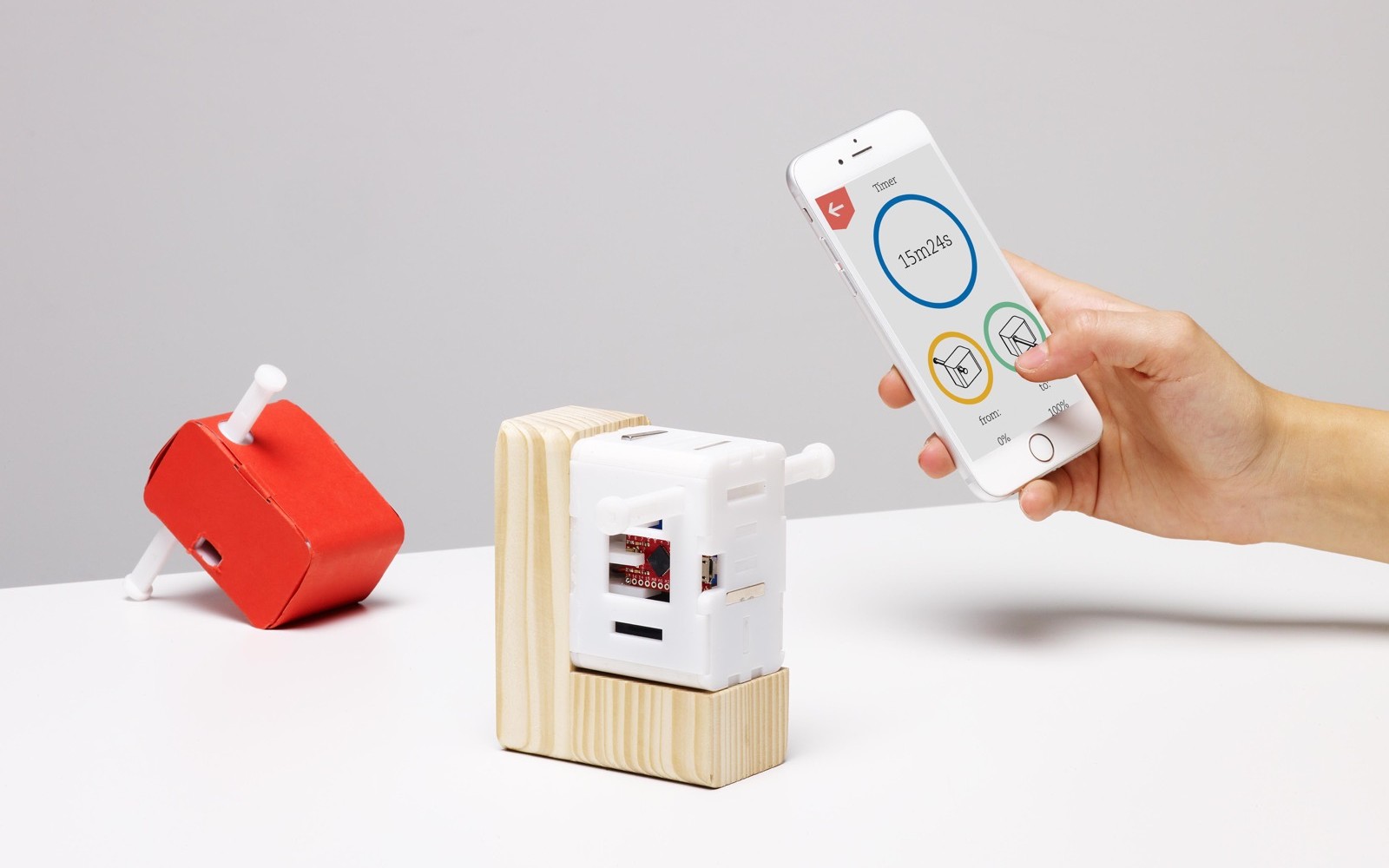
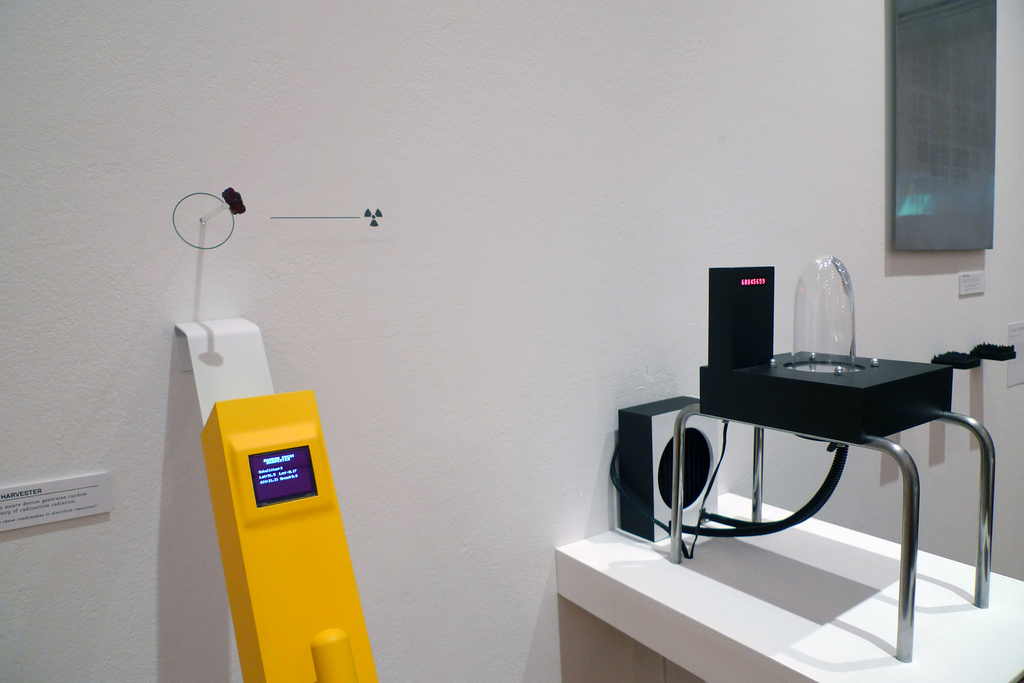
The Random Event Harvester (seen below) is based on a Geiger counter that notices radioactive particles, producing a bitstream that is afterwards converted in real numbers. It’s characteristic of being portable allows collecting random numbers in the environment and store them with associated geographical information. To visualise the claimed data, or the bit stream, etchings and millings are produced. The three examples of the millings represent sections of the complete bit stream results, etched in stainless steel. The harvester itself is rapid prototyped and contains an arduino inside. The display is an oled and the actual counter from sparkfun. For evaluating the numbers the team used a couple of tiny processing sketches; which led to the negative for the etching and the milling files.


The Cosmic Ray Detection Chamber (seen below) is inspired by current approaches to generate true rather than pseudo random numbers: Particle movement is tracked on a quantum physics level (cosmic rays on wiki). The design is based on a Wilson Chamber that visualises tracks of cosmic rays that are energetic charged subatomic particles that originate from outer space. These tracks are then used to generate random values. The cloud chamber is made out of mdf, aluminum and glass. Nothing special in there so far; only an arduino to drive the displays. The team opted not to use the actual cloud chamber developed previously (see videos below) so instead an empty glass cover was used to communicate only how the final design may look.


After exploring different methods of generating random numbers, the team are now working on creating speculative scenarios in form of social fictions that require specific types of random numbers; as created with the Random Event Harvester and Cosmic Ray Detection Chamber – a society that renounces deterministic beliefs.
Steffen Fiedler | Jonas Loh | interaction.rca.ac.uk