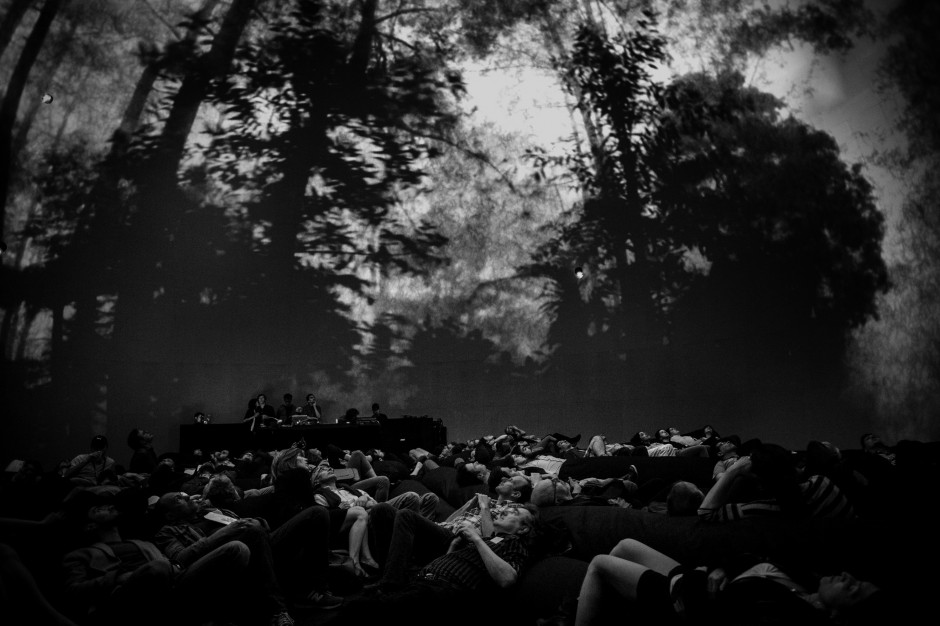
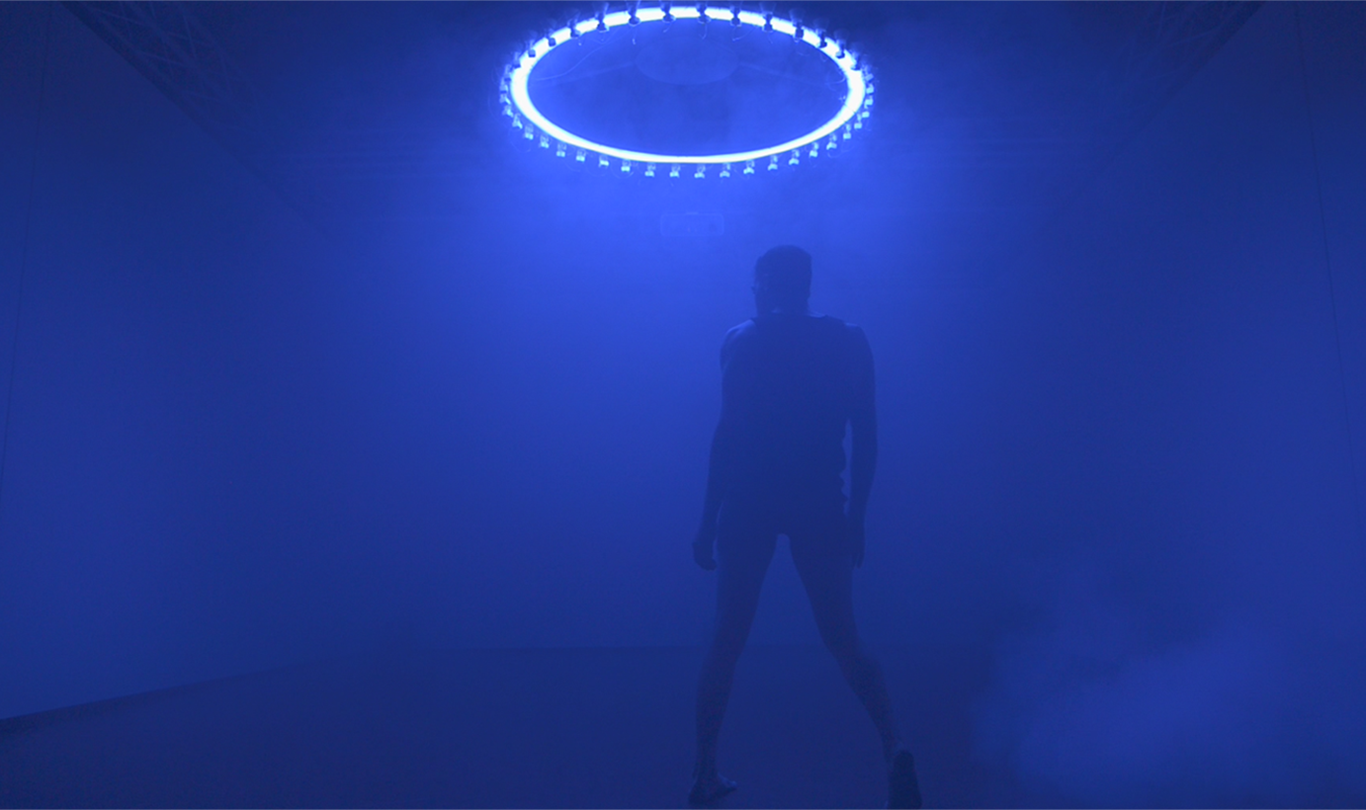
Created as a collaboration between Joanie Lemercier and James Ginzburg (one half of emptyset), Nimbes is an audio-visual installation designed for 360º immersive environments. The piece just premièred at the Satosphère, projected on a 18 meter diameter dome and screened everyday until the 27th of June. The project explores boundaries between natural and artificial, questioning the solitary nature of perception and observation and their relationship to both the cosmic and human scale.
Audience is in the center of a universe that comes into being, and explores it as it unfolds. We observe landscapes, mountains, forests and vacant architectures, with questions on the linearity of time.

To create content for the installation Joanie and James started with shooting real footage. They built a very compact 360 degrees rig for 6 GoPro cameras, that could be taken everywhere. Joanie had a chance to travel intensively during the making of Nimbes, and shot footage in many locations around the world, from forests in Berlin and France, deserts in Arizona and Utah, the Duomo cathedral in Milan, to the top of Bromo and Agung, two active Indonesian volcanoes. Having done a number of projection tests trying out the footage, the duo realised that most of the footage simply wasn’t usable due to challenges posed by dome projection. After more research it appeared that the best option was to combine the footage and textures with 3D data to gain more control over the lighting and the shading of the scenes. They used 3D reconstruction from pictures for the simple scenes, when the level of quality was sufficient, and LIDAR laser scans for the very fine and detailed scenes (scan of a forest provided by ecosynth). Blending actual footage and it’s digital representation allowed them to bypass the constraints, and also helped reshape and refine the story.


A variety of techniques was used to create the 3d data: LIDAR laser scan, manual 3D modeling but also automatic scene reconstruction from sets of 2D images using Photoscan. The third technique came up after they had an issue with the “cathedral scene”: After several tests with “clean” 3D models, the geometry was too linear and didn’t match the intended “organic feel” of the piece. They then exported many 2D stills of these perfect meshes, using various textures to trick the point detection algorithm in the software, and loaded in renders. After a long analysis pass, the software would find the cameras’ positions in space, and reconstruct meshes from the 2D data. A lot of tweaking was required to achieve the right results and they came across many modeling artefacts and unexpected results which at the end became part of the narrative.


The soundtrack for Nimbes was created in three stages. The initial recording session was carried out in a large space within a disused power plant in Berlin with contrabassist Yair Glotman and percussionist Brandon Rosenbluth, and was recorded by sound engineer Kai Schoorman. The recordings were then brought back to Multiverse in Bristol UK for editing, producing and premixing before being given a final mix in the dome in Montreal. Since Nimbes is concerned with questions of the solitary nature of perception, the soundtrack has been kept primarily focused on the voice of the contrabass and it’s relationship to the space in which it was recorded.

The project is currently on shown at the Sat, Société des Arts et Technologies in Montreal until the 27th of June, alongside Quantum, an audiovisual project from 1024 Architecture, who were also part of the same artist residency.
It will soon tour in festivals and domes in Europe, and the artists are now looking for partners for the production of a longer piece, and a new version of the project will be shown as an installation, using the Oculus Rift 2 in Fall 2014. More details on the project’s page below.
Project Page | Joanie Lemercier | James Ginzburg
Visuals: Joanie Lemercier / Software development: Nikolay Matveiev / Laser scan of a forest by Ecosynth project
Music: James Ginzburg / Contrabass – Yair Glotman / Percussion – Brandon Rosenbluth / Location Recording Engineer – Kai Schoormann / Special thanks to Laurens Von Oswald & Kraftwerk Berlin
Production: Artist production – Juliette Bibasse / coproduced with SAT Montreal
Photos in the dome: Sebastien Roy / SAT