This project aims to create a low-cost DIY kit for off-grid electricity in the remote region of Turtuk, Leh, India, in collaboration with the local community. The kit includes visual schematics for wind turbines and electronics such as PCB inverters and MPPT controllers, empowering residents to construct and maintain the turbines independently for supplemental electricity generation. The project was executed with the community during a 14-day workshop that involved building and deploying a wind turbine prototype. Due to limitations, the prototype was not tested under various weather conditions and requires further improvements to optimize performance.
Turtuk, a remote village on India’s border, experiences severe winters with temperatures reaching -40°C. From November to February, river streams freeze, cutting off the village’s only power source. This leaves the community dependent on limited electricity from diesel generators that run just 4 hours daily (6pm–10pm). The restricted power supply hampers essential activities like heating and cooking, forcing residents to rely heavily on firewood. Some areas within the village have no electricity at all.
During winter, the region becomes inaccessible due to transportation challenges, preventing outside assistance. This isolation creates a need for additional electricity sources that the community can operate and maintain with minimal external support.
Interviews were conducted with community representatives from Turtuk, including Mr. Anayatullah (Village Head) and Mr. Ghulam Mehndi (District Councillor, Leh), with additional validation from LEDeG, an NGO from Ladakh. These community insights guided the development of wind turbine models at various scales—1:10 and 1:5 using 3D printing, and a full-size 1:1 model using local materials—specifically designed to function efficiently in Turtuk’s low wind speeds (6-8 m/s).
After finalizing the design, a full-scale prototype was developed in Ahmedabad before traveling to Turtuk. Built over 10 days, the prototype involved collaboration with local fabricators, an architect, and family members. All low-cost materials were sourced locally.
The project culminated in a 14-day field deployment in Turtuk, where the prototype was built and installed collaboratively with the community. Turtuk, like many regions struggling for year-round energy access, offers a unique opportunity to test self-deployed energy systems in harsh environments. This pilot project serves as a model for empowering remote communities through a bottom-up approach, fostering collaboration instead of dependence on external support. The kit enables community members not only to build wind turbines but also to adapt and expand beyond this initial application, developing additional energy solutions independently.


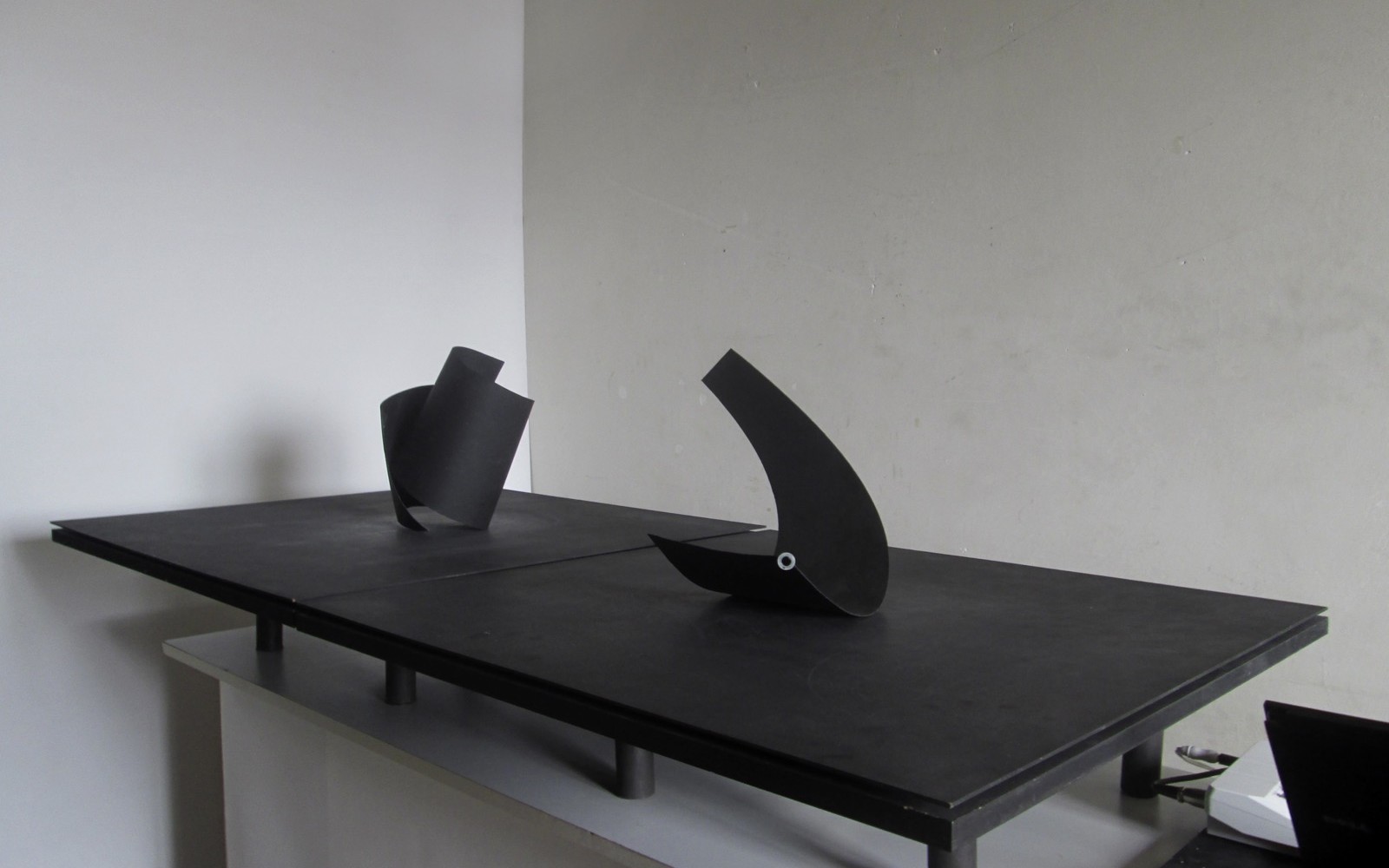
The research commenced with systematic prototyping using 1:10 scale 3D-printed wind turbine models representing various industry-standard configurations. Nine distinct turbine forms were evaluated in a controlled wind chamber featuring three enclosed sides to maintain consistent wind pressure conditions. All models were subjected to identical wind speeds to identify the optimal configuration for low-speed wind power generation applications.
Following design validation, a full-scale prototype was constructed using locally sourced materials to ensure community accessibility and sustainability. The turbine assembly utilized bicycle rims as the primary structural framework, supported by a dual-diameter metal rod system. The central shaft consisted of a larger-diameter rod, while the rotational mechanism incorporated a pair of S-shaped thinner rods engineered to generate the necessary helical twist for efficient wind capture. The central shaft was welded to bearing discs positioned on both sides, enabling smooth rotational movement within the assembly.

The aerodynamic surfaces were constructed using jute rope as a tensioning framework, around which cloth material was wrapped and secured. To enhance weather resistance and operational longevity, a water-resistant adhesive coating was applied to all cloth surfaces, providing protection against environmental degradation.
The electrical generation system integrates an AC motor connected directly to the wind turbine rotor assembly. The generated alternating current is directed to an MPPT (Maximum Power Point Tracking) controller, which stabilizes the irregular current output resulting from variable wind turbine rotational speeds. The processed electrical output is then routed through an inverter that converts the AC current to DC, enabling power supply to small-scale devices including LED lighting systems and mobile device charging stations.
Project Page | Perth Patel | Twitter/X