There is a particular violence in the disappearance of names. Not the violence of the act itself, but the slower, more administrative violence of a name that was recorded, documented, published — and then passed over. Filed. Scrolled past. The information exists. It was counted. And yet it vanishes, not through censorship but through the filtering mechanisms we rely on to manage the overwhelming volume of what we are asked to know. Zero Range occupies this space: the distance between data that is available and recognition that never arrives.
Zero Range centers on a single column in a dataset: age ‘0’. Over 1000 rows. Each one is the name of a Palestinian baby under one year old killed in Gaza since October 2023. The number zero reveals a tragic paradox — entire lives compressed into a data field that contains no quantity, only the void of what never had the chance to be.
The work emerges from a specific tension: human rights organizations have documented, published, and made accessible detailed knowledge about Israel’s actions toward the Palestinian population, yet Israeli society maintains a systematic disregard of this information. The information exists. It is not hidden. And yet it disappears — not through censorship but through the filtering mechanisms that characterize contemporary information culture, the same mechanisms we rely on to manage overload and that can just as easily be used to suppress what is unbearable to acknowledge.
The Installation
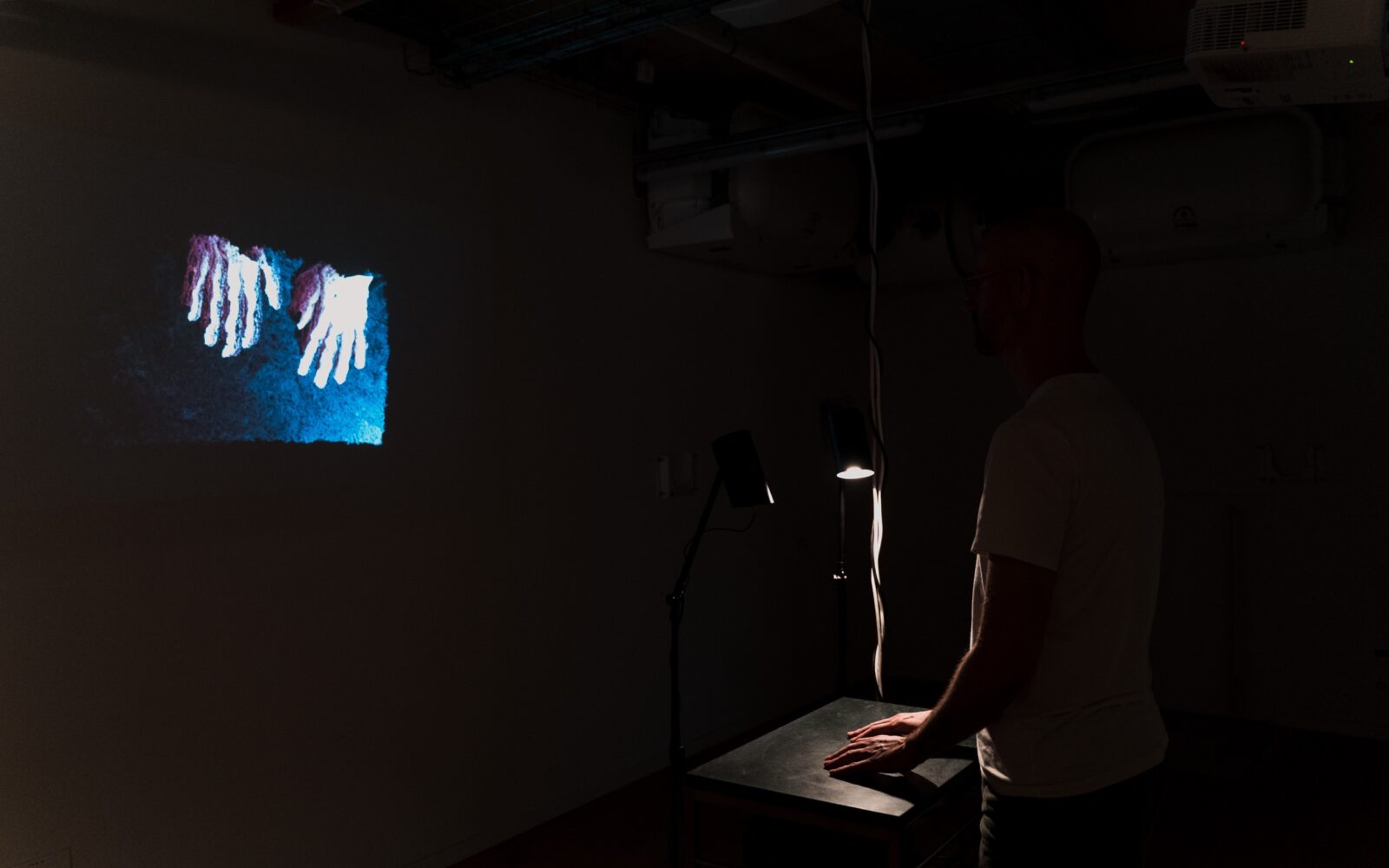
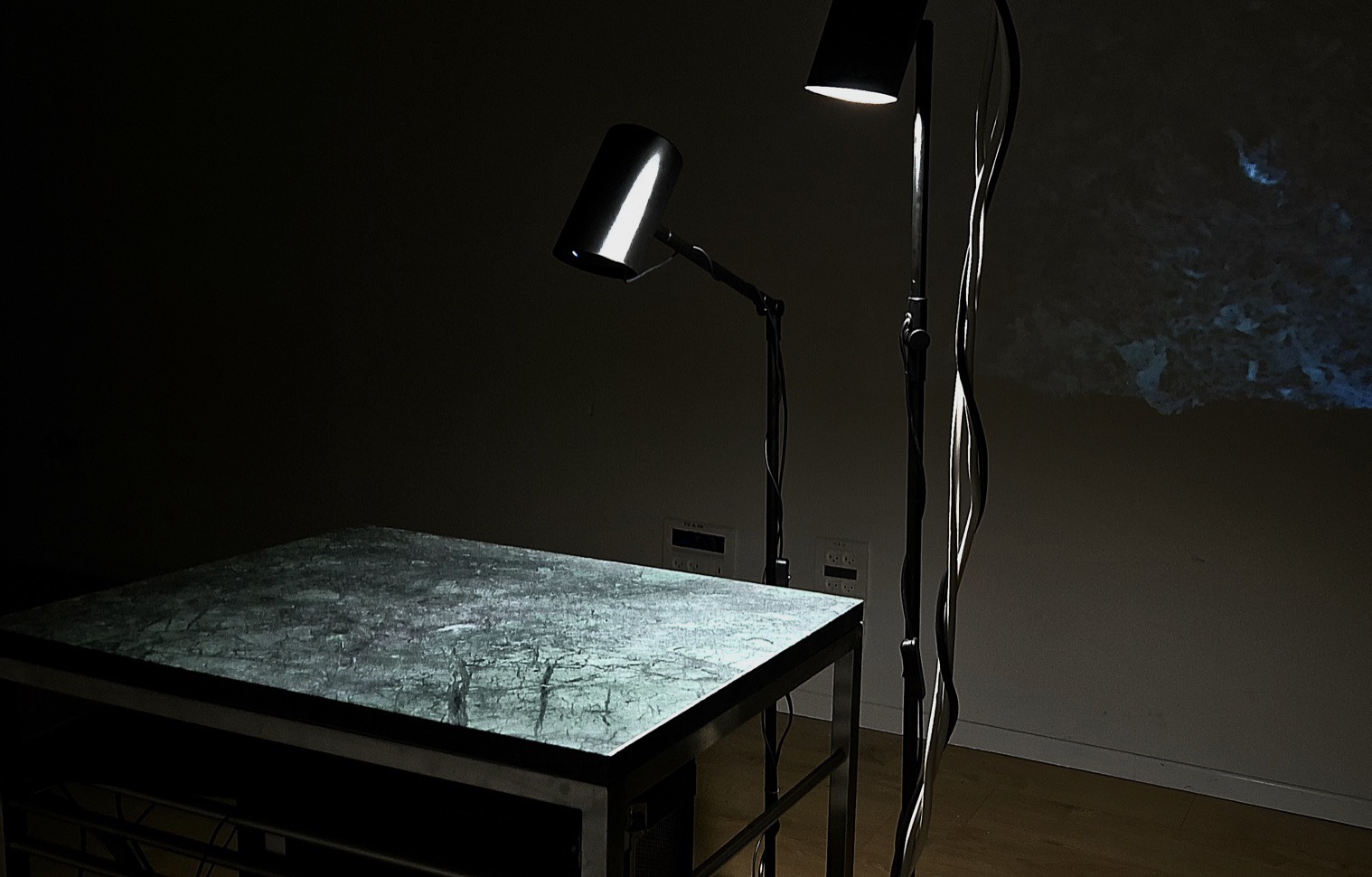
The installation takes the form of a minimal steel kitchen cart with a green and black marble surface — an aesthetic that deliberately evokes both domestic spaces and institutional sterility. The choice of object matters. A kitchen cart carries associations of care, nourishment, the everyday labor of sustaining life. Transformed into a site of confrontation, the familiar becomes a space for encountering the unthinkable. The sterility is not incidental — it evokes the clinical distance of data processing, the bureaucratic calm with which atrocities are recorded and filed and made manageable. The cold marble surface holds both of these registers simultaneously: intimate and institutional, domestic and forensic.
One visitor at a time. Both hands placed flat on the surface. Only after several seconds of complete stillness does a name appear — retrieved from the documented death toll, one of the over 1000 babies under one year old recorded as killed. The moment is captured through computer vision, adding an image of the visitor’s hands to a growing Embodied Archive that links an act of recognition to a Palestinian name. The archive accumulates with each interaction, becoming a collective record of acknowledgment.


The Interaction
The experience is designed around embodied engagement rather than passive consumption. The technology waits. It responds only to sustained, motionless contact — demanding patience and intention from a visitor accustomed to the frictionless pace of digital scrolling. This deliberate slowness is the work’s sharpest formal instrument. The cold of the marble, the required stillness, the weight of the name when it finally appears: these are not decorative choices but epistemological ones. The body is asked to do something the screen does not require of it. To stop. To commit. To be present with a specific life lost rather than a statistic absorbed.
Visitors maintain complete control — they can withdraw at any moment. But the design of the encounter resists easy exit. Having placed your hands, having waited, having received a name, the act of leaving becomes itself a choice that must be made consciously. The work does not trap or coerce. It simply makes the moment of turning away visible, both to the visitor and to the archive.


The Embodied Archive
Each interaction becomes part of a growing record. The captured images of hands — not faces, not identities — create a visual accumulation of acknowledgement. The archive does not claim to offer absolution or political resolution. It offers something more modest and perhaps more durable: evidence that these names were encountered, that hands stopped, that someone stood still long enough to receive one name from among more than a thousand.


The distinction between recognition and absolution is central to the work’s ethics. Zero Range does not suggest that the act of placing your hands on marble constitutes meaningful political action, or that it compensates for the structures of indifference it critiques. What it proposes instead is that genuine recognition — slow, embodied, individual — is a precondition for anything else. The wall of indifference that enables the continuation of atrocities, or their denial, is built from the accumulation of moments in which information was available and was not received. The installation attempts to create the conditions for a different kind of moment.
Zero Range is an interactive installation combining physical object design with real-time computer vision and a live data pipeline. A camera mounted above the marble surface feeds into TouchDesigner, where hand detection is handled through MediaPipe — the computer vision library developed by Torin Blankensmith for TouchDesigner. The system tracks the placement and stillness of both hands; a name is triggered only once sustained, motionless contact is detected, ensuring the interaction demands genuine presence rather than casual touch. Names are drawn from a connected Excel sheet containing the documented death toll of over 1000 Palestinian babies under one year old killed in Gaza since October 2023. Each interaction is automatically captured and processed through a Python backend, which collects the image of the visitor’s hands and uploads it to an online archive frontend.
Zero Range was developed during Eyal Landman’s M.Des research at Bezalel Academy of Art and Design, 2023–2025. Advisor: Naomi Slaney