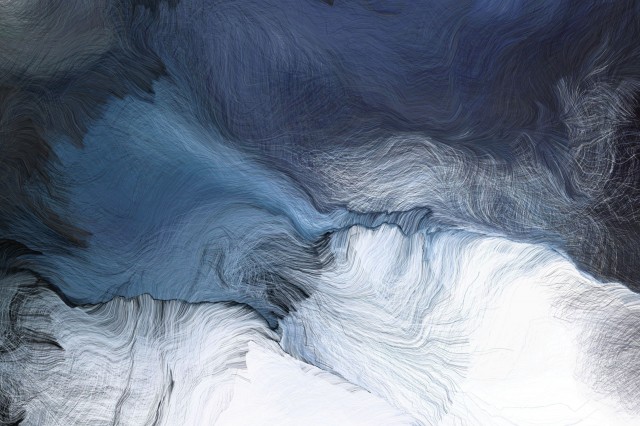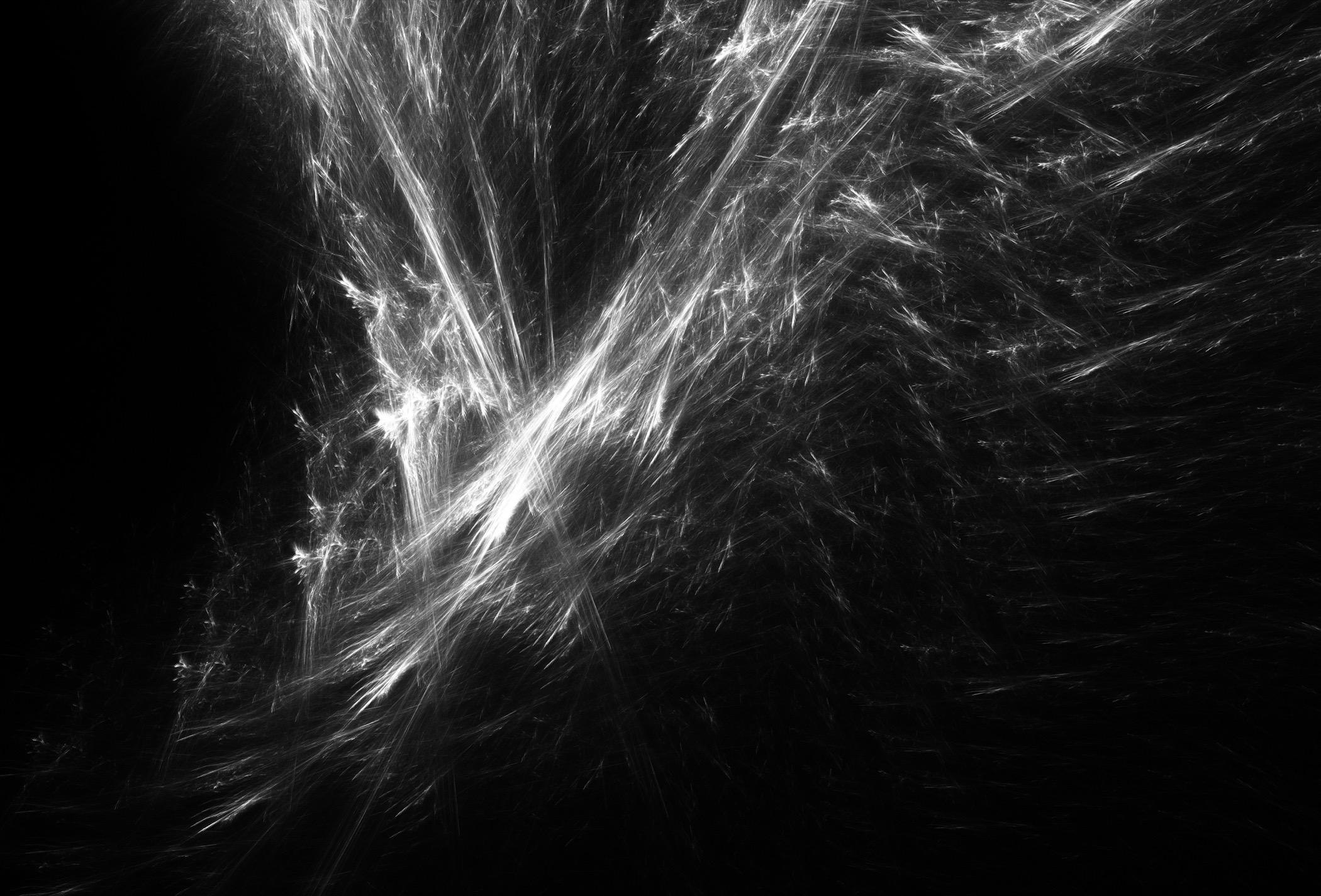
The latest in the (almost daily) series of experiments by Karsten Schmidt, is a small selection of long-exposure images created from randomly generated IFS (aka Iterated Function Systems), a family of apparently very oldskool primitive/trivial fractal functions, but which can produce a fairly wide variety of outcomes. Each image is the result of billions of iterations of a single particle being iteratively transformed (meaning the particle’s current position is used as the input for computing its next position etc.) For each iteration & position, a tiny amount of light is being captured, slowly revealing an image, just like a negative does in analogue film photography.
..it’s one of these projects I keep on returning to occasionally for almost 30 years now (similar to my cellular automatas) and b) it feels “full circle” to how I first started experimenting with photography as a teen in the 80s, recording light patterns of a small torch pendulum directly onto photo paper (even before I had my first camera), and it’s what essentially brought me to digital/generative art as wider field…
Karsten Schmidt on Mastodon
Some of these images have been “exposed” (aka computed) for up to 30 mins. The smaller the amount of light captured per iteration, the smoother (less grainy) the outcome.


Karsten also provides some more technical information for the savvy:
This is one of those projects where a floating point pixel buffer _really_ makes all the difference! My exposure rate is only 0.001 per pixel per frame; some of the images use even weaker settings… That means for a pixel to become fully white, is has to be visited at least 1000 times [or more])
Made with thi.ng/matrices (matrix transformations) and thi.ng/pixel (“film” capture).
Follow on Mastodon | Karsten Schmidt