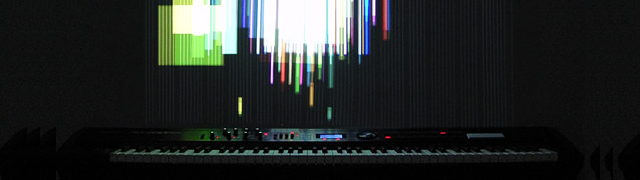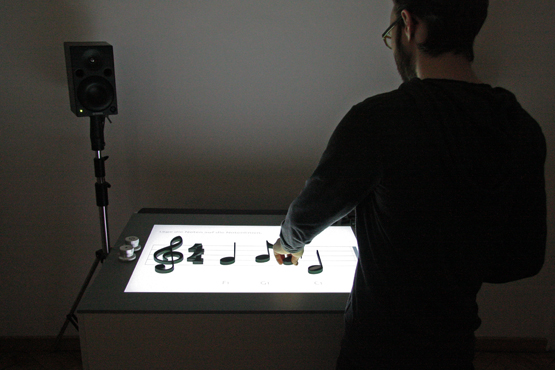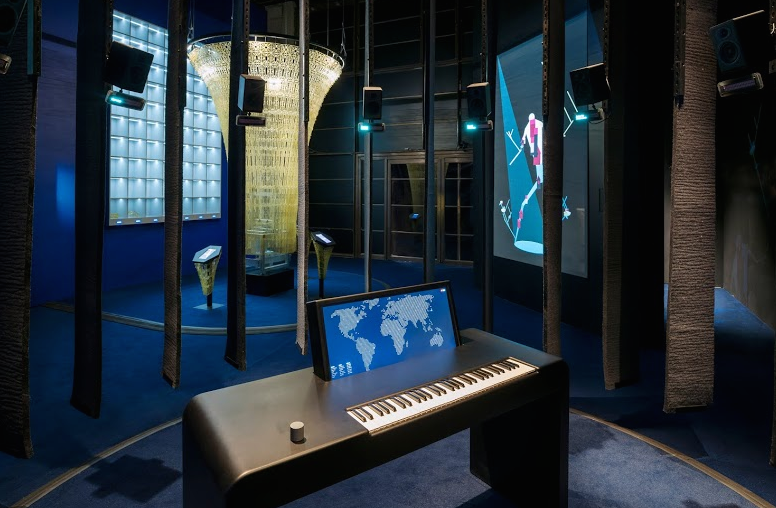
Created by Zach Lieberman and currently on display at the Barbican’s “Digital Revolution” exhibition in London, Play the World invites visitors to perform with a keyboard that finds samples with the same note in near realtime from web radio stations around the world. For example pressing a middle C key, will play a matching C note from Nigerian sports radio or a Brazillian Bassa Nova station.
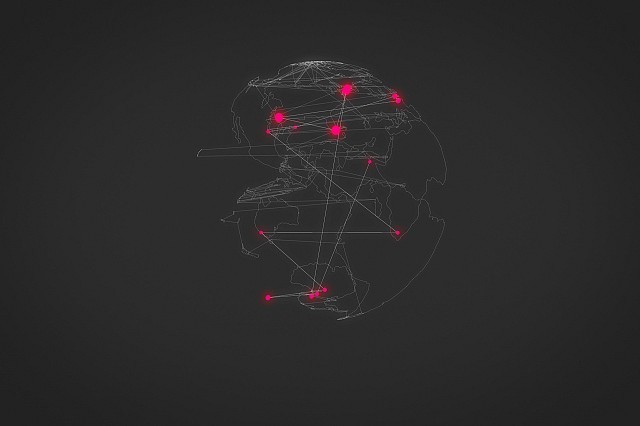
 The installation is comprised of vertical columns made of felt holding up speakers with text displays that show the city and country the sound is coming from. In the centre of the space is a keyboard and a screen with a map presenting geographic orientation to the audience, highlighting the voluminous, enchanting and playable global soundscape that surrounds us.
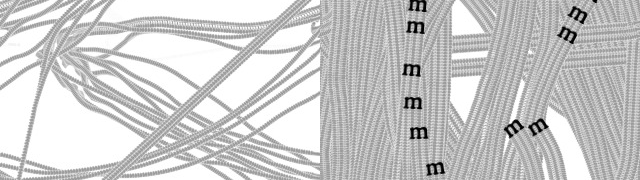
In the process, Zach used Chroma as a way of identifying notes. Chroma is a kind of pitch detection that doesn’t care about octave. It works like a wheel, where the same note in different octaves is the same angle around the wheel. Chroma is computed by remapping the frequency transform so the bins map to more to musical notes. It’s very similar to how you might use FFT to figure out how much bass, midtone or trebble there is in a note. In this case, Zach is looking at the strength of all the partials of a given note in the frequency space.
(Above: An experiment with using chroma (note) detection and using shepard tones to recreate the sound based on chroma.)
For many different streams, Zach has hundreds of openFrameworks apps running in the cloud simultaneously listening to different radios and looking for notes. He is decompressing an mp3 stream and as the application finds something that sounds like a note it gets recorded and sent back to the installation. For Zach it was important to find notes and samples that are long enough to understand the context. Since this becomes a big data problem, generating billions of file, Zach has been using the cloud 20 seconds delay to listen, record and send back. In addition there is also a large database of collected notes which can be played should the software fail or delay for too long. The final result is a playable (extremely spatial) instrument that cuts through the world, brining you a small slice of what is going on at each location.
20 minutes of notes Zach found on the radio that sound like “A”.
The project is currently on Display at the Barbican until 14th September 2014. More information can be found here and on the DevArt website.