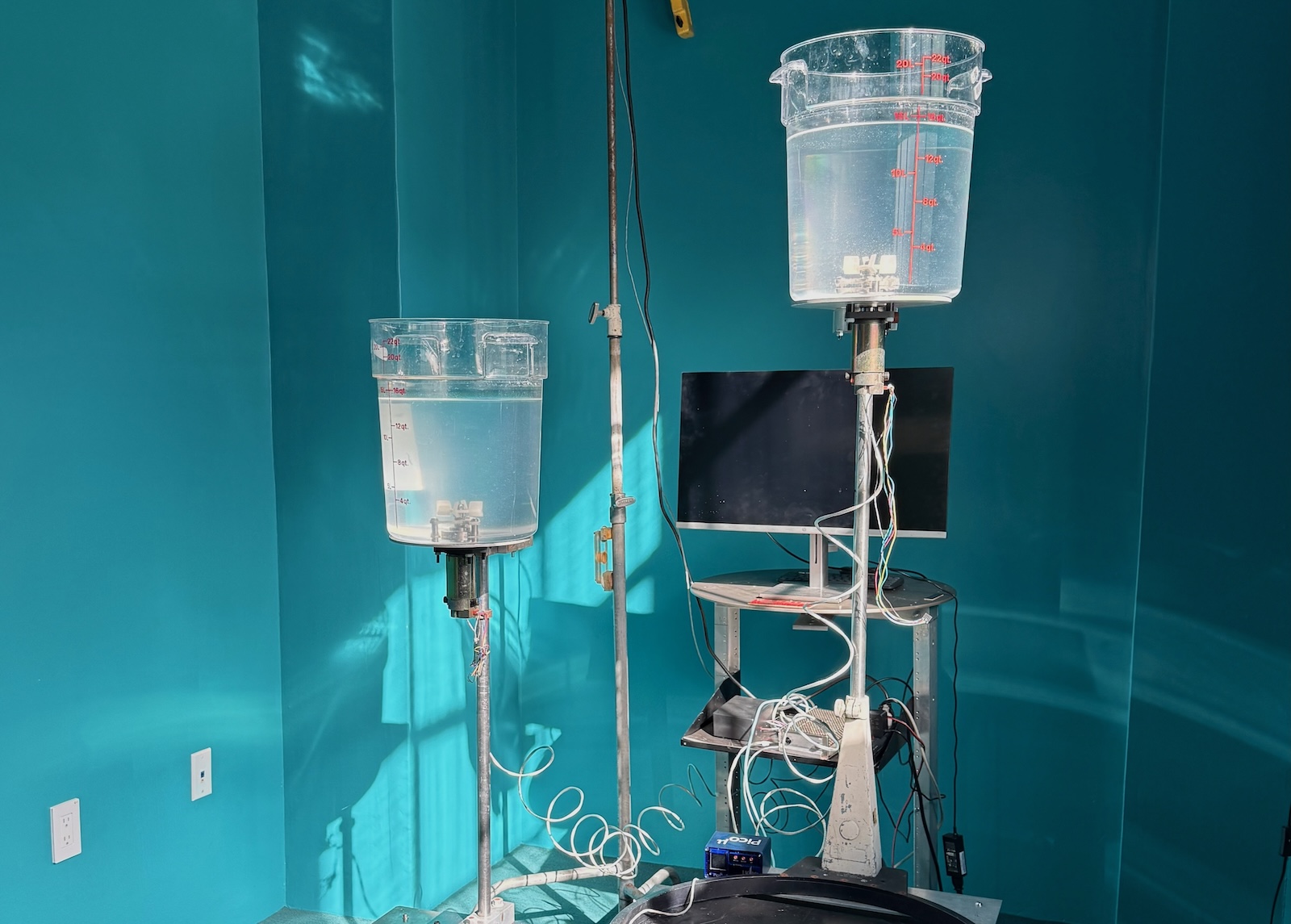
Created by Barney Haynes, Muon/Vortex is a sculptural system in which cosmic particles called muons, arriving randomly from deep space, activate a detector, which in turn activates vortexes in two water-filled containers. Extended pauses between the muons’ arrival allow the water’s surface to settle into reflective calm, while clustered arrivals drive turbulence that carves ribs and channels through the flow.
I imagine Muon/Vortex as participating in a long lineage of artworks incorporating machines (considered broadly) and chance. The Dadaist poet Tristan Tzara, known for creating poems by pulling random words from a hat (or his pocket), is a key influence. Chance for him was a collaborator, not a flaw—a portal through which the world itself could speak, and reveal a deeper and more honest order than anything the poet could impose. Although the elements Tzara used were linguistic and his “machine” a simple container, Muon/Vortex extends his gesture. Instead of a bag of cut-up words, it responds to the arrival of atmospheric particles. In Muon/Vortex, the artist’s job is not to compose but to listen. The universe provides the text; a detector translates it; the water vortex gives it voice.
Barney Haynes
Unlike other kinds of particles that reach the Earth’s surface from space, muons don’t require expensive equipment to detect them. Indeed, they can be detected using a DIY mashup of Geiger tubes and coincidence circuits. Muon/Vortex detects muons via a relatively simple apparatus, namely two stacked scintillators. When a muon passes through a scintillator, it excites electrons in the material, producing a tiny flash of light (lasting only billionths of a second, but still detectable). When both scintillators fire simultaneously, we know that a muon has passed through, as opposed to background radiation, which would have been stopped by its interaction with the first scintillator it encountered.
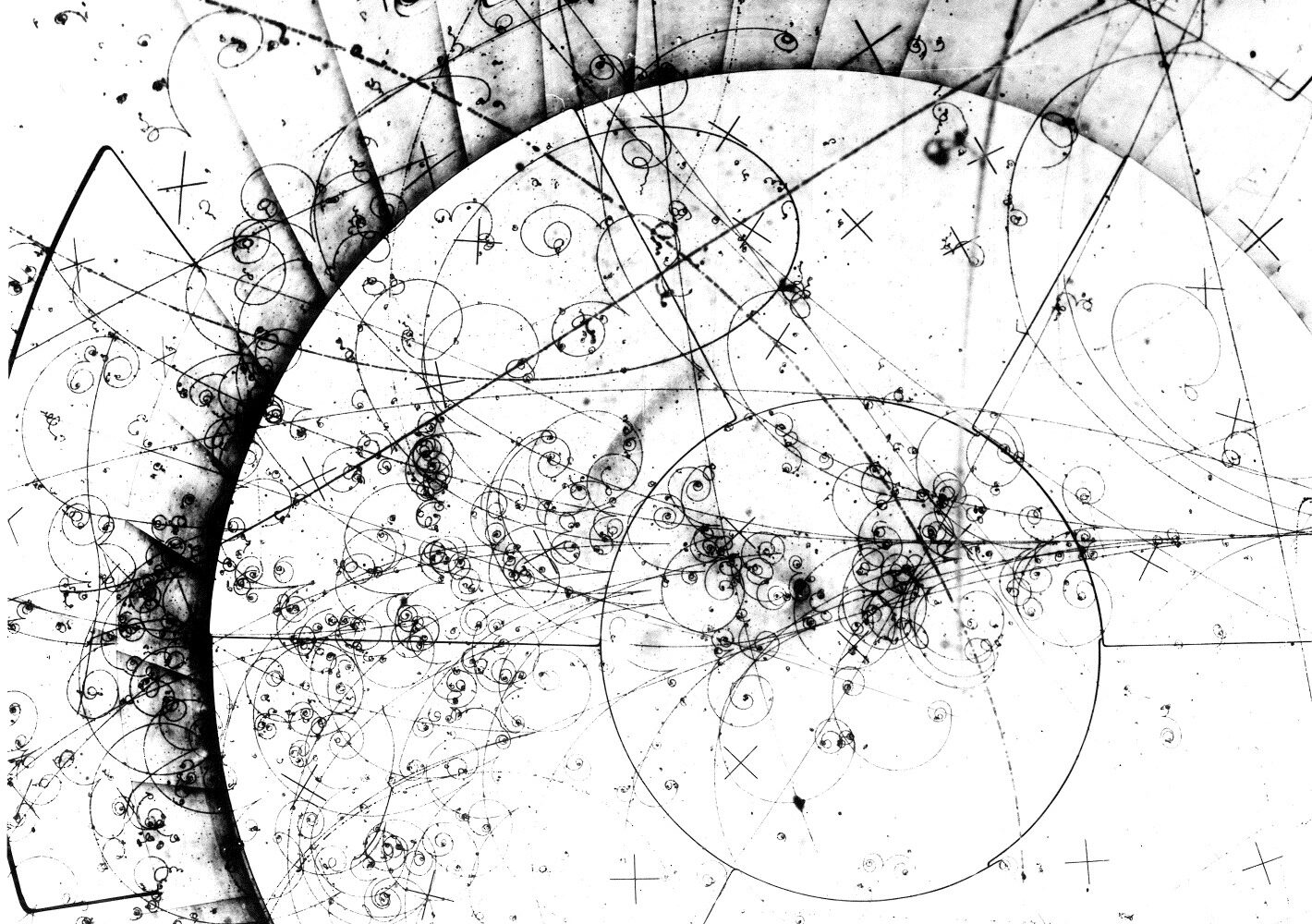
The visualization below responds in real time to muon detections in Barney’s studio. The dominant trace is the muon, which is identified by the symbol μ. Its arrival is rendered in the style of bubble chamber photography, the mid-century technique that made subatomic collisions visible as elegant curving tracks. Secondary particles arc and spiral around the muon’s path, their geometry shaped by the energy of each detection.
The work renders chance as a material force, revealing a quiet correspondence between cosmic time and embodied experience. The installation becomes less a machine performing a task than a situation in which unseen forces are allowed to leave a trace. Energy that has traveled for millions of years briefly inscribes itself into water before vanishing again.
| MATERIALS & SYSTEMS | |
| Detection | PicoMuon cosmic-ray detector (UK Radio Astronomy Association) |
| Computation | Raspberry Pi 5 microcomputer |
| Software | openFrameworks (open-source C++ environment) |
| Actuation | Dual-channel 6–24V, 10A DC motor driver |
| Motors | Gearless Pittman Lo-Cog 24 VDC motors |
| Coupling | Custom magnetic couplers (hybrid-manufactured) |
| Fluid Interfaces | 3D-printed impellers |
| Structure | Aluminum and stainless steel, polycarbonate vessels, bearings, shafts, nylon fasteners |
| AI tools | Claude, ChatGPT |
| Web | p5.js, Node.js, nginx, WebSockets |