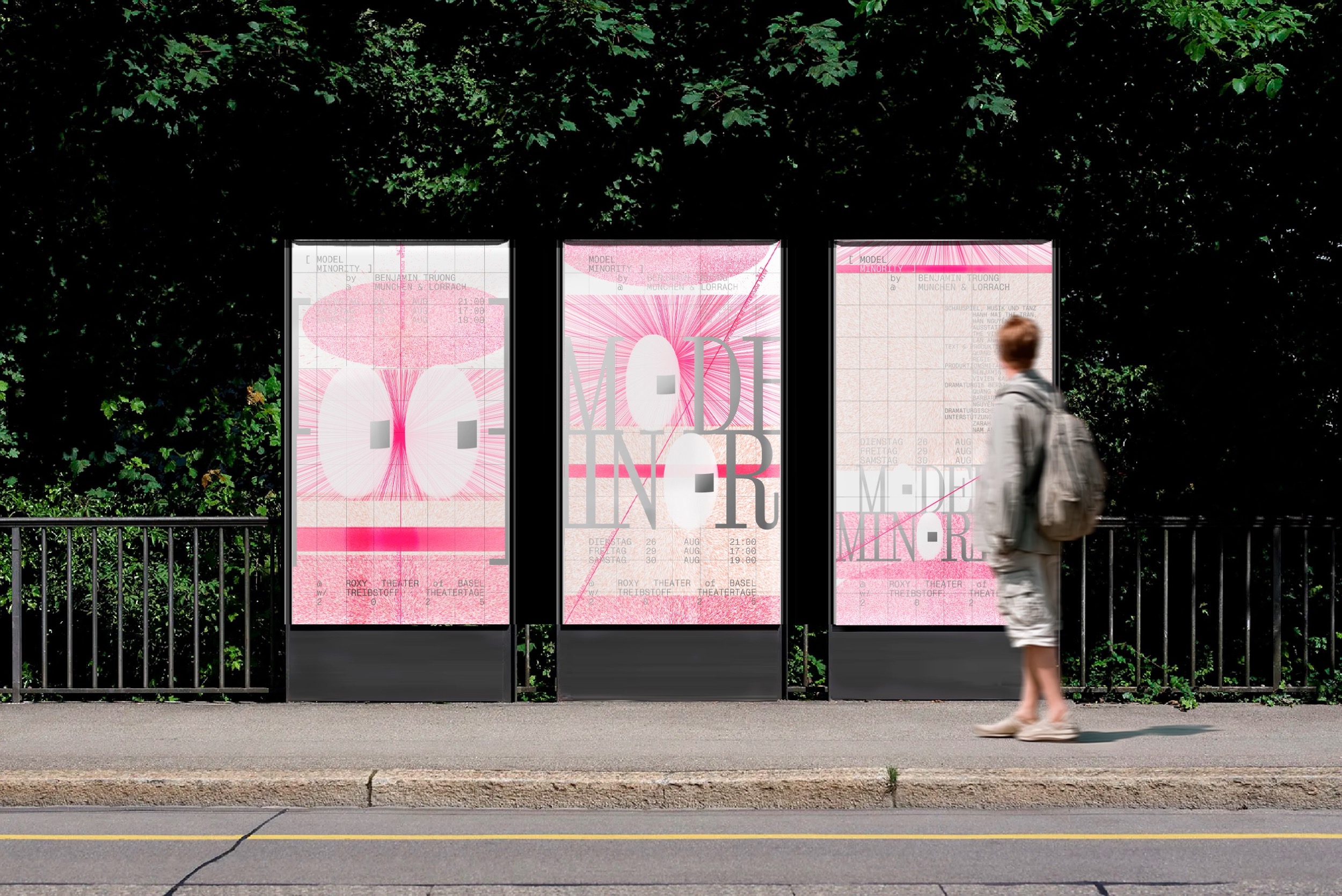
Post-Poster – Mockup image of Model Minority Poster on a street of Basel, Grace H. Park, 2025
| MDes Thesis | |
| Post-Poster – a Graphic Medium Rewired by Interaction Grace Hannah Park 2025 MDes Thesis IDCE HGK Basel FHNW | Mentors: Bérénice Serra Jiri Oplatek Invar Torre Hollaus Ted Davis |
Grace Hannah Park’s (MDes Basel, 2023 – 2025) graduate thesis project, Post-Poster, reveals new possibilities for the moving poster through an exploration of physical sensors and creative-coding. Stemming from the design question “How can posters evolve from one-directional messages into responsive systems that engage people and environments?” – her research began with real-time influence, such as interaction from the microphone and webcam, on historical Swiss posters:

Right: Audio-reactive homage built with p5.js, Grace H. Park, 2025.
Interested in how the viewers environment could further shape the analog-digital experience, this lead to creating the 0PEN:SENSE repository which serves as both a catalogue of physical computing sensor experiments and as a resource for future designers to build upon.

One example of this research applied, was an attempt to create the reflective qualities of a silver metallic screen-print on a digital display. For this experiment a photoresistor was used to influence a gradient, mimicking the effect of shining light on such a surface.
In the pursuit of an application for this research, cultural events were considered ranging from music festivals to theater productions, settling on a fruitful collaboration with Benjamin Truong for their premiere of Model Minority, a play that explores the living conditions and sociocultural tensions experienced by second-generation Vietnamese Germans. Multiple layers, each reactive to difference sensors (distance and motion), were then designed to convey topics dealt within the play, including gaze, visible/invisible, population data and memory.
Left: Horizontal Location
Center: Distance
Right: Time & Location
3D mockup of Model Minority layer system, Grace H. Park, 2025
Prototype of Model Minority poster using the webcam for distance and position sensing, Grace H. Park, 2025
» Thesis Process Documentation
» 0PEN:SENSE
MDes Study
Gain a personal insight to Grace’s thesis and studies within the MDes Basel program in HGK Basel’s Vlog series:
HGK Basel Vlog: Grace Hannah Park, 2026 Video: Pati Grabowicz and Ruckstuhl Film
MDes Basel
The International Master of Design in Graphic Design UIC/HGK Basel program (MDes Basel) is a collaboration between two preeminent design schools housed in leading public research institutions: The Institute Digital Communication Environments of the Basel Academy of Art and Design FHNW, Switzerland (HGK Basel) and the School of Design at the University of Illinois Chicago (UIC). Our MDes Basel program offers advanced design students’ opportunities to amplify their creative abilities as they engage in the world-class cultural offerings of two vibrant cities.
Basel Academy of Art and Design FHNW has influenced the international graphic design community since the 1960s. UIC is a young, progressive, and distinguished public research university. Based on the tradition of Swiss Design pedagogy, the aim of our collaborative graduate program is to advance the profession’s expanding directions and range of impact by balancing deep disciplinary engagement with proactive critical intent. In this context, students are encouraged to connect the meaning and purpose of their work to global, cultural, political, technological, and socio-economic issues.
Unique to this program, is the opportunity to graduate with an internationally accredited Master of Design (MDes) from UIC and the Swiss equivalent, MAS in Graphic Design I, Iconicism and Graphic Design II, Mediality from the HGK Basel. Students are matriculated and registered at UIC with classes being held at the HGK Basel. This is a 4 Semester, 120 ECTS (60 US Credits), full-time program.
Key Issues:
Application Deadline: March 30th, 2026
Semester Begins: September 14th, 2026
Course language: English
Video: Mahdi Hosseingholi and Mojtaba Zarghampour