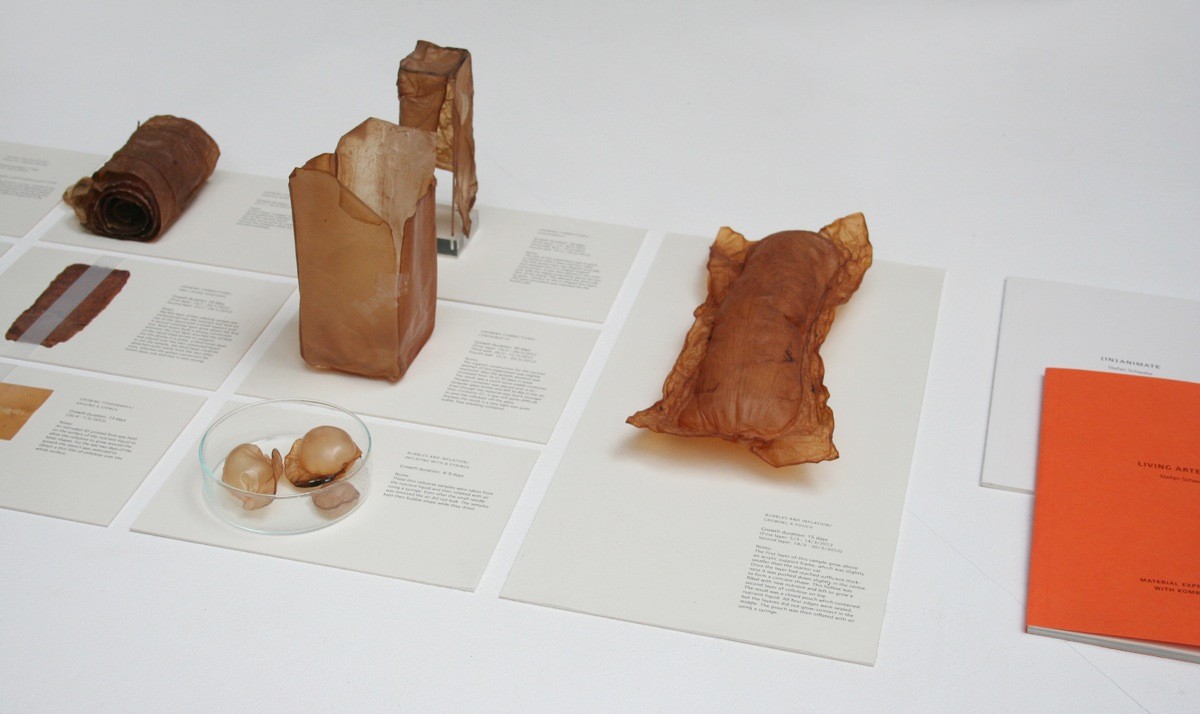
Living Artefacts is a project by Stefan Schwabe, a student of Design Interactions at the Royal College of Art. Stefan is exploring the subject of “natural” and “artificial” by using bacterial cellulose to harvest artefacts.
It is during these times that myth may become reality. The creation of composite beings no longer remains a chimerical matter of our ancient tales. As a result of modern scientific advances, the combining of different life forms has become routine. Where might this lead us? Are we indeed able to extend our minds, not only into material culture, but also into living artefacts?
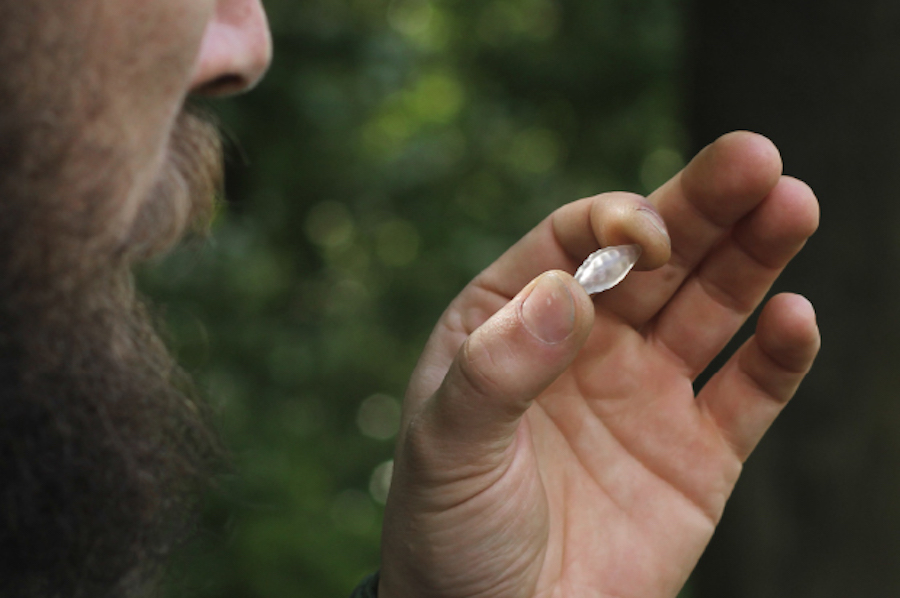
“The Kernels of Chimaera” is an chamber constructed by Stefan which maintains the growth of a living material and performs an automated production of these hybrid living artefacts. Each day, the machine automatically harvests a layer of bacterial cellulose that has grown in one of the nine reactor jars. The cellulose is then picked up by a vacuum arm and placed within a small wooden clamp to be inflated by a syringe. Finally, once the inflated cellulose has dried, it is carried upwards by a flow of air flow of air and begins to levitate.


The disc with the nine reactor jars moves constantly, but very slowly and reaches one complete rotation every nine days. Inside the structure sits one Arduino Mega which is programmed to control the full cycle. The main chamber is driven by a stepper motor and speed is reduced by worm gears. The vacuum arm is driven by two DC motors (one for the rotation and one for vertical movement). Sensing is done with Hall sensors. Pic and place is solved with vacuum suction, solenoid valves and a pressure sensor. The syringe that inflates the form is driven by a DC motor. The inflation itself is done with an air pump. There is a constant air flow in the whole column which dries the cellulose once it is inflated to a Kernel. This also prevents flies etc to enter the chamber with the reactor jars.
Read more about Stefan on stschwabe.com and about the project on di12.rca.ac.uk
Previously: Troblion [Objects]


“The Kernels of Chimaera” is currently on display at the RCA, Battersea campus. This year, the Royal College of Art’s annual summer show will include work by the greatest number of graduating students in the College’s 175-year history. Show RCA 2012 is to take place simultaneously in six buildings across the College’s two campuses in Battersea and Kensington. Design Interactions is located in Battersea. Click here for directions.