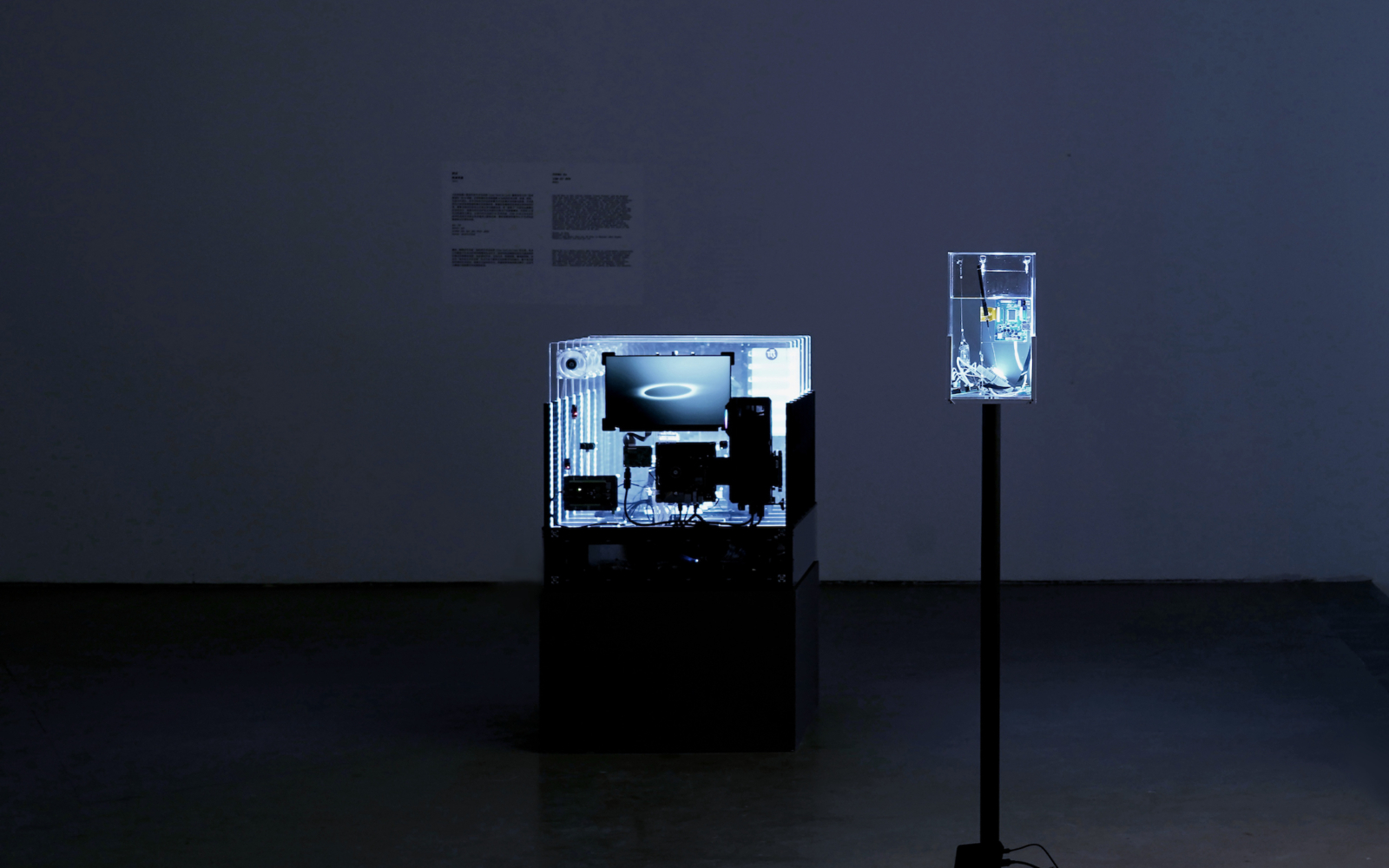
Developed by as a collaboration between Daito Manabe, SoftBank Research Institute of Advanced Technology and the Ikeuchi Laboratory at the University of Tokyo, Brain Processing Unit explores the adaptation of artificial brain tissues alongside custom electronics to stimulate artificial brain tissue, analyze its activity data, and develop the necessary APIs, networks, and other interface technologies required for these operations.
For some time, the SoftBank has been researching how the abilities of a human brain could be applied to computing technologies. One of the key breakthroughs involves “cerebral organoids,” small artificial brain tissues, created using iPS cells, which only a few millimeters in diameter can cultivate up to nearly 100 million neurons, similar to those in the human brain. Together with Daito Manabe and the Ikeuchi Laboratory, the team has now developed a series of communication methodologies that not only provide electrical stimuli to these cultivated neurons (mini-brains) but to also capture the signals processed by the neural networks within these organoids, as well as ability to interface with other technologies.
The work-in-progress exhibition took place at the University of Tokyo showcasing the current state of the research and included three demonstrations of application, and presening the future potential of cerebral organoid research.
Cellular Ears

Music transcends cultural and linguistic boundaries, evoking emotional responses in people across the globe. But how is this universal power of music perceived and processed by our nervous system? Our brain can instantly analyze the complex elements of music and recognize its features.


This project investigates the fundamental mechanisms of music recognition using cerebral organoids, shedding light on the intrinsic relationship between the art form of music and the biological systems of life. Music undergoes a process that emulates the frequency analysis performed by the human inner ear. It is then delivered to the cerebral organoid as an optogenetic stimulation, effectively “playing” the music to the organoid. The responses from the cerebral organoid are subsequently analyzed. The experiment involves varying the types of music played to the cerebral organoid (e.g., techno, classical, ambientnoise) and analyzing the organoid’s responses (such as timing and pattern changes in output). These results are compared against cases where inputs like “noisesilence” or a “440 Hz pure sine wave” are used.
MacBookPro
Digital Micromirror Device
Cerebral organoids (eight connected)
High-Density Microelectrode Array System
Display 75inch
Speaker
FFT analysis (AiK)
Video Editing
Clustering Analysis


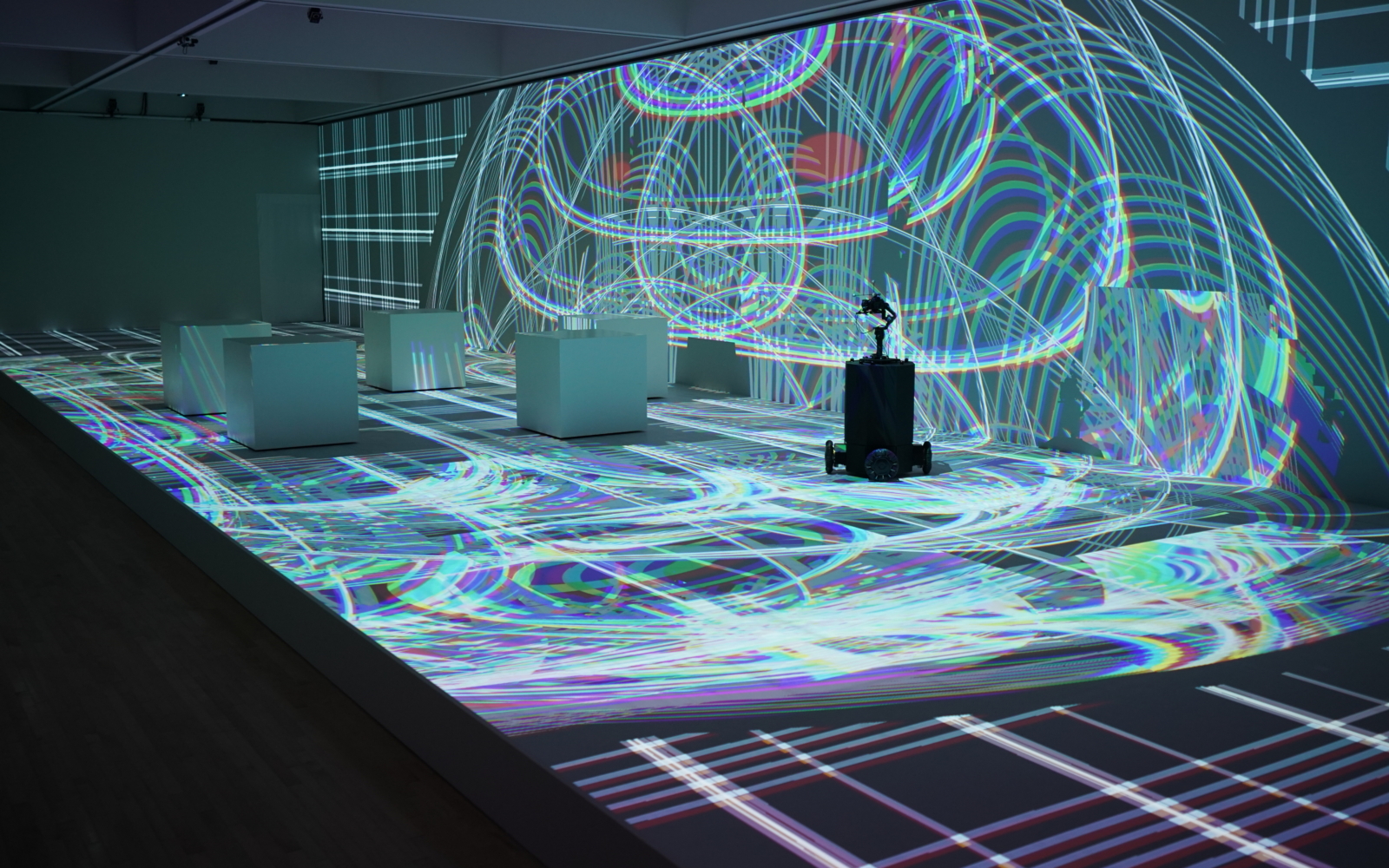
Experimental Study on Autonomous Robot Control Using Living Neural Networks
The adaptive learning capabilities of living organisms allow them to flexibly respond to dynamic and unpredictable environments, such as real-world settings. By incorporating actual brain neural circuits as the core of a robotic control system, this project aims to establish a novel control architecture.


This project explores the potential for intelligent control through biological systems, rather than relying on artificial intelligence. An autonomous robot is controlled using cultured neural cells (cerebral organoids). The system employs cerebral organoids as the central control unit for a quadrupedal robot, enabling it to execute obstacle avoidance behaviors. A ceiling-mounted camera tracks the real-time position of the robot, converting this data into electrical signals that are transmitted to the cerebral organoid. The learning mechanism functions by associating electrical stimulation with the presence of free space in the robot’s virtual field of view. When an obstacle is detected, the stimulation decreases, and just before a collision, it nearly disappears. Through this mechanism, the presence of electrical stimulation serves as a “reward,” while its reduction acts as a”punishment,” allowing the neural cells to autonomously develop obstacle avoidance behaviors. The system gives the viewers opportunity to directly experience how living neurons process information and dynamically adjust behavior.
Web Camera
GPU Workstation
Server (API)
High-Density Microelectrode Array System
Cerebral organoids (two connected)
Projector
Unitree Go2
Robot Position Analysis
Stimulation Pattem Conversion
Visualization
Control Signal Conversion
Stimulation Command Generation
pre-processing
Spike Count


Life and Rhythm
Why do humans involuntarily respond to music with movement? Our bodies constantly maintain rhythm without conscious effort. The heartbeat, synchronized brain waves, and breathing rhythms—all of these life activities exhibit inherent rhythmicity.

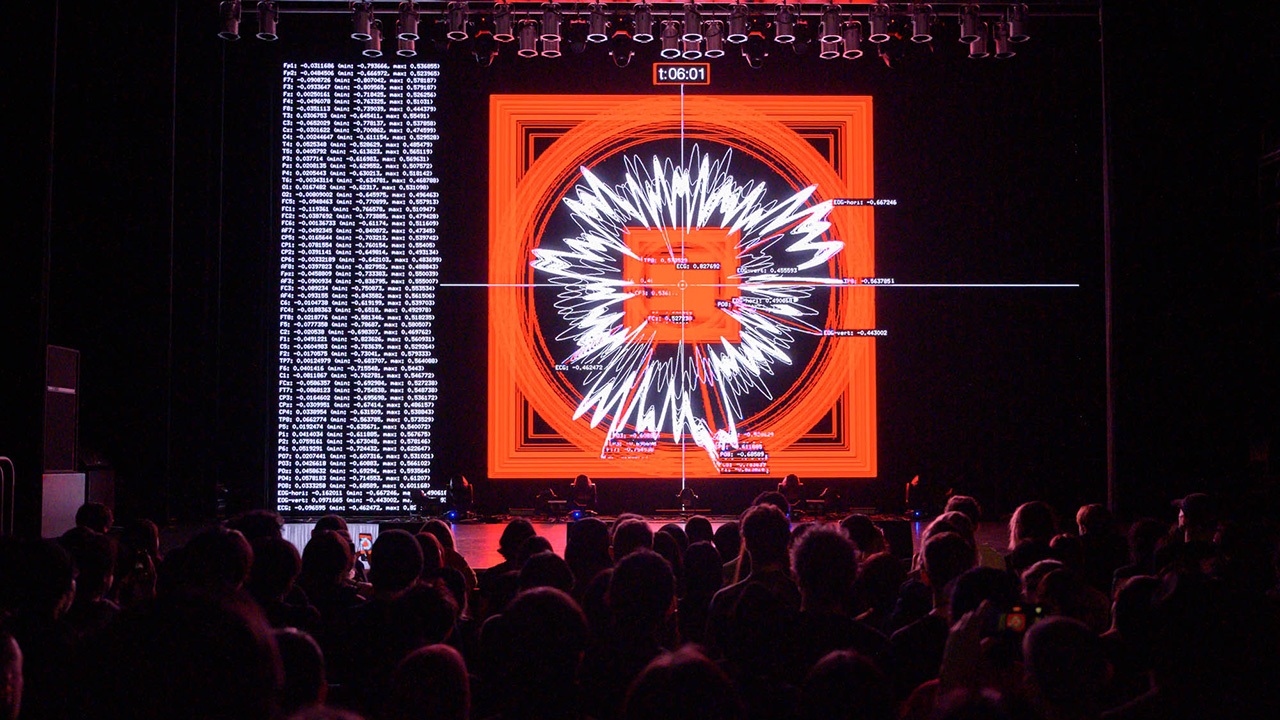
Using cerebral organoids, this project investigates the relationship between this intrinsic rhythm of life and the response to external rhythmic musical stimuli. In the experiment, rhythmic patterns are delivered to the cerebral organoid as electrical signals, and its responses and self-generated neural activity are observed. During the first 30 seconds of a 1-minute cycle, rhythmic patterns are input through periodic electrical stimulation. In the latter 30 seconds, the stimulation is stopped, and the spontaneous activity of the cerebral organoid is recorded. The activity of the cerebral organoid forms distinctive patterns, which are visualized in real time and also converted into acoustic signals. By observing and listening to how the cerebral organoid responds to rhythmic input and how its spontaneous activity evolves, the team can gain insight into the learning and generation of rhythm in biological systems.
As a new experimental approach, the team conducted an experiment where the response of brain organoids is fed back into the input (electrical stimulation). Specifically, in addition to the current process of “MIDI drum pattern (sequence data) → electrical stimulation → response (observation),” they introduce a new step: “response → reconversion into a MIDI drum pattern → (delay) → electrical stimulation.” This additional electrical stimulation is applied to a location separate from where the initial sequence-based stimulation occurs.

The delay is inserted to prevent direct electrical feedback (oscillation) that does not involve internal processing within the brain organoid. Through this loop, neurons recognize the rhythm they generate and create new rhythmic patterns based on their own past outputs. This creates a cyclical process akin to recurrent neural networks (RNNs) in artificial intelligence. However, due to the nonlinear interactions and noise inherent in biological neural circuits, the system exhibits more complex and unpredictable behavior than conventional AI models.
The background of this experiment is based on the hypothesis that one of the reasons humanity developed higher intelligence is that we became capable of perceiving our own spoken words in the same way as words heard from others. Surprisingly, before this evolutionary shift, early humans were thought to be incapable of recognizing their own speech. In this experiment, the team aims to observe how a feedback loop, where the brain organoid recognizes its own actions (playingdrums), influences its behavior and rhythmic output.
MacBookPro
Server (API)
High-Density Microelectrode Array System
Cerebral organoids (two connected)
GPU Server
Hardware Decoder
Speaker
Display 55inch x2
Stimulation Pattern Conversion
Rhythm Pattem Conversion
Sound Generation
Visualization
Stimulation Command Generation
pre-processing
Visualization
Rendering


Daito Manabe | Ikeuchi Lab | SoftBank
Organizer: SoftBank Research Institute of Advanced Technology
Collaborators: Daito Manabe, Studio Daito Manabe, Ikeuchi Lab (Institute of Industrial Science, University of Tokyo), INERTIA