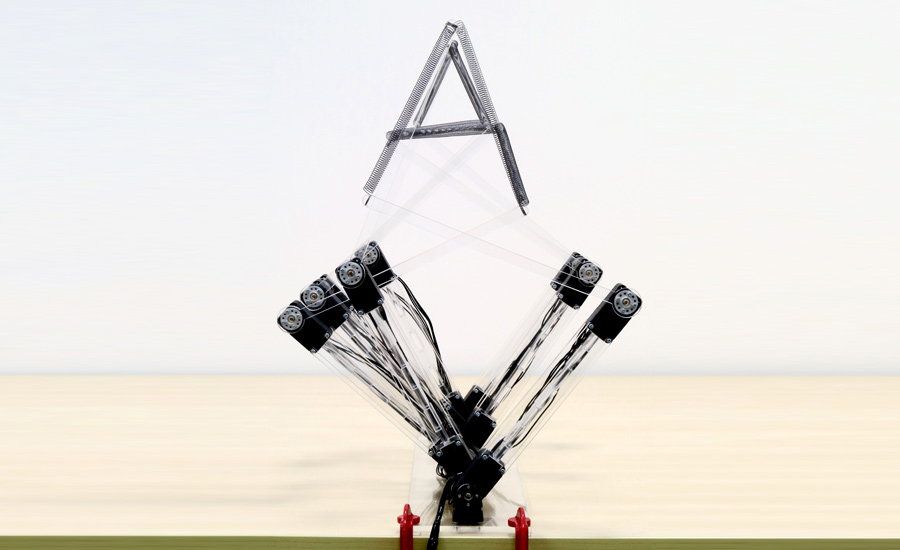
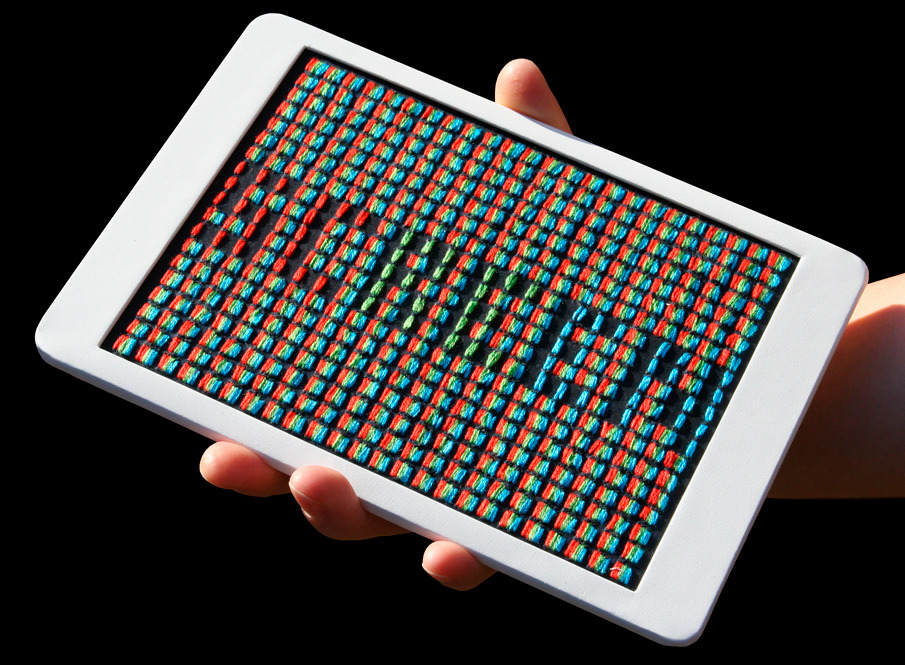
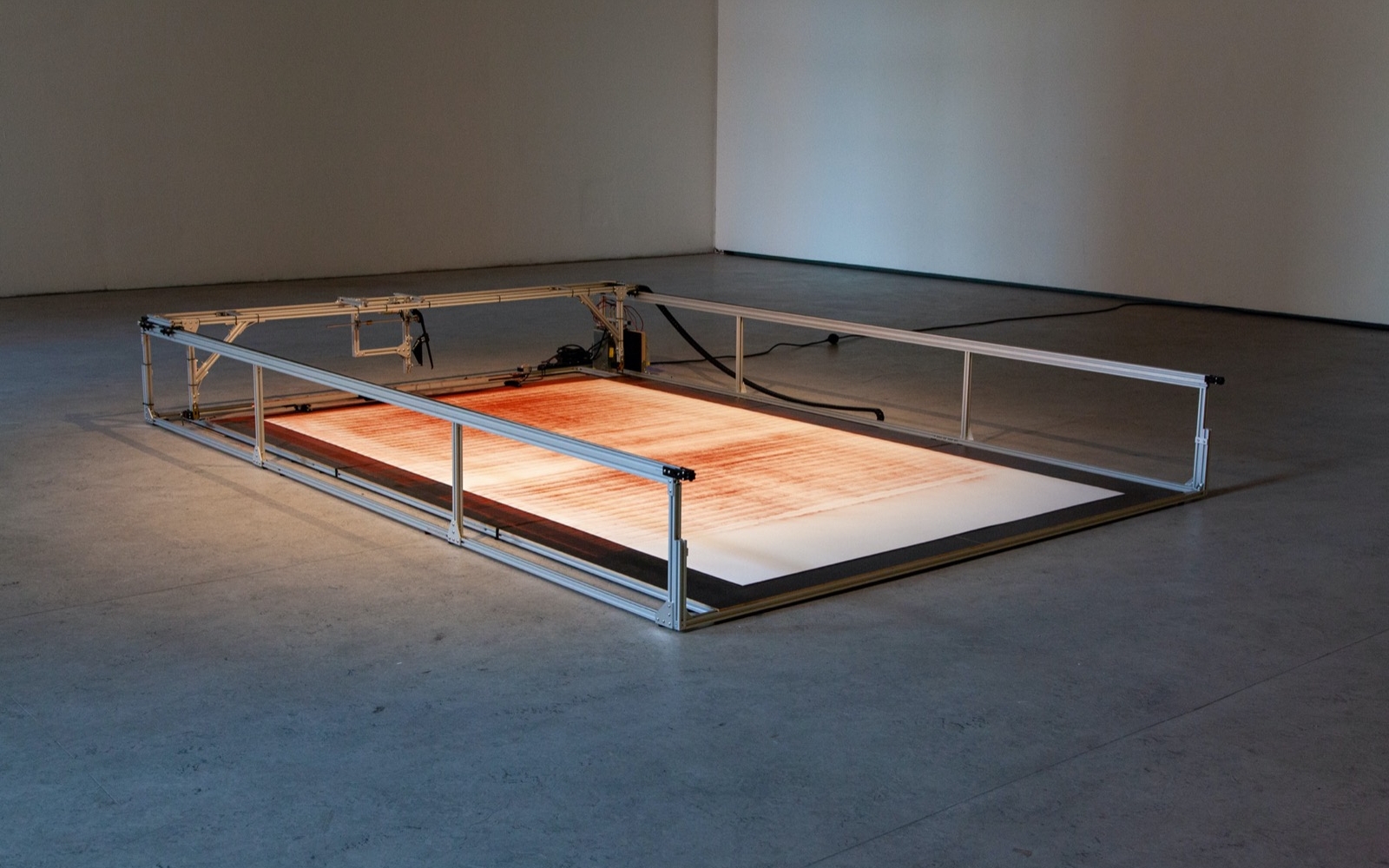
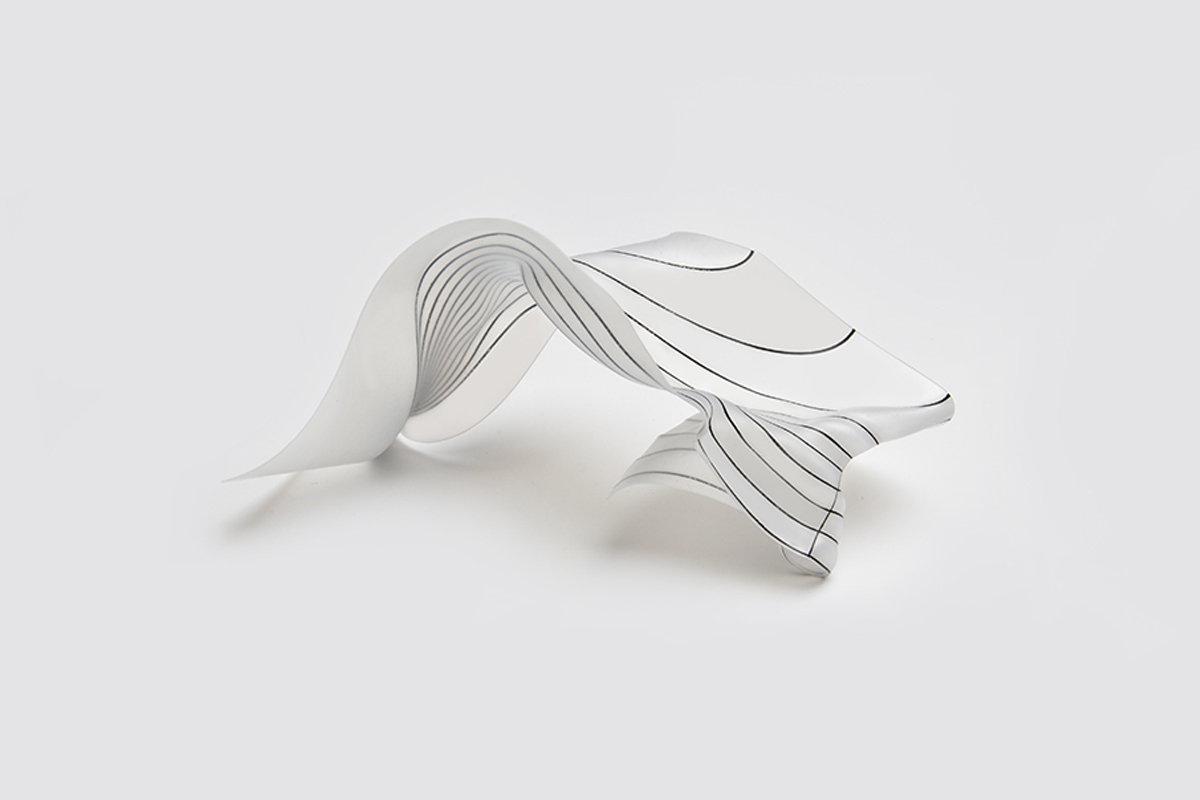
This work was born from an exploration of kinetic typography using linear objects. From the surface of black knit fabric, twenty-eight sewing needles appear and disappear, visualizing the passage of time while moving back and forth between point and line, analog and digital.
Since ancient times, humans have written letters, drawn diagrams, and compressed the three-dimensional world into two dimensions through lines. Computers, on the other hand, present information as an assembly of points. Focusing on this difference, the artist has, since 2016, continued a practice of dynamically forming characters using springs, strings, bands, and chains, and is now working with “needles.” In Japanese, the same character 針 is used for both the hand of a clock and a sewing needle, as both are sharp, linear objects. The act of using them is also expressed with the same word sasu: one “points” to time and “pierces” fabric. The needle, however, has a dual nature: from the side it is a line, from the tip it is a point. By controlling this reversible quality, a new display arises that oscillates between point and line.
The moment when the needle changes from point to line recalls the growth of a thorn or a hair, imparting a sense of vitality. The appearance and disappearance of twenty-eight needles cross the boundaries between sign and matter, discrete and continuous, digital and analog.
This work consists of four black rectangular units reminiscent of bookshelf speakers. The front of each unit is covered with black knit fabric, and inside each one are seven custom-built linear actuators. The sewing needles used are small, 38 mm in length and 0.7 mm in diameter. Normally retracted, they extend forward through the fabric when driven by a signal. Due to subtle misalignments with the fabric, the needles tilt and gradually lie against the surface, shifting from “point” to “line.” The arrangement of seven actuators controlled by Esp32 in each unit imitates a seven-segment display, and the total of twenty-eight needles are controlled by Max MSP running on a MacBook Air, expressing the time as kinetic typography. Between time displays, motion graphics are generated, combining programmed choreography with randomness, so the screen continues to show gentle variation. The hardware is also intentionally given a certain looseness, so that the needles are not fixed in the same position, and their insertion angles fluctuate, producing organic movement.
Project Page | Yuichiro Katsumoto | Instagram | Twitter/X