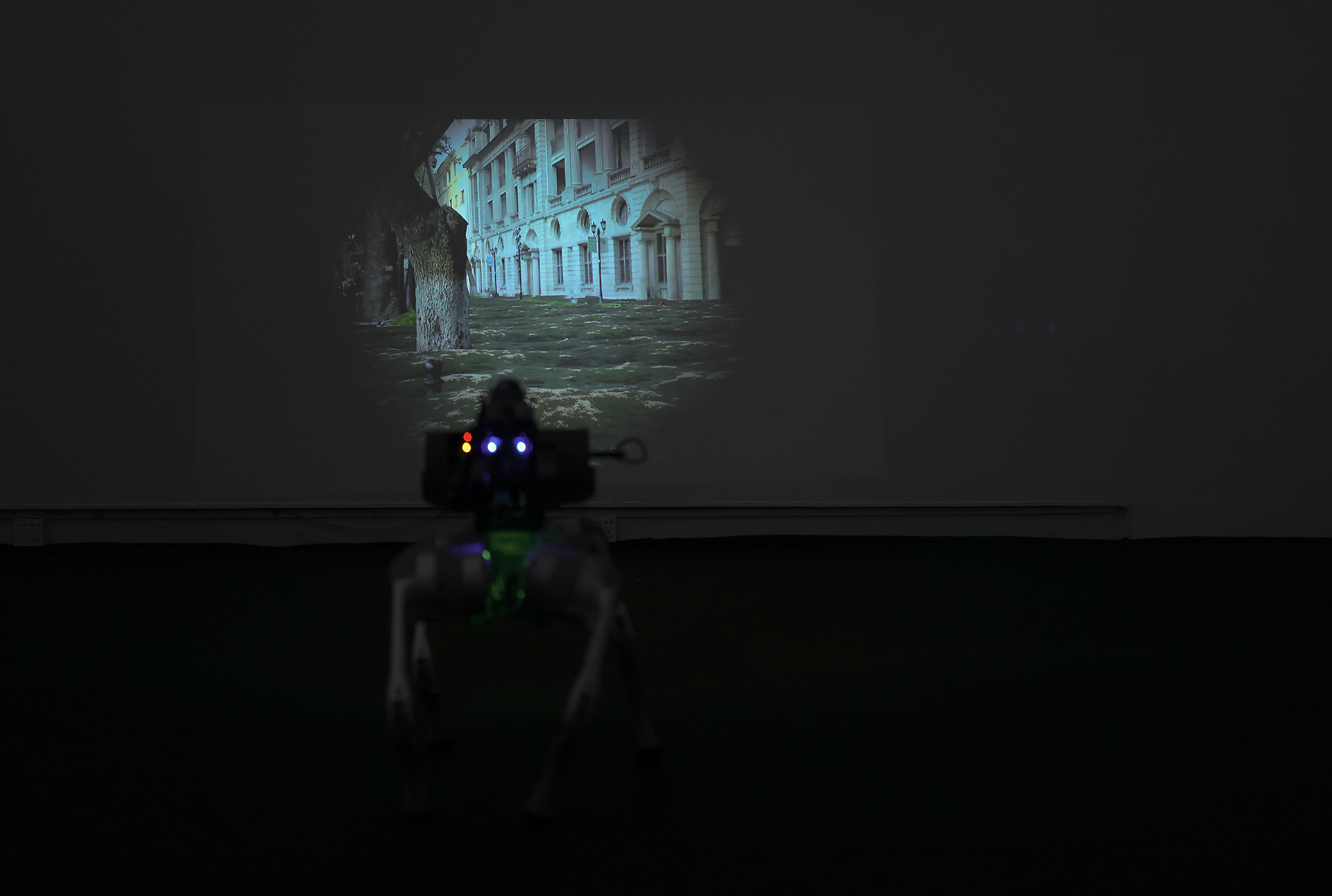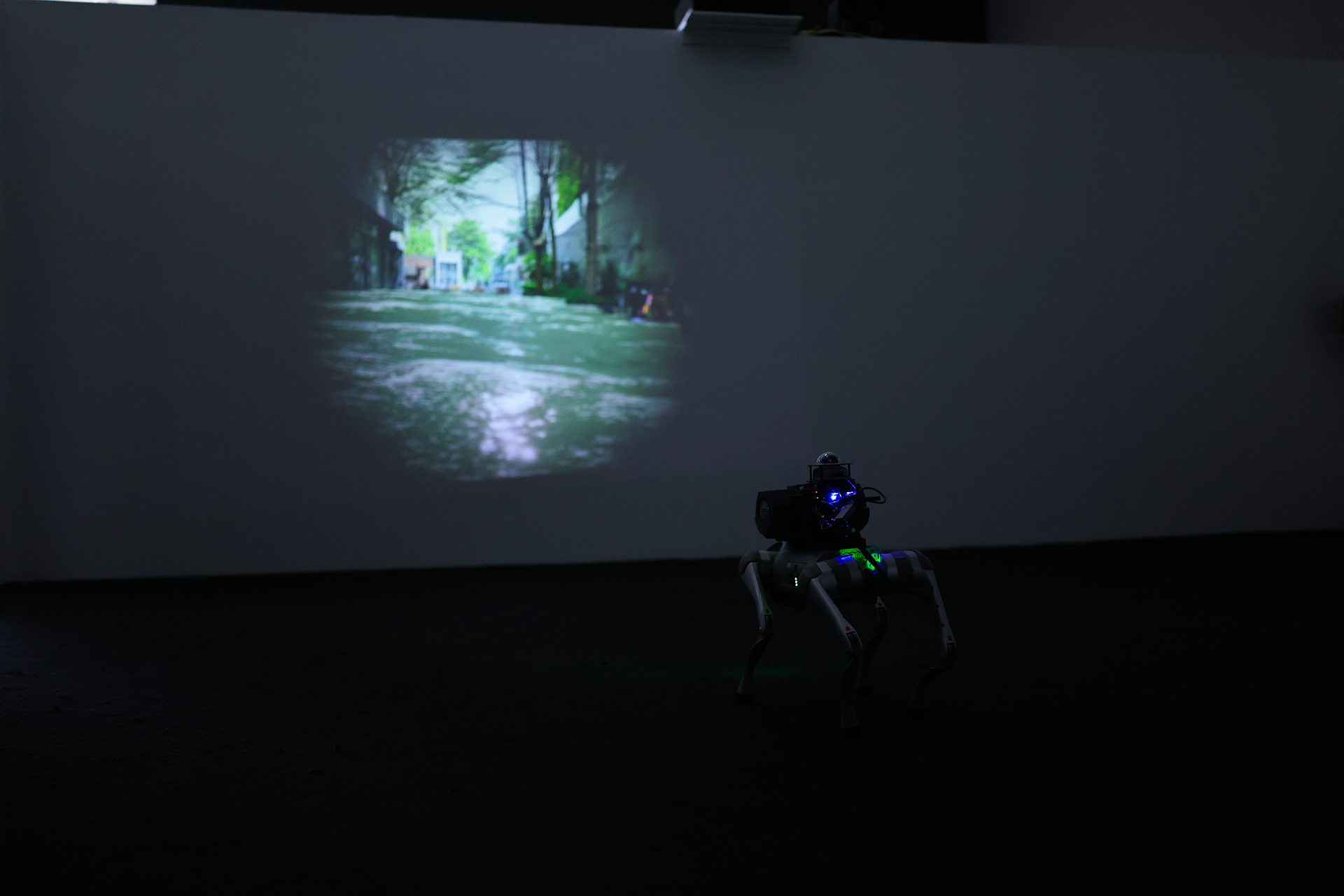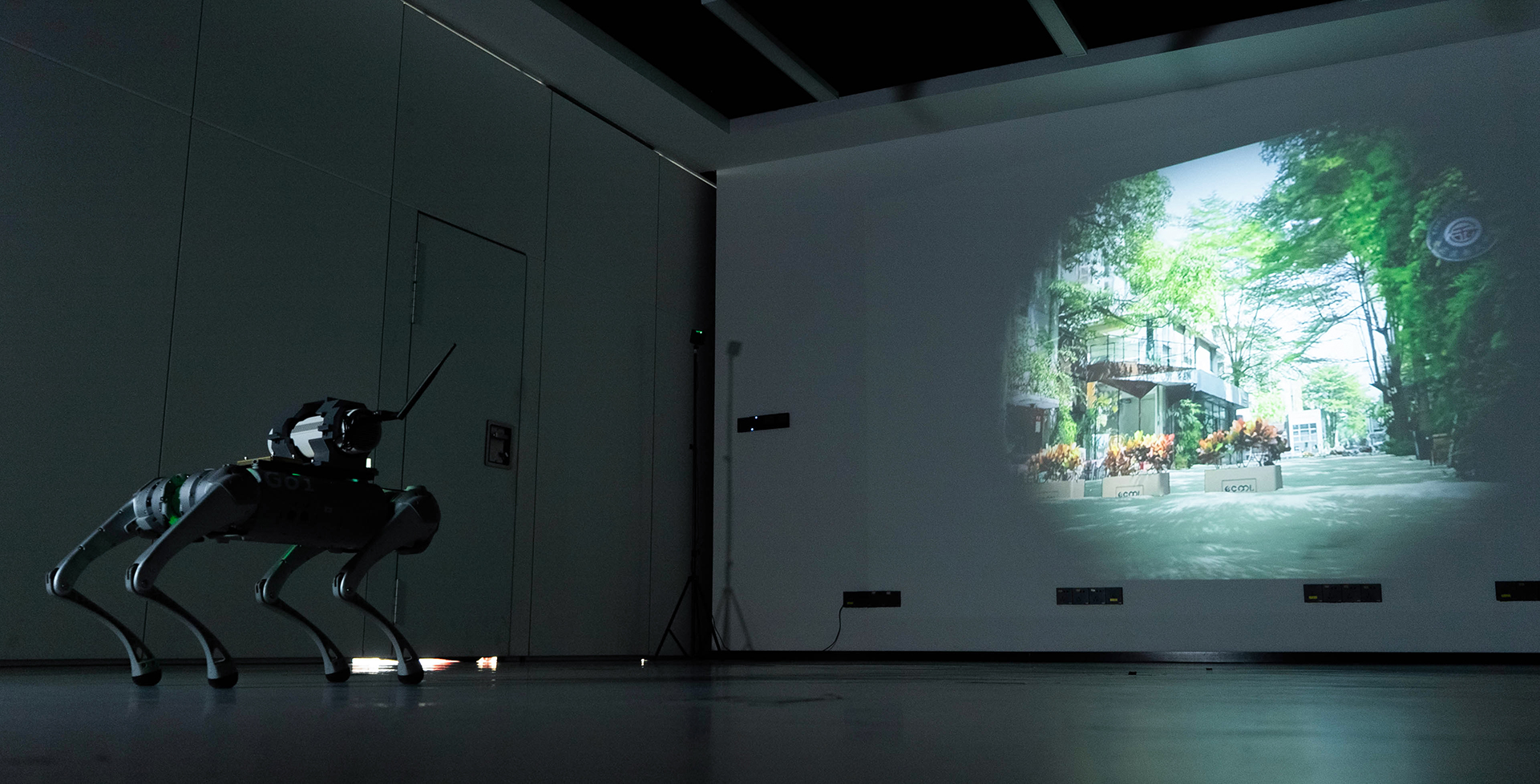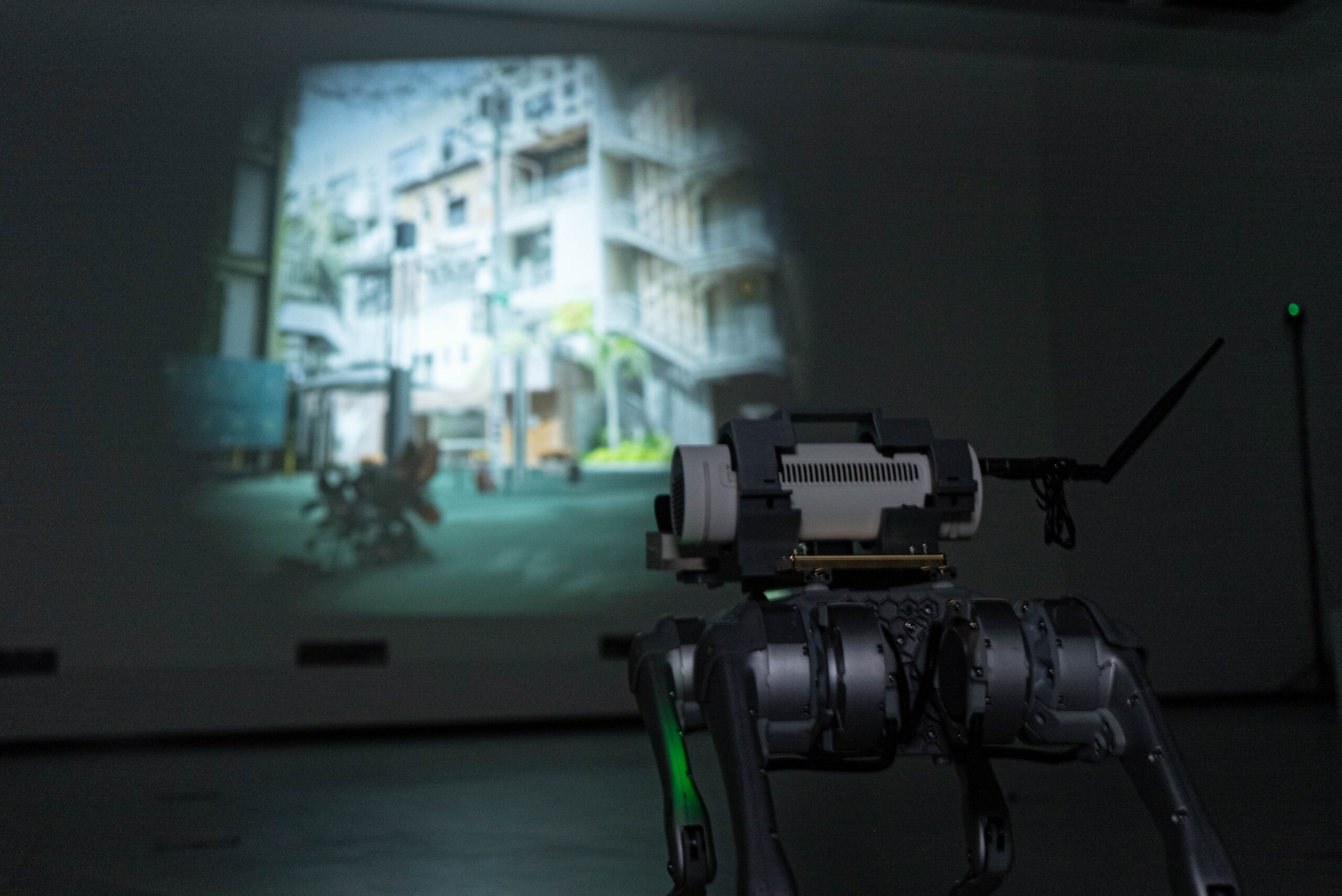
Created by Ary-Yue Huang, Drift of the Uncharted is a robotic installation, intertwining climate prediction, real-world landscape scanning, scene reconstruction, game engines, and virtual projection to unfurl a speculative world where urban landscapes bear the imprints of climate change’s potential impacts.
The project utilises 3D Gaussian Splatting for reconstructing regions prone to the impacts of sea-level rise while computer-generated water is integrated into the scenario through a game engine. A quadruped robot equipped with a projector traverses the physical and virtual space, projecting sea level rise scenes onto the exhibition area, as if it were a spectral agent of humanity, peering into the drowned cityscapes.
To explore the potential impact of future sea-level rises, Huang used Shanghai, Shenzhen, and Guangzhou as the primary locations for scene reconstruction – using Climate Central’s Coastal Risk Screening Tool with 2050 as the projection year. The model, based on IPCC 2021 data, projects combined impacts of local sea level rise and annual flood heights, assuming current emission policies and a projected global temperature increase of 3.6°C by 2100. Based on the predicted vulnerable areas, specific locations of cultural and urban significance were identified and scanned and reconstructed in 3D, all of which are intertwined with resident life and collective urban memory.
The setup includes a Unitree Go1 robot fitted with a Vive Tracker and an onboard projector, a control computer, and four Vive Base Stations. The Vive system relays the robot’s real-time position to the motion-control program and Unity through the OpenVR SDK, enabling the robot’s movements to drive the virtual camera. The computer then streams the resulting imagery wirelessly to the robot’s projector, casting the virtual environment onto the exhibition space.
Project Page | Ary-Yue Huang | Research Paper