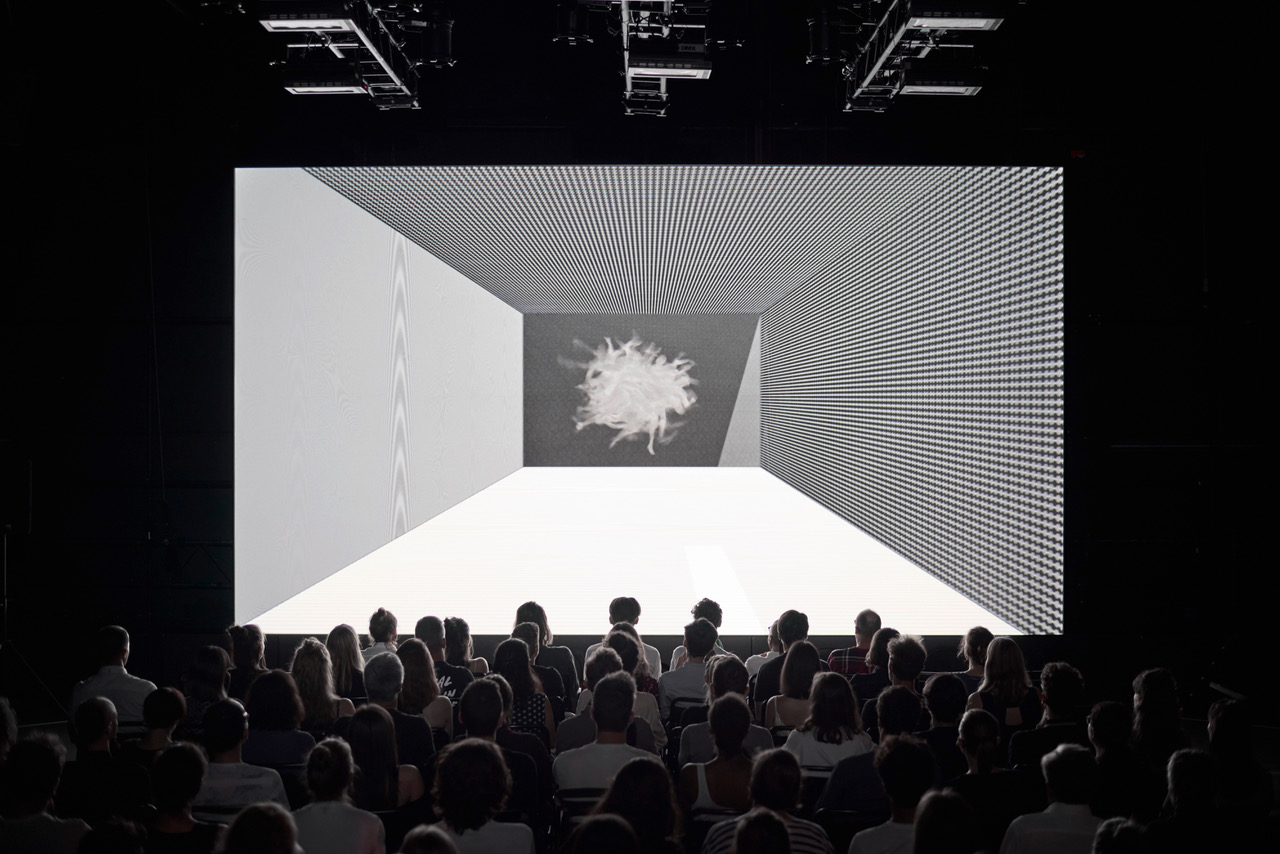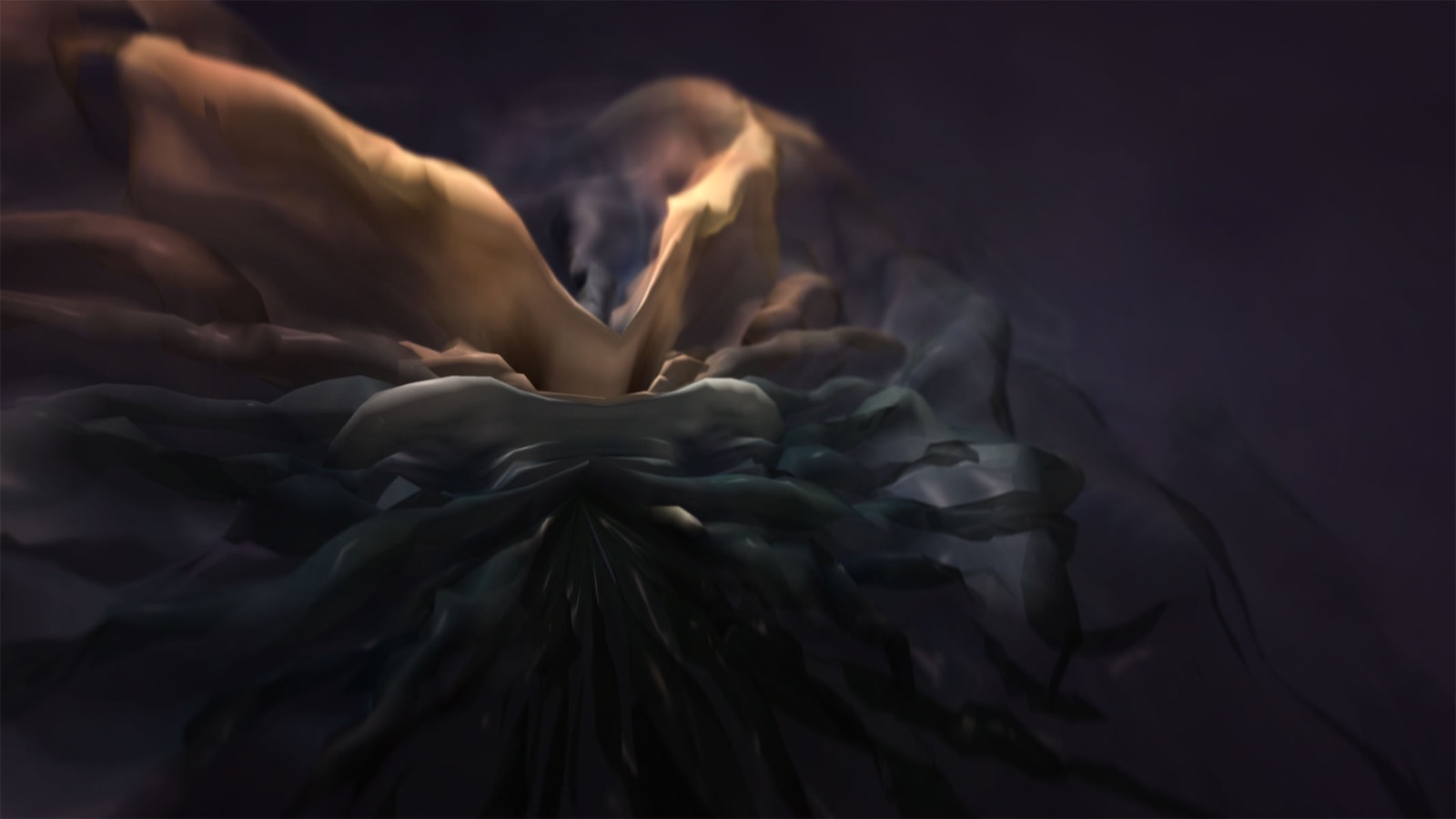
Created by James Alliban, Nova is an experimental study of the slit-scan technique with a particular focus on emphasising its spacial and temporal properties. The slit-scan image is created using video footage of bioluminescent deep sea creatures, particularly Comb Jellyfish. The resulting structure resembles a surreal organism that is locked into an ever-increasing state of perpetual growth, decay and transformation.
The structure is built and rendered in realtime using openFrameworks. It uses the incoming column of pixels from the video to determine the z-depth of the vertices emanating from the centre (depth based on pixel brightness). The new vertices continually radiate outwards undergoing a range of forces. These include perlin noise (standard) and verlet integration for cloth simulation (following this excellent explanation). As the vertices reach the edge of the ‘organism’ they increase in agency while their connections begin to weaken. This results in more tearing and disintegration.
The slit-scan image is used as a texture for both sides of the mesh to aid the symmetry. The pixels of this texture bleed gently into each other over time enhancing the decayed look. Below are a few screenshots of the resulting image.


James explains that one of the most challenging aspects was creating a realistic looking tear. Initially, the holes would have unsightly square edges that spoiled the illusion. After several failed approaches James found the following solution:
- Once all forces have been applied, loop through all of the mesh vertices looking for partially connected ones (this is where one or more surrounding vertices have become disconnected, i.e. too far from a linked vertex).
- Once a partially connected vertex is found, make a vector containing all fully connected vertices that surround it.
- Get the average of all these connected vertices.
- Adjust the position of the partially connected vertex by pushing it in the direction of this average.
The difference is illustrated here:


It was important to take some footage that explored the scene in a manner that complimented the organic motion. A range of different approaches for animating / controlling the camera were explored including the application of perlin noise and manual control using iPad (via TouchOSC).
[three_columns_one]
[/three_columns_one]
[three_columns_two_last]
He finally settled on using his hands to move the camera through the scene with the help of Leap Motion. The palm controls the camera position, the space between the forefinger and pinky is the “look at” point and the rotation of these 2 fingers rotates the camera on the z-axis. With a lot of smoothing and scaling (to exaggerate angles) this proved to be a particularly effective tool for the job.
The project was created using openFrameworks with addons including ofxFastFboReader, ofxLeapMotion2, ofxPostProcessing, ofxUI. Music in the video is No Idea by LukDab.
[/three_columns_two_last]
[divider]