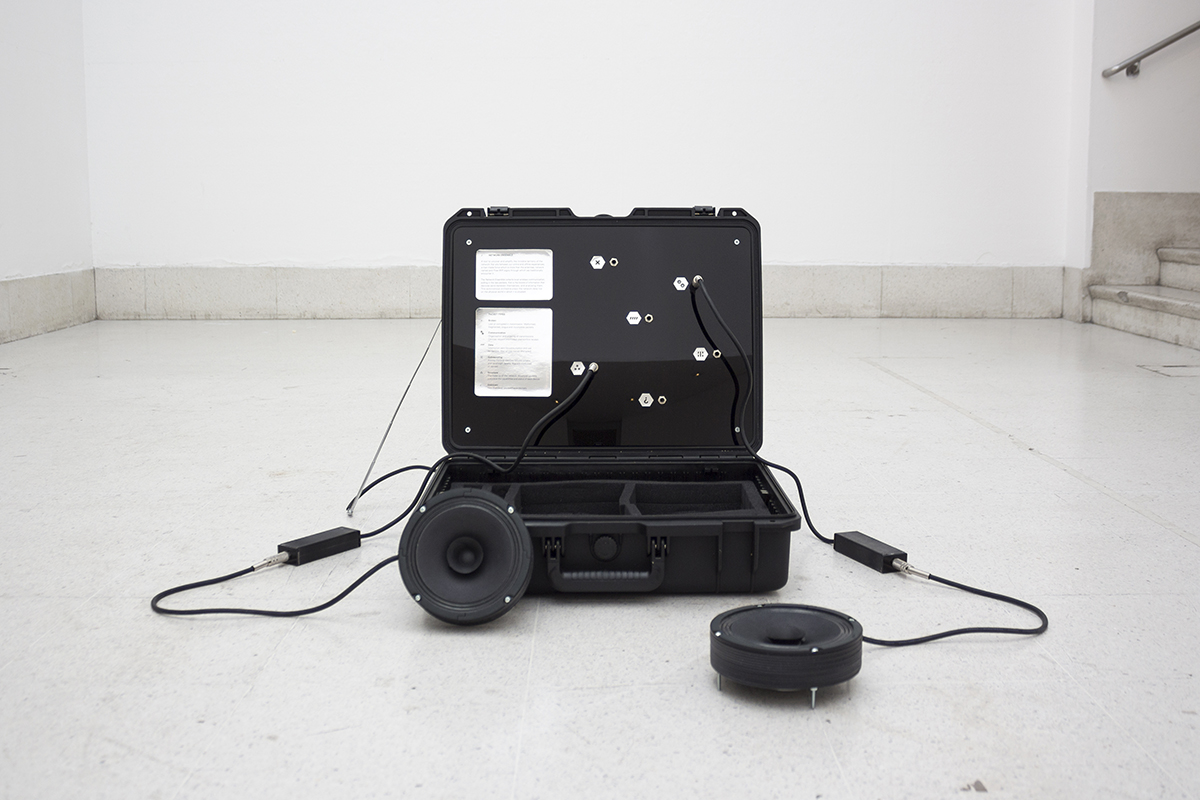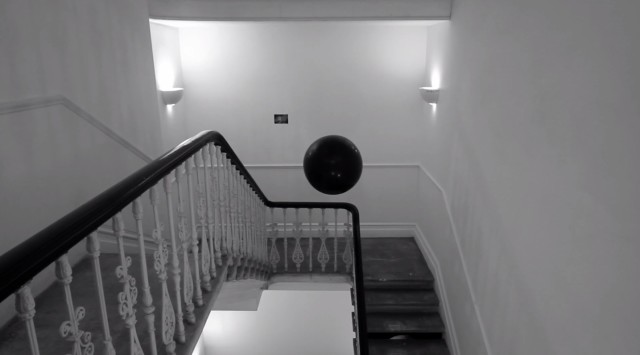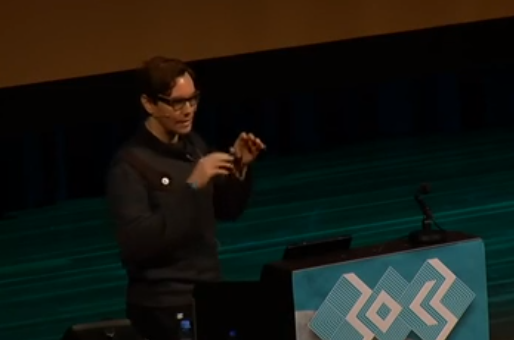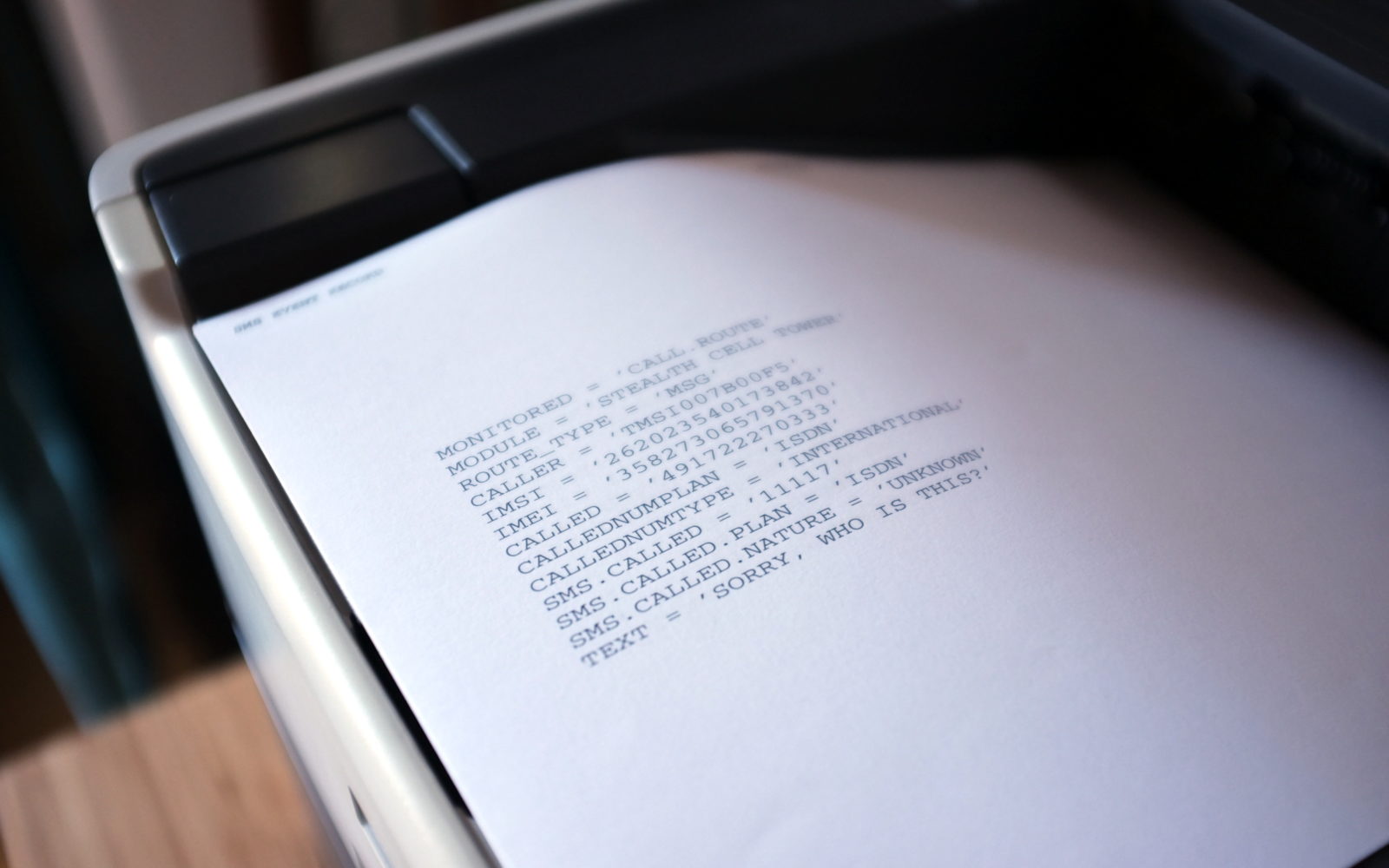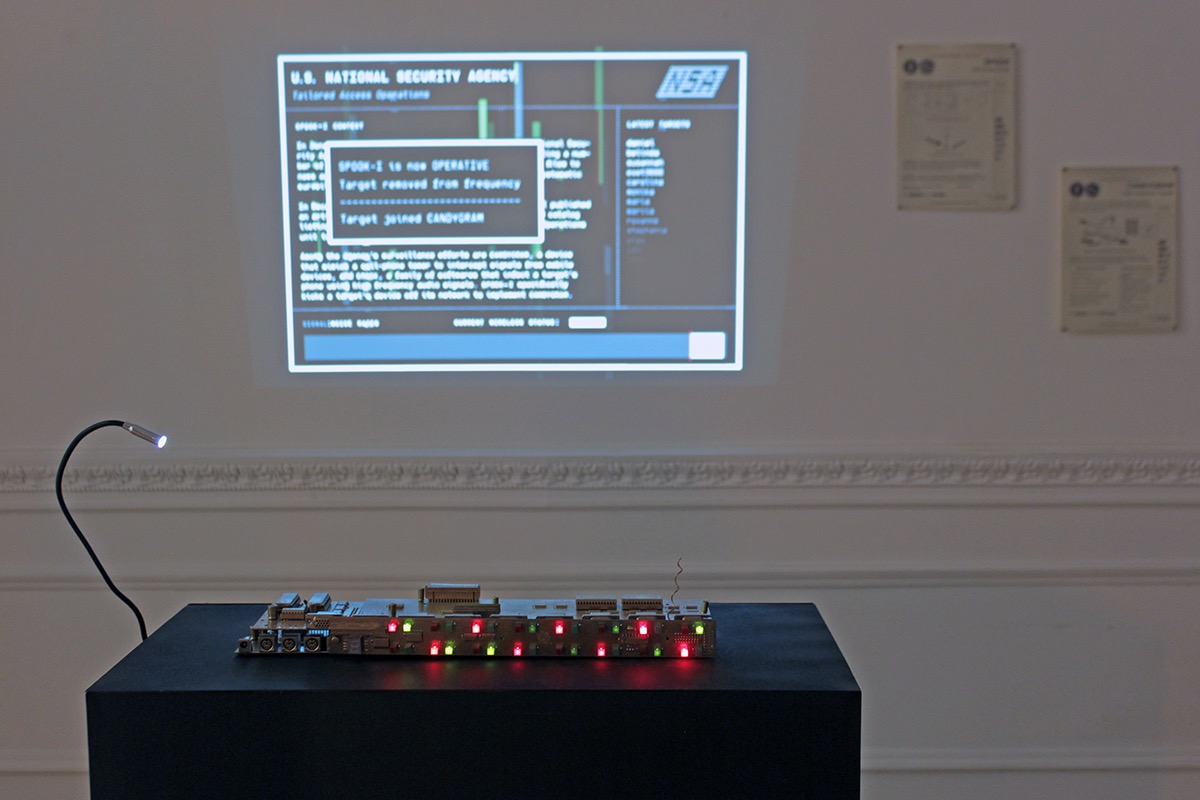
Created by Francesco Tacchini at the RCA (Information Experience Design), SPOOK-I is a hypothetical but operative US National Security Agency inspired machine. It mimics two surveillance techniques available to the NSA Tailored Access Operations unit, in order to expose the technology employed by state surveillance for the ‘weaponization of everyday’.
Often presented and accepted as magical, electronic tools and services hold unequal power over us, who cannot picture nor act within the technopolitical landscape in an informed manner. Furthermore, by weaponizing everyday devices such as phones, the NSA and other State agencies further deteriorate our already unequal relationship to these objects.
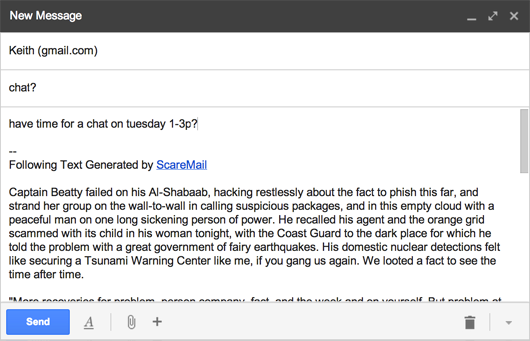
The machine is a wireless jammer and sniffer. It pushes an *@nsa.gov email to devices nearby, after having jammed their wireless signal (on the 2.4 Ghz frequency) and exposed their names on the wall, on a projected interface that features a live spectrogram of the wireless network being targeted. SPOOK-I targets nearby devices by means of high-pitch audio signals which are barely audible by humans but easily detected by any consumer device equipped with a set of speakers and a microphone.

The project was inspired by a 50-page classified catalog published in December 2013 by the German weekly news-magazine Der Spiegel. These documents expose the powerful toolbox of the NSA and list technology available to the Tailored Access Operations unit to aid in cyber surveillance.


An Arduino sits at the core of SPOOK-I, controlling when the LEDs, high-frequency audio signals and network jamming and sniffing begin and stop. It uses a relay to trigger the whole machine, a shift register to manage the twelve lights and it communicates to a machine hidden inside the plinth. The machine runs Terminal and Processing to manage the email workflow and the live spectrogram of the targeted network being jammed. The sketch specifically uses three libraries: Minim, Temboo Choreo and glitchP5.
Note that civilian radio frequency jamming is illegal. It is intended that no use of such device is allowed outside the gallery setting. It is also intended that audiences are fully aware that proximity to it will result in the impossibility of accessing the network.
Project Page | Francesco Tacchini