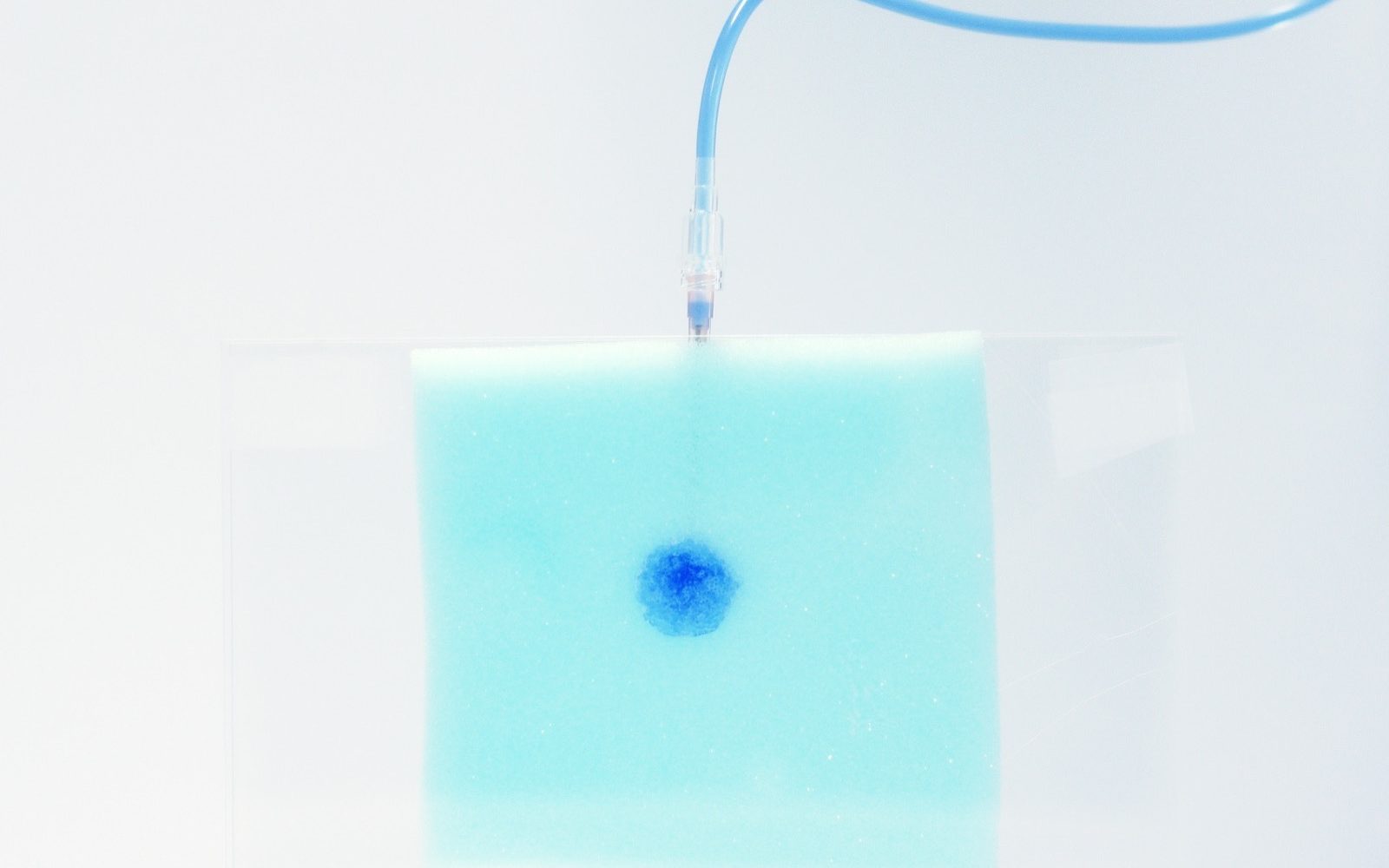
Created by Brian Harms, the aim of this project is to blur the line between processes of design and fabrication by increasing the fluidity of the fabrication process through coordinated material and robotic processes. Thanks to gelatinous medium and the process injecting and suspending light-curing resin, one can shape freeform objects without the need for molds or supporting structures. In addition, the process allows for tool changes, manual injections, on-the-fly robotic injections, multi-material injections, live modification of the digital or physical model, and the ability to physically “undo” (resin removal via suction or scooping).
The gel acts as an omnidirectional support material which is reusable, so there is no wasted material. By injecting and suspending light-curing resin in a gelatinous medium, one is afforded the ability to shape freeform objects without the need for molds or other subtractive manufacturing processes that would otherwise be necessary. The gel acts as an omnidirectional support material which is reusable, so there is no wasted material.
One major distinction between this project and other rapid prototyping processes is the ability to utilize 3D vector-based toolpaths. Virtually all other processes use paths generated via contouring a digital model, and rely on the hardening of each successive layer before being able to move on to the next. The suspension of resin in space without added support material allows for the ability to navigate and fabricate directly on and around other existing objects within the Gel, as well as the ability to observe the process from any angle.
Project Leader: Brian Harms (nstrmnt.com)
Project Team: Haejun Jung / Vince Huang / Yuying Chen
Instructor: Peter Testa / Brandon Kruysman / Jonathan Proto
Harms is currently pursuing a Masters in Design Research at the Southern California Institute of Architecture (SCI-Arc), and earned his bachelors degree in Architecture from Cal Poly, San Luis Obispo, in 2011. He has previously worked at such firms as IwamotoScott, Future Cities Lab, Griffin Enright Architects, and has consulted for Stephen Phillips Architects (SPARCHS), Doug Jackson Design Office, and Testa/Weiser.
Previously about Sci-Arc:
Robotic motion control as a creative medium for designers – SCI-Arc
Synchronous Dissections – Light drawing workshop at SCI-Arc with robotic arms
Approxymotion and MisPortraits – Geometry, drawing, material and robotic arms..


via Dezeen