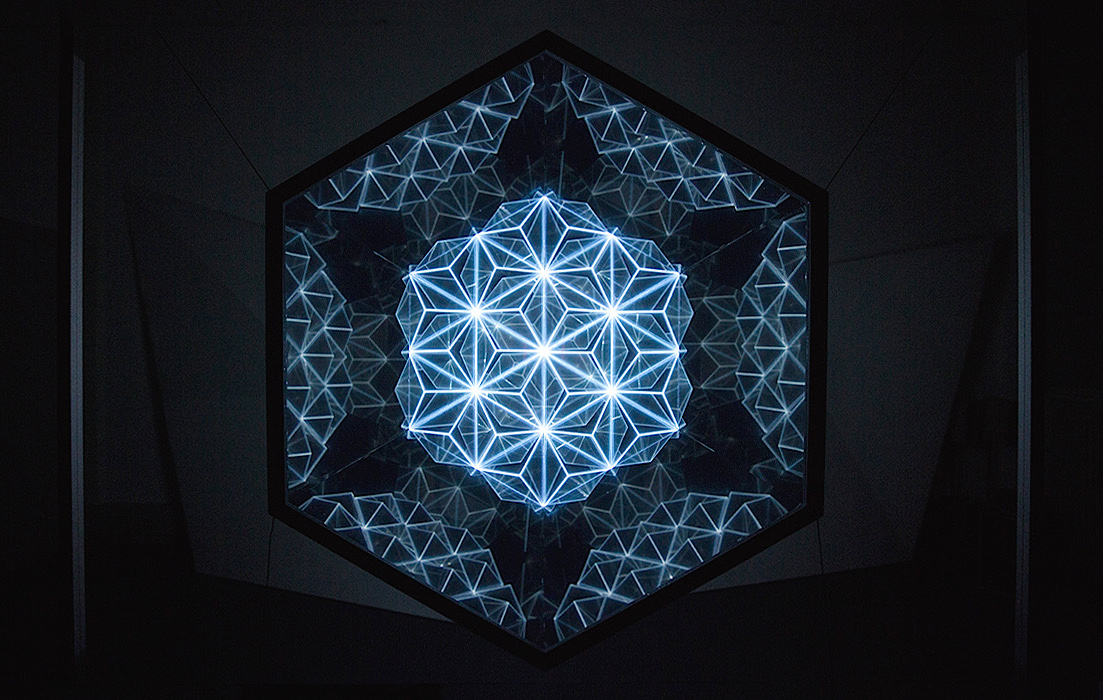
Created by Gaspar Battha and exhibited at the recent Retune conference in Berlin, Patterns of Harmony is an installation comprised of animated fractal of cubes, without containing any physical cubes, rather the reflections and projections of them. It is built by applying a combination of rear-projection and two-way mirror foils on acrylic glass, and the final effect is achieved by mapping and projecting animated graphics on the back of the installation. Thereby the light gets “trapped inside” the object, breaks on it’s physical structure and create the illusion of other shapes, eventually letting our minds take care of the construction of the visible geometry.
The language of nature as Galileo said is an alphabet of simple shapes of spheres, triangles, pentagons and their combination. But what are these shapes? Why is a cube constructed as it is and why do we find the same shapes and geometrical structures on the largest as well as on the smallest scales of the cosmos? Is geometry only an illusion of our senses or is it an essential building block of the universe?
 The animation was created using mostly After Effects and the Sound Keys plugin, which Gaspar used to analyse the music data. Processing and the minim library were also used for the sound analysis, and the same in Cinema 4D using it’s built-in Sound effector. The basis of the animation is mostly regular vector graphics, keyframed manually, then with the help of Adobe Extend Script in AE to translate the musical information into visual effects, time-remapping, image distortion, etc. For example, in some part of the animation, Gaspar made a simple linear vector animation moving at a constant speed, and did a time-remapping on that sequence by translating the dynamic of the music into keyframes (stronger impact in the music -> bigger ‘jump’ in the animation). Or in other cases he limited the music analysis to certain frequencies, thereby making low and high tones give different impulse to the image. This is what gives those small vibrations and why the video sort of follows the rhythm of the music. So simply put, as Gaspar explains, it’s a combination of pre-composed and generative graphics, composited all together in After Effects.


The projection is mapped with MadMapper. He first created a template (just a schematic vector image of the sculpture) and mapped each animation onto that template. Thereby everything in the animation is fixed to the coordinates of the template and you can simply use the template to map the graphics onto the physical sculpture.
For more informations and ideas that drove the project, please visit the links below.