Created by Christine Brovkina at the University of Bremen (Digital Media), I!&3_OCR is a typography project exploring human-only legibility. It comprises a series of typographic experiments with OpenType and Variable Fonts technologies, which are only readable by humans, and any attempt to recognise a text set in this typeface using OCR (Optical Character Recognition) tools will produce incorrect results. The project includes three typographic experiments with OpenType technology and testing results for developed OCR-resistant fonts.
Legibility is the ease with which a reader can decode individual symbols, while readably is the ease with which a reader can follow and understand words, sentences, and paragraphs. Traditionally, type design practitioners strive to construct their typefaces to be legible and readable in all different situations and applications, which is a long and dire process involving lots of compromises. But who tells what is legible and/or readable? And what is legible and/or readable for whom?
Christine Brovkina
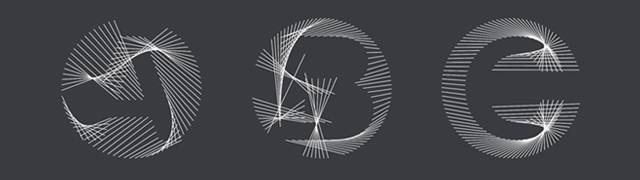
Christine began this project with a reflection on the concepts of readability and legibility in type design, distinguishing between the ease of decoding symbols (legibility) and understanding text (readability). She questioned the conventional approach of designing universally legible and readable typefaces and wondered who determines these standards. Inspired by David Kriesel’s talk on OCR errors caused by XEROX machines, Christine explored the possibility of creating typefaces that are legible for humans but problematic for OCR software. With some prior experience in working with typefaces, she embarked on designing new ones using OpenType and Variable Fonts. The result are three strategies focusing on human recognition of letter shapes, gap-filling, and spatial reasoning. She created basic glyph sets for three experimental typefaces—Resolution Display VF, Disruption Monospace VF, and Disorientation Sans VF—and tested their recognizability by Tesseract OCR, uncovering intriguing and sometimes unexpected results regarding OCR performance.

Resolution Display VF, all-capitals display font with one axis of variation, which ‘dissolves’ its rather limited letterform characteristics in the rectangular shape.

Disruption Monospace VF utilises the principle of closure (Reification) in visual design, which states that human minds prefer complete shapes, so we automatically fill the gaps between elements to perceive a complete image.

Disorientation Sans VF is a two-axis variable font, which relies on the human ability of spatial reasoning. It explores the potential of contextual rotation and displacement of glyphs, using Open Type features.
Resolution Display VF


The font was tested at larger sizes, divided into shorter strings, to balance the clarity of letter shapes and the lack of contextual clues for OCR systems. Three sets of tests were created for different weights (800, 850, 900) and sizes (42pt and 80pt) with matching line height. In total, 81 testing images were generated for the Resolution VF font, and the OCR testing returned a confidence score of 0 out of 100 for all assets, indicating that the OCR system did not recognize the text as text at all.
Disruption Monospace VF


Due to the font’s suboptimal performance at small sizes, larger font sizes and shorter strings were chosen to facilitate clearer letter shapes, despite potentially impacting OCR scores. Three sets were tested at weights of 600, 650, and 700, each at 40pt and 80pt sizes. A total of 81 test images were generated and evaluated. The results showed common OCR misinterpretations, including incorrect letters, “trash glyphs,” and inconsistent case recognition. For weight 600, the average confidence score was 38.5; for weight 650, the score was 29.5 with a skew towards lower values; and for weight 700, the average was 33.4.
Disorientation Sans


Due to the font’s lack of optimization for small sizes, the text was presented in shorter strings at larger sizes to enhance letter clarity for OCR. Nine testing sets were created across two axes at levels 0, 50, and 100, with sizes of 40pt and 80pt, and a line height of 125%. A total of 243 test images were evaluated in an OCR environment. The typeface’s design, employing complex strategies to evade recognition, showed that using OpenType features effectively reduced OCR confidence scores. A font instance without variation scored 90 out of 100, returning the correct text. However, applying variations reduced the score, with horizontal and vertical adjustments alone lowering it to 53.3 and 58.8, respectively. The lowest confidence score of 38 was achieved by combining variations on both axes, successfully leading to incorrect text outputs.
In addition to the three above mentioned typefaces available for download on the site, Christine has also included an OCR testing environment you can use to evaluate any font. It uses Tesseract OCR (Optical Character Recognition), an open-source software library that enables the recognition and extraction of text from various sources, such as images, scanned documents, and PDF files. It was initially developed at Hewlett-Packard Laboratories in the 1980s, and later maintained and enhanced by different organisations.
Project Page | Digital Media Bremen
Suprevised by Dr. Petra Klusmeyer, Prof. Dennis P Paul, Prof. Dr. Andrea Sick, Prof. Peter von Maydell and Prof Ralf Baecker.