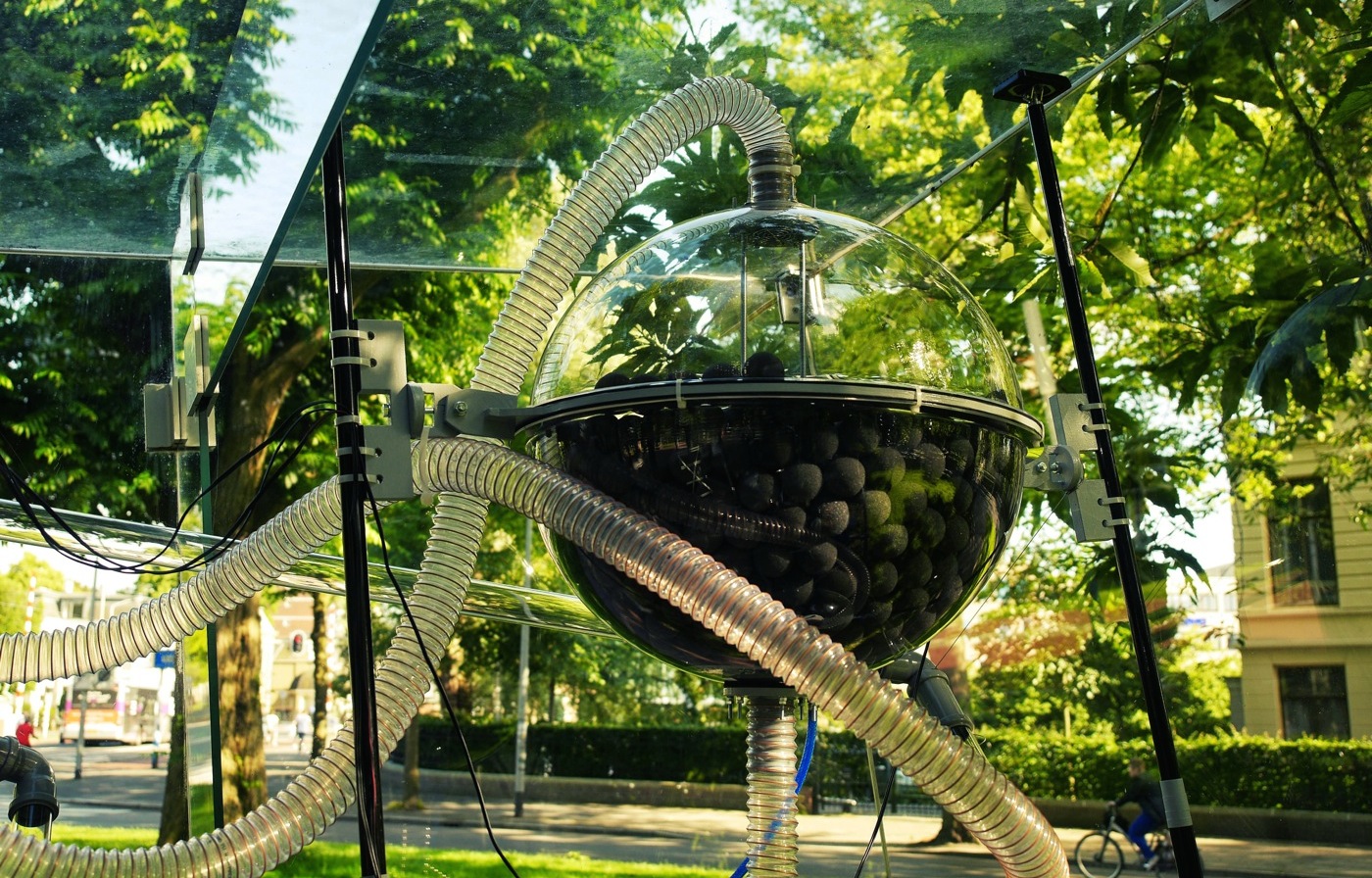
Created by Niklas Roy and located at the Tschumi Pavilion in Groningen / The Netherlands, the installation contains 1000 black sponge balls, which are sucked through 150m of transparent pneumatic tubes at high speed. Visitors are invited to operate the machine with a touch sensor mounted on the pavilion’s front glass: They can change the direction of the airflow and watch the balls speed up, slow down and reverse.
Inspired by the particle accelerators such as CERN’s well known “Large Hadron Collider” (LHC), the installation attempts to uncover the incomprehensible nature of these gigantic machines. Some 27km in length, they are designed for observation and there is not much to see since of course particles are too tiny to be seen with the bare eye. When Niklas was approached to construct a machine inside the pavilion, he wanted to create something that general public could enjoy – a particle accelerator for the masses.


The movement of the particles (42mm diameter) from one bubble to another is created by a difference in air pressure. When the vacuum cleaner is sucking air out of one bubble, using the power of an ordinary vacuum cleaner, it lowers the air pressure inside this bubble, which will be equalised immediately by the incoming air from the other bubble. This creates an airflow between the bubbles, which entrains the particles. The machine is switched on by the people who pass the pavilion using a touch sensor installed at the front glass of the pavilion. Once the accelerator is running, the airflow can be reversed by touching the sensor again. When the balls race through the pipes it is almost impossible to follow them. But when you reverse the direction of the airflow, hundreds of balls slow down all at the same time, just to speed up in the other way one moment later.
The installation runs using an Arduino Ethernet. The sensor part runs separately on an Atmega8, programmed in plain C. In addition, the installation also includes internet access and data logging where the working of the installation can be checked from remote location. Although quite cryptic and aimed at the one who understands it, you can find it here and the repository can be accessed on bitbucket.
For more details about the installation see the link to project page below.
The installation will run until end of September and it’s located here.
Project Page | Niklas Roy | Tschumi Pavilion