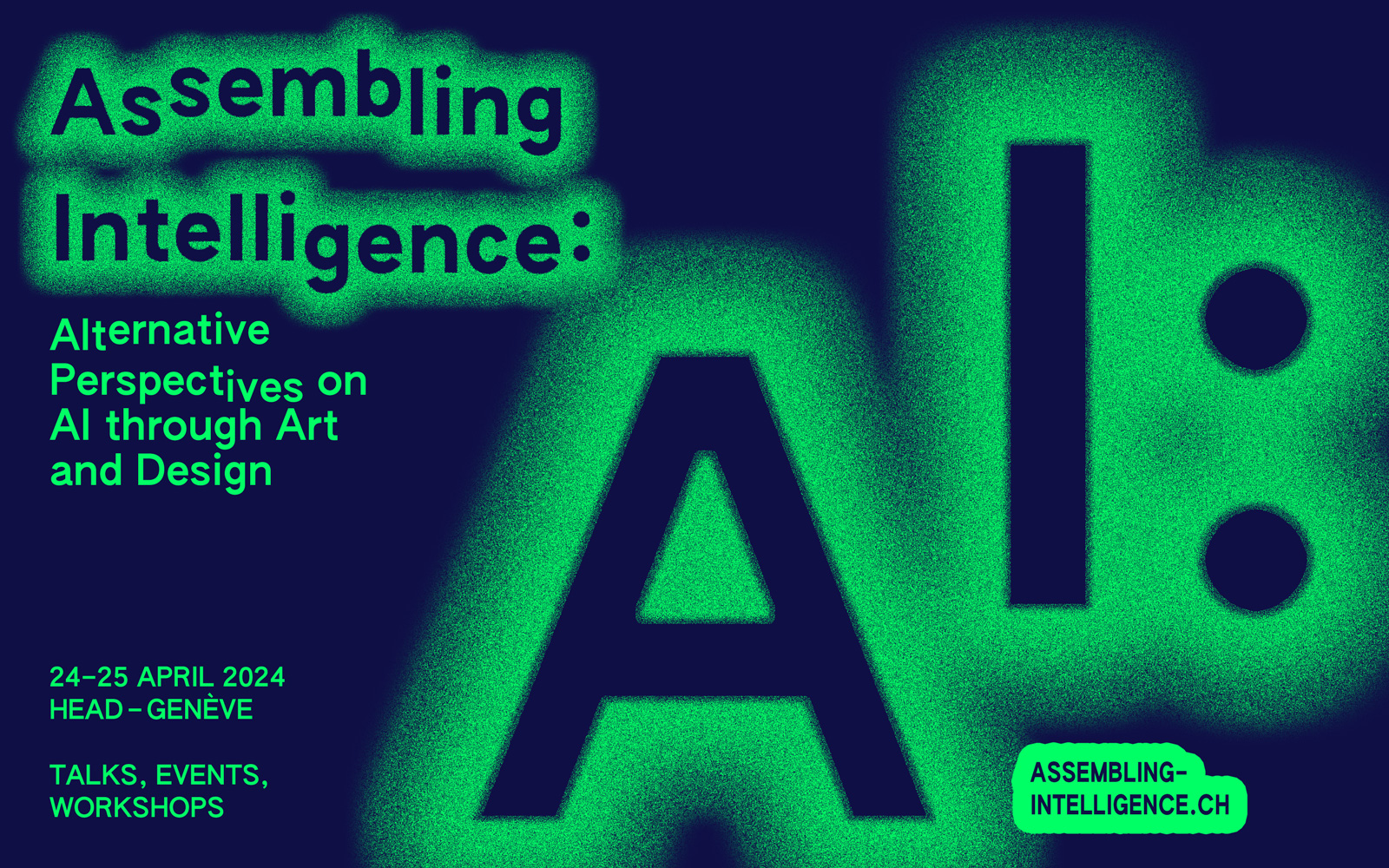
Assembling Intelligence, a multidisciplinary symposium organised by HEAD – Genève (HES-SO), will bring together artists, designers, and researchers to highlight a spectrum of alternative definitions for ‘artificial intelligence’. The discussions will introduce much-needed diversity into the otherwise monochromatic and frequently cynical perspectives manifested in mainstream corporate AI models.
A series of talks, workshops, screenings, and performances will bring attention to overlooked intellectual histories of AI, explore intersections between popular culture and human-machine intimacy, look at open software as means for creative emancipation, and highlight diverse futures for our damaged planet by extrapolating from the material and environmental underpinnings of AI infrastructures.
24–25 April 2024
HEAD – Genève (Geneva University of Art and Design)
Free tickets and stream links available via the event website.
On-site and live streamed online.
Free on-site workshops; screening; and closing performances.
Session 1: Interdisciplinary Histories of AI
Wednesday, April 24. 9:15—12:30.
Recent advancements in machine learning cannot be divorced from a long history of thought experiments. From the Turing Test to John Searle’s Chinese Room Argument, an exclusively Western tradition of conceptualizing intelligence has influenced engineering choices, notably the focus on language as a metric for cognition. As a result, public AI discourse is dominated by both anxieties and techno-positivism rooted in the Western ideology. Could interdisciplinary practices and incorporating the perspectives of artists and designers help us move away from distinctly human- or primate-centric conceptualizations of AI?
Speakers:
Computational Mama
Tariq Krim
Dorota Gawęda et Eglė Kulbokaitė
Moderated by Anthony Masure.
Session 2: AI Intimacies
Wednesday, April 24. 14:30—17:45.
Human-AI interplay in the digital culture sphere has seen significant developments in the realm of ‘soft’ interactions, encompassing emotions, attachments, and intimacies. From online ‘romantic partners’ like Replika (2017) and ‘sexbots’, to chatbots preserving our memories for future generations, monsters and chimaeras have taken shape, challenging conventional perspectives on relationships. What role do desires and intimate relationships play in the currently emerging AI-powered attention economy? How might human-machine romance play out in this evolving landscape?
Speakers:
Andrew Mallinson (Feminist Internet)
Saul Pandelakis
Performance by Simon Senn & Tammara Leites
Moderated by Clément Grahn
Session 3: Creative Emancipation through Open Software
Thursday, April 25. 9:15—12:30.
OpenAI, the company behind ChatGPT (2022), initially started as a not-for-profit but rapidly turned to commercial AI tools. Along with other companies, OpenAI is set to trigger another peak in Silicon Valley culture characterised by large-scale, profit-driven software development, exerting monopolised influence over ethical and regulatory guidelines and obfuscating their algorithms to avoid early competition. In response to these dynamics, we will look at open source art and design movements, pedagogical AI toolkits, and the potential for tiny datasets to challenge data-hungry approaches. How can open knowledge sharing empower creative processes and aesthetics to diverge from mainstream AIs?
Speakers:
Dries Depoorter
Nadia Piet (AIxDESIGN)
Silvia Weidenbach
Moderated by Vytas Jankauskas
Session 4: AI Materiality
Thursday, April 25. 14:30 – 18:00.
Ever since cybernetics proposed an innate connection between environment and technology, computational metaphors have used ecological terminology. Our data is ‘the new oil’ to fuel AI; it’s just ‘in the cloud’ rather than underground. We also know that artificial intelligence is built through the extraction of fossil fuels and rare earth minerals, and applied through clicking and labelling done by underpaid gig workers. Art and design are inevitably confronted with questions around the ethical and environmental approaches they should adopt in light of the high cost for the current AIs to exist. How should we position ourselves when engaging with AI, and what alternative strategies could we adopt?
Speakers:
José Halloy
Antonio Casilli
Audrey Samson
Moderated by Nicolas Nova and Cyrus Khalatbari
This event is organized by the Digital Pool and Research Institute for Art and Design (IRAD) at HEAD – Genève.