Created by Piet Schmidt and resulting from artistic research at the CERN laboratories in Switzerland and France, Towards Matter, Particularly explores ways of relating to matter that constitutes us and our world through sensory experiences of light and sound.
Subatomic particles, building blocks of matter, are hidden from our senses but revealed through scientific instruments. Particle physicists use these to rationalize the mysteries of matter’s foundations. But isn’t there more to the human experience than the scientific stories can tell? Why are we only engaging with these microscopic worlds through science? Isn’t there more to the human experience than scientific understanding? What if the power dynamics are inversed? Instead of accelerating and colliding particles we let them reveal themselves to us? Can an encounter with the mesmerizing particle traces inside a cloud chamber renew an appreciaton for the matter we and everything we know is made of?
Piet Schmidt
In this installation, scientific instruments are repurposed to bring to our sensual awareness the ever-present particles whirling with us. Here, the particles determine how and when they reveal themselves, eliciting moments of light and sound. The installation invites new relationships with the matter that is us and our worlds.
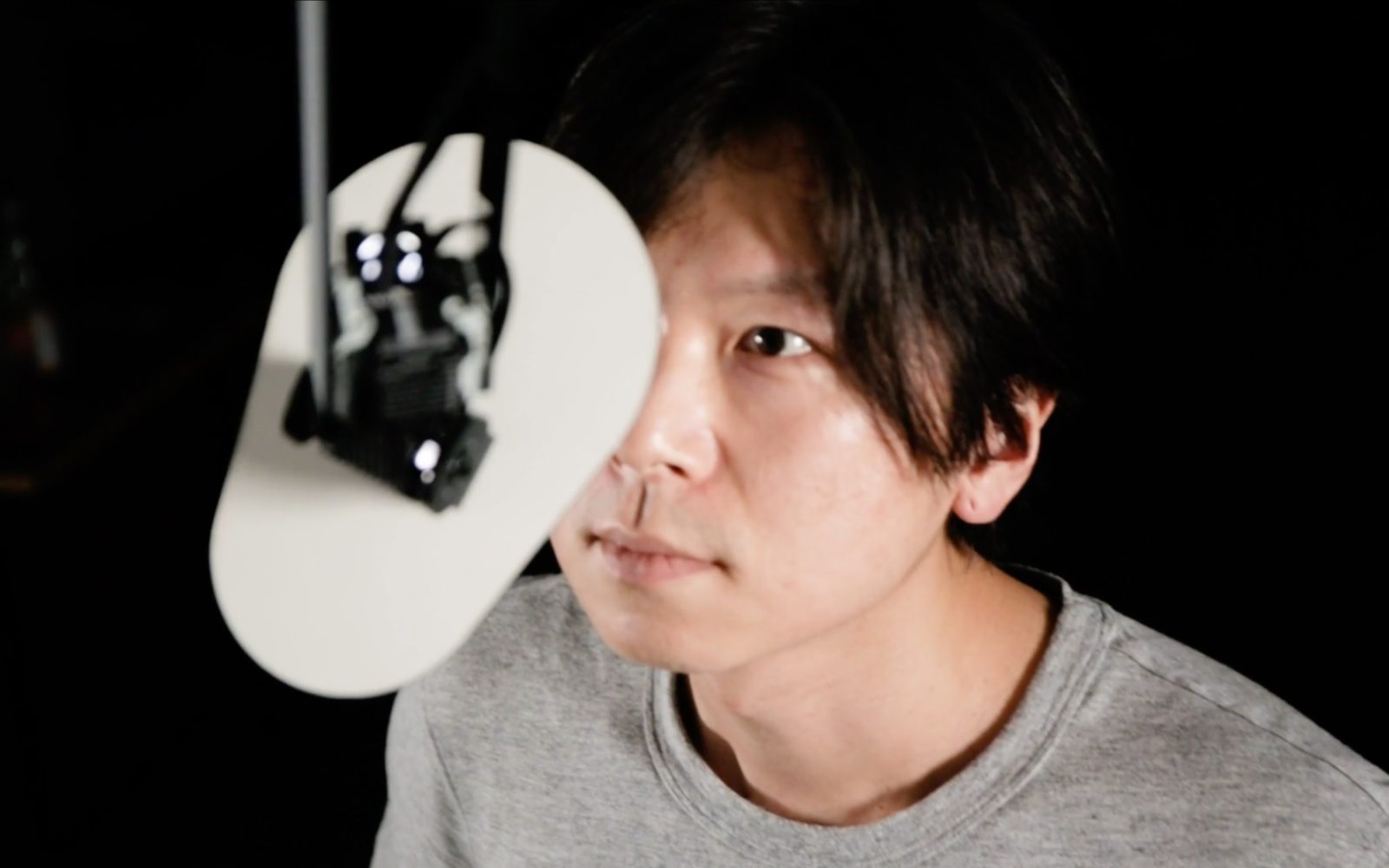
The two particle detectors each consist of a M4011 Geiger tube, an artifact from CERN (a brass machine component and a piece of copper cable braid discarded in the laboratories’ metal waste bins), an LED filament. When ionizing radiation—high-energy subatomic particles—hits a Geiger tube, it generates a small voltage spike. This spike triggers a flash of the LED and produces a sound via the CERN artifact.

The brass machine part rings like a bell when struck by the tip of a solenoid, while a small electric arc can be seen and heard forming between the loose strands of the copper cable braid. Additionally, the particle detector sends a signal to the particle visualizer, influencing the light conditions inside a cloud chamber. One particle detector toggles the light on and off, while the other alters the direction of the light beam.
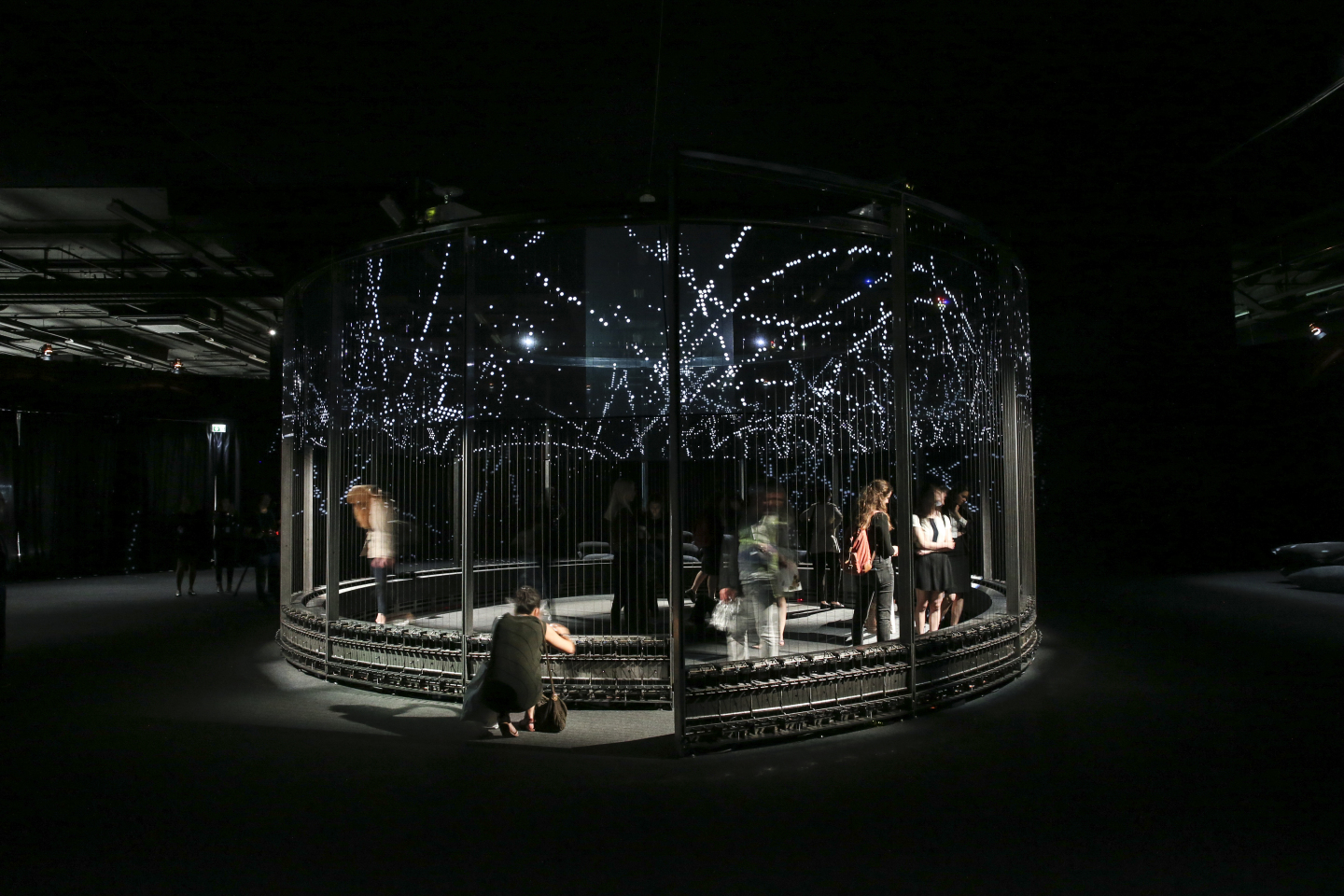
The particle visualizer consists of a cloud chamber, a cooling mechanism, an alcohol pump, an LED light source, a focusing lens, a rotating periscope-like mirror setup, and control electronics. The floor of the cloud chamber is cooled to approximately -30°C using a two-stage Peltier module, which dissipates heat into a heatsink. Isopropyl alcohol is pumped into a reservoir at the top of the chamber, where it is heated to produce alcohol vapor that gradually descends to the bottom.


Near the chamber floor, the air reaches a supersaturated state. Here, molecules ionized by high-energy particles act as condensation nuclei, causing the alcohol vapor to condense into tiny droplets. Under specific lighting conditions, these droplets appear as a dense but transient mist, tracing the trajectory of the particles. These random traces of high-energy subatomic particles are only visible when the light is turned on and the beam is directed toward the viewer.
Full list of components:
# **Particle detectors**

## Electronic components:

### Geiger Tubes:

- 2x M4011 Geiger Tubes
- 2x Geiger-Counter-RadiationD-v1.1-CAJOE boards

### LEDs:

- 2x Flexible LED Filament String
- 2x DC-DC Adjustable Step-down Buck Converter XL4015 5A - with Current Limiter

### Sonification:

- 1x Solenoid ZMF-1632d.001-12VDC
- 1x high voltage transformer from electric fly swatter

### Control Electronics:

- 4x MOSFETs for LED dimming, solenoid control and arch control
- 2x Arduino Nano V3.0 for controlling all particle detector electronics

### Electrical connection to particle visualizer:

- 2x 5m orange cable Lapp ÖLFLEX 5x0,75mm^2 with GX16-5 connectors

## Structural components:

- bent 20 x 20 mm aluminium square tubes
- bent and welded 5mm steel rods
- various 3D printed connectors and mounts

# **Particle Visualizer**

## Light System:

- 1x GVM-PRO-SD300B 300W LED light, DMX controllable
- 1x Projection Attachment Snoot with 36° Lens 100SLENS-MAX with circular insert
- 3x 120 x 120mm square glas mirrors on custom 3D printed tilt mounts

## Motion System:

- 2x Slew rings of different sizes
- 2x Stepper Motors NEMA17 0.55N.m
- 1x GT2 Timing Belt and pulley for small slew ring
- 1x custom 3D printed pair of double helical gears for large slew ring
- 2x TMC2209 Stepper Drivers

## Cloud chamber:

### Cooling System:

- 1x 100W TEC2-19006 double peltier cooling module
- 1x CPU heatsink
- 1x 120mm 12V Fan

### Alcohol recycling system:

- 1x DC liquid pump
- 1x black PTFE tubing
- 1x voltage regulator with potentiometer

### Chamber structural:

- 1x custom CNC milled POM bottom plate for clamping peltier module
- 1x copper disk with matt black adhesive foil
- 1x borosilicate glass cylinder
- 1x custom CNC milled POM alcohol reservoir with heating resistors
- 1x custom CNC milled POM chamber lid
- 1x custom 3D printed enclosure for high voltage transformer
- 1x high voltage transformer from electric fly swatter
- 1x aluminium grid from electric fly swatter

## Control Electronics:

- 1x Arduino Mega 2560
- 1x DC-DC Adjustable Step-up Boost Converter 150W for Peltier module
- 2x Stepper Motor Expansion Boards

## Structural components:

- various 30 x 30 mm steel square tube, bent, welded
- 1x 4mm steel disk
- 3x 8mm steel rods with threads as detachable legs
- 1x custom light source and electronics enclosure from perforated aluminium sheet
- 1x 3mm laser cut aluminium plate

## Power Supply:

- 1x 12V 400W Power Supply
To observe more traces, viewers must move with the light beam, circling the cloud chamber. At CERN, particle accelerators make particles move in circles. In this installation, however, it is the particles that make people move in circles.
Towards Matter, Particularly is the graduation project of Piet Schmidt in the MA Contextual Design program at Design Academy Eindhoven. The Installation is exhibited during the Dutch Design Week 2024 as part of the Graduation Show of DAE. Research, concept, design, production, documentation: Piet Schmidt /
Video edit: Yaqin Si / Special thanks to Iliana Tatsi for her generous support at CERN.