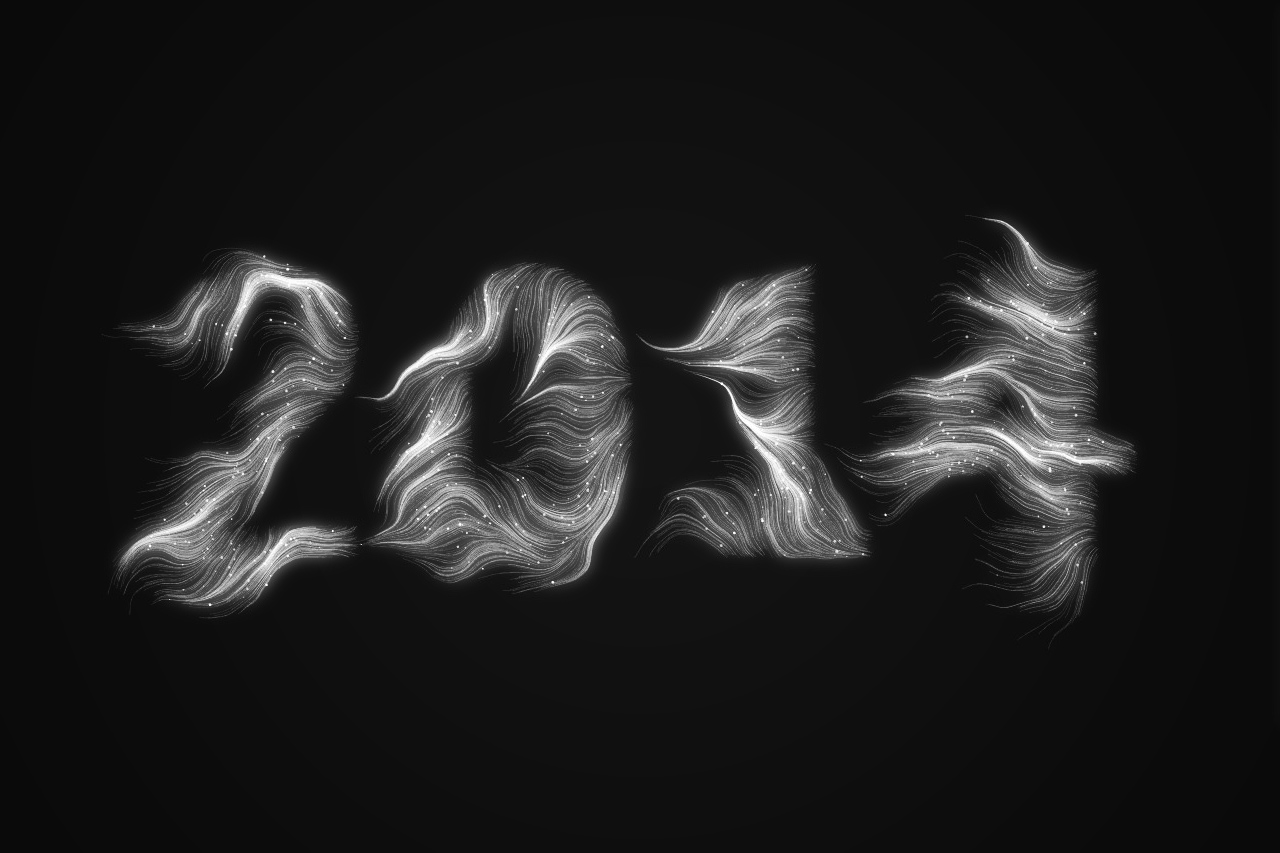
At CAN we don’t really care for lists. But as we look back as the year winds down, we’re known to make an exception. To keep up with our tradition, today we present our most memorable projects of the year. These works have not only inspired us, but were loved by you. Here’s to an amazing 2014! To see the best of the past, see our collections from 2011, 2012, 2013.
10. Smile TV – It works only when you smile
Recent Royal College of Art (RCA) design graduate David Hedberg’s Smile TV is more than a loving homage to the good old ‘campfire inside the living room.’ Made from an open frame CRT monitor and equipped with a computer vision system, the unsuspecting television set turns the medium’s engagement pattern on its head: instead of making you smile at on-screen silliness, you have to “smile to watch.” Only when you do – and for as long as you do – will Smile TV reveal its otherwise scrambled broadcast.
9. OccultUs by Simon de Diesbach – Designing for alternate reality
Created by Simon de Diesbach at ECAL, OccultUs is an installation that exploits the potential of the Oculus Rift technology by immersing the user into a sensory experience that mixes two distinct realities, physical and simulated. The project raises a number of interesting questions about how we may begin designing physical objects that complement and connect to our virtual experiences. Traditionally we have sampled real life sounds to produce the digitally enhanced or manipulated. In this reverse scenario, we are using the real-world generated sounds to enhance the alternate reality.
8. Picture the Sky Berlin – August 16 at 11:59

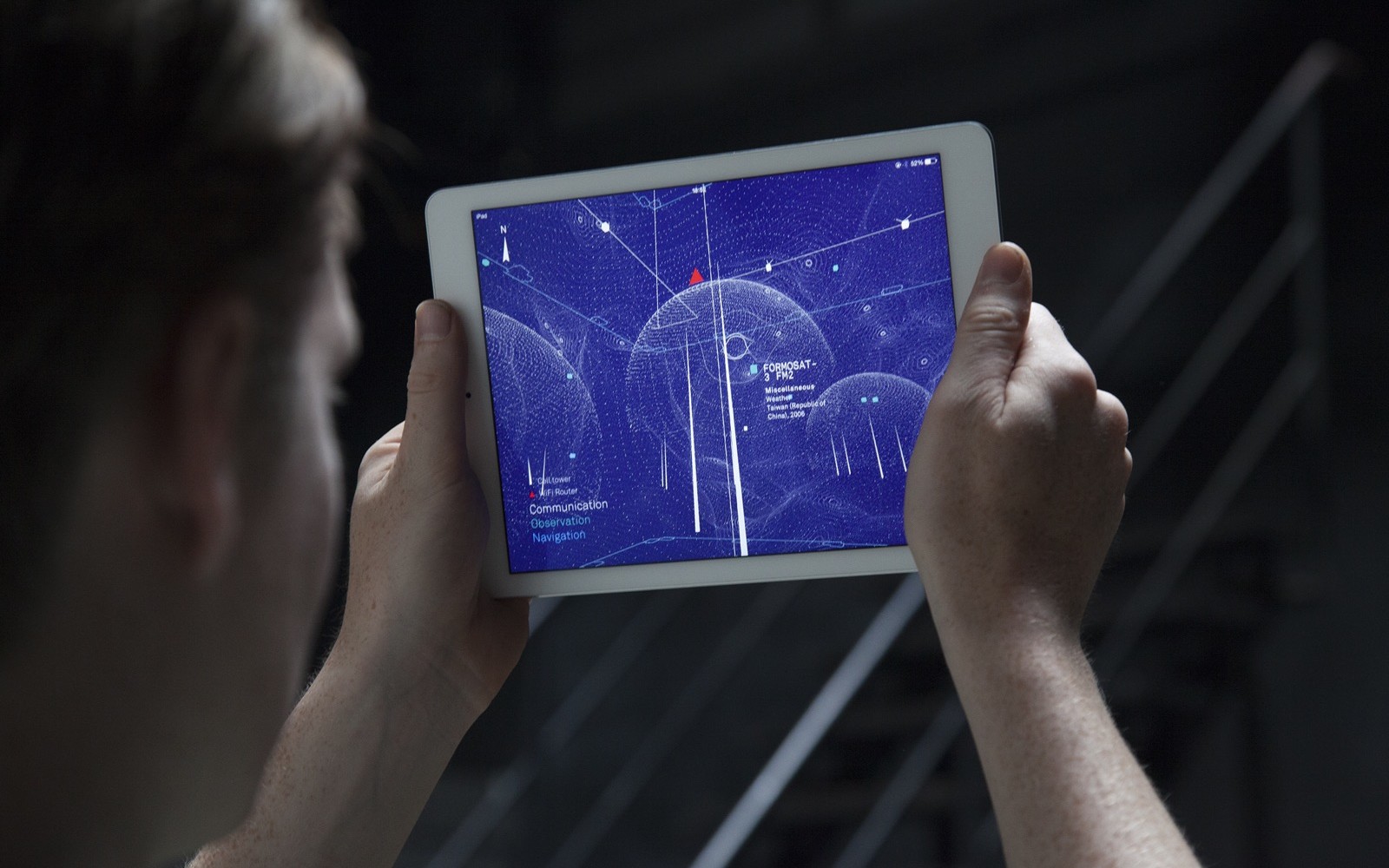
Picture the Sky is a project by Karolina Sobecka in an attempt to reverse the process of satellite imagery to where we, as one, become a very large ‘sociotechnological apparatus’ looking up at the sky, an infrastructure for our technology. Multiple observers are positioned at GPS coordinates that form the points of a grid. At the moment of the satellite flyover, on Saturday, August 16th at 11:59, we all take photographs looking directly up. Our images are stitched together to form a single large image, the view of the sky.
7. Modulares Interface B.A. – Physical controller interface for iPad
Created by Florian Born, Modulares Interface B.A. is a physical interface for iPad comprised of knobs, buttons and sliders to provide precision and haptic feedback when operating a digital interface. The system is comprised of three different parts – the physical controllers – made out of conductive aluminium to pass on the electrical discharge of the human skin, a frame – made out of aluminium and plastic, in which the iPad is inserted and finally, the software, running as an app on the iPad which organizes the control elements and sends the parameters to the corresponding software, which is controlled by the modular interface.
6. Nimbes – Exploring solitary nature of perception and observation
Created as a collaboration between Joanie Lemercier and James Ginzburg (one half of emptyset), Nimbes is an audio-visual installation designed for 360º immersive environments. The piece premièred at the Satosphère earlier this year, projected on a 18 meter diameter dome and screened everyday until the 27th of June. The project explores boundaries between natural and artificial, questioning the solitary nature of perception and observation and their relationship to both the cosmic and human scale.
5. Superposition—5.84 Quintillion Facets of the Digital Sublime
Ryoji Ikeda presented the North American premiere of superposition to a crowd of several hundred at the Musée d’art Contemporain de Montréal (MAC). As would be expected, the sixty-five minute multiscreen performance played out as kind of a data aesthetics megamix that flashed through a series of precisely choreographed abstract visual vignettes that grappled with the digital sublime and pondered the agnosticism of network culture. However, what was a pleasant surprise—one welcomed with open arms, in fact—was the integration of the talents of two ‘imperfect’ human performers centre stage into the middle of Ikeda’s austere audiovisual animations.
4. Wanderers – Digitally grown 3d printed wearables that could embed living matter
Wanderers is a collaborative project between Neri Oxman (and the team at the Mediated Matter Group at MIT Media Lab), Christoph Bader & Dominik Kolb (Deskriptiv) to create four digitally grown and 3d printed wearables that could embed living matter. The teams have been working on a computational growth process which is capable of producing a wide variety of growing structures. Inspired by natural growth behaviour, the computational process creates shapes that adapt to their environment. Starting with a seed, the process simulates growth by continuously expanding and refining its shape. The wearables are designed to interact with a specific environment characteristic of their destination and generate sufficient quantities of biomass, water, air and light necessary for sustaining life: some photosynthesize converting daylight into energy, others bio-mineralize to strengthen and augment human bone, and some fluoresce to light the way in pitch darkness.
3. Mountain
Known for his harsh videogame aesthetics, it was only a matter of time before madcap animator and filmmaker David OReilly would debute a videogame of his own. First announced at the GDC 2014 and released in early June, Mountain is as weird and wonderful as you’d expect. Featuring a free-floating, procedurally generated mountain, all the player get’s to do is watch. As time passes, you’ll see the weather change, mysterious objects appear and the occasional “deep” message. Fun? Possibly. Zen? Definitely! Mountain is available for iOS, Android and desktop computers.
2. Cosmos by Semiconductor – Scientific data made tangible
Created by Semiconductor (Ruth Jarman and Joe Gerhardt), Cosmos is a two metre spherical wooden sculpture that has been formed from scientific data. Interested in the divide between how science represents the physical world and how we experience it, Semiconductor have taken scientific data as being a representation of nature and are exploring how we can physically relate to it.
1. Light Barrier – Millions of calibrated light beams create floating phantoms in the air
Created by Kimchi and Chips, Light Barrier is the latest installation by Seoul based duo Elliot Woods and Mimi Son. First shown at New Media Night Festival, Nikola-Lenivets Park (4–6 June 2014), the installation creates phantoms of light in the air by crossing millions of calibrated beams; creating floating graphic objects which animate through space.
Notes: Cover image for this post was created using the Generative Typography tutorial by Amnon Owed.