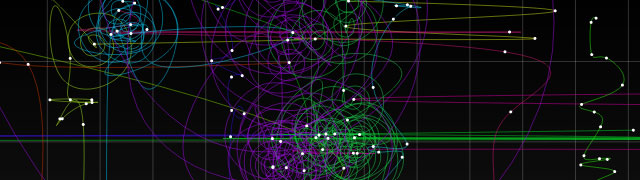
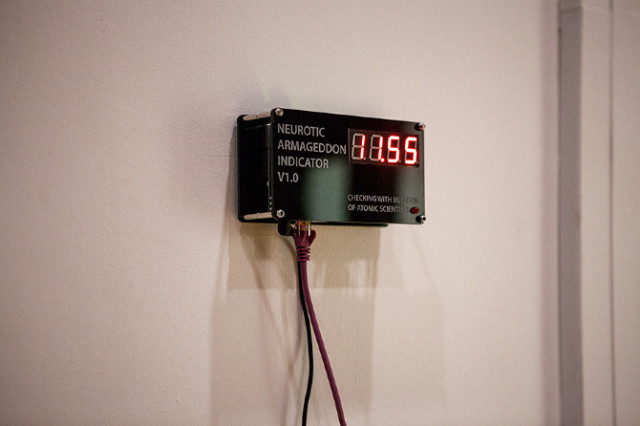
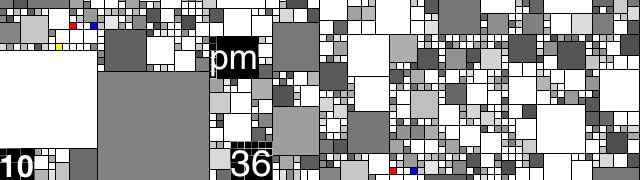
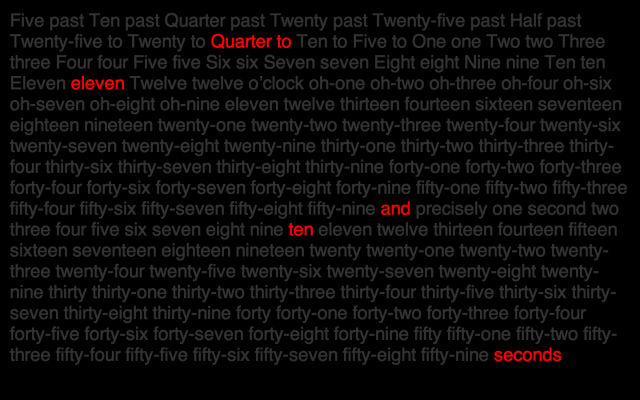
Alternative Clock is a research project that examines “clock time” as a form of data, exploring how it governs lives and shapes the built environment, and a prototype of clocks that operate using diverse data inputs, offering new ways to experience and interact with time.
Time is a culturally constructed concept that is influenced by political and contextual factors. Although the global time system is widely used, it is important to recognize its limitations and the fact that it is not an absolute truth. The accuracy of the global time system is achieved through the averaging and adjustment of time data from atomic clocks across more than 62 countries, which is compiled into Coordinated Universal Time (UTC). Occasionally, leap seconds are added to the system, resulting in minutes that are longer than 60 seconds.
Following time measurement, the conversion of time into time zones and adjustment for daylight saving time occur. The delineation of time zones has historically been influenced by economic zones and is subject to changes based on political alliances. The most extreme time zones are +14 hours at Line Islands (Kiribati) and -12 hours in and around Baker Islands (US). Therefore, the maximum possible difference between times on Earth is 26 hours.
As time is a human invention, it is possible to design new timepieces and create alternative temporal systems to meet the changing needs of society. With advances in communication technology, a single clock is no longer necessary to synchronize activities, and quantifying previously difficult-to-measure phenomena is now possible through technology. This project advocates for challenging dominant narratives of clock time and exploring new ways of measuring time to better understand the world. Just as different maps are available for different purposes, using different projections into the same space, the same can be done with time.

This project creates a new temporal system using a Raspberry Pi that connects to WiFi to retrieve various types of data: UTC time, sunrise and sunset times, and personal energy data derived from my Fitbit API using Python. Each clock represents a distinct perspective of time—society, nature, and self—with custom-designed dials engraved on a clear acrylic panel, allowing users to view each dimension of time transparently.
The system is set up in Bash to connect to GitHub and automatically run the program without turning on the GUI. The cloud-derived data is then converted into stepper motor angles and transmitted to an Arduino via a residual communicator. The Arduino controls the stepper motors using C++, resulting in clocks running at different speeds. The new clock necessitates a new cognitive pattern that combines multiple clocks to orchestrate the contingent rhythms of an individual’s day. The clocks can be customized to meet the individual’s needs, and the person can switch between systems if necessary.


Clocks not only measure time but also orchestrate human actions and how we interact with space. Time zones, for example, enable clocks to connect or disconnect us from others. Imagining a new type of clock offers a unique perspective on the world. For instance, if scientists investigating nature do so through an animal-time clock— could we discover something new with this new lens on time? Will alternative clocks give rise to new social protocols—such as scheduling school or work schedules according to the energy cycles of each individual rather than conventional clock time? The possibilities are endless.
More about the project here
Saralee Sittigaroon

- Birth, K. (2012). Objects of Time: How Things Shape Temporality (Culture, Mind and Society). Palgrave Macmillan.
- Lombardi, M. A. (2017, March). Experts: Time Division into Days, Hours, Minutes. Scientific American. https://www.scientificamerican.com/article/experts-time-division-days-hours-minutes/
- Landes, D. S. (2000) Revolution in Time: Clocks and the Making of the Modern World. Belknap Press.
- Loukissas,Y. (2019). All Data are Local, MIT Press.
- Nanni, G. (2012). The Colonization of Time. Common Ground Research Networks.
- Pschetz, L., Bastian, M., & Speed, C. (2016). Temporal design: looking at time as social coordination. In Proceedings of Proceedings of DRS 2016, Design Research Society 50th Anniversary Conference.
- Pschetz, L. (2014). Temporal design: design for a multi-temporal world (Doctoral dissertation, University of Dundee/Edinburgh).
- Pschetz, L., & Bastian, M. (2018). Temporal Design: Rethinking time in design. Design Studies, 56, 169-184.
- Tuckman, A. Employment Struggles and the Commodification of Time: Marx and the Analysis of Working Time Flexibility. Philos. of Manag. 5, 47–56 (2005). https://doi.org/10.5840/pom20055221