For Mesopotamian diviners, an unusual event could be read as a sign of something yet to come. A sheep born with five legs might be a sign of financial ruin in the land. Thousands of these relationships were recorded in archives as lists of conditional statements: IF a particular sign occurs, THEN a particular consequence follows. These served as a systematic method to make sense of the world.
With House of IFs, I’m using this structure as a model for an agentic AI system that reads contemporary news, to explore and critique how these systems claim knowledge.
Each day, the system looks for an unusual event, or fait divers, alongside a major news story. It searches earlier reporting for a comparable relationship and uses these connections to construct an omen in IF/THEN form. On 24 July 2026, for example, 2 separate incidents of pythons found in the hood or engine of a car (then and on August 2018) became a sign of US tariffs (also then and on August 2018). The prescribed counter-action was to tie a knot before discarding the rope into a river.
I find the counter-actions (namburbi) to be a key aspect of the work. They show a future that is not fixed: ritual action could be used to avert the consequences of a bad omen. What might equivalent forms of contestation or counter-action look like in AI systems and interfaces? How might someone challenge or act upon a prediction made about the future?
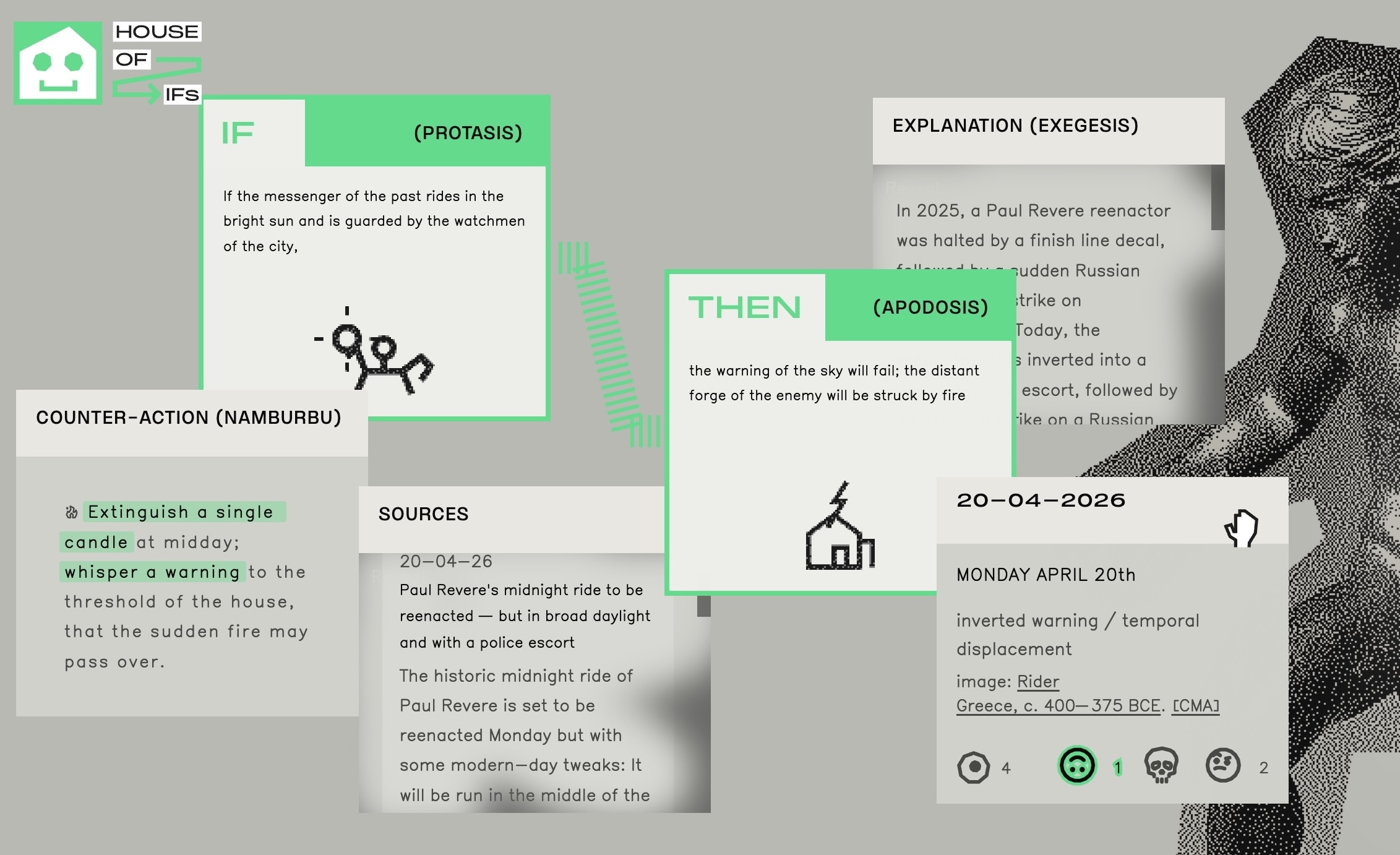
Large language models are particularly good at constructing plausible-looking explanations between distant pieces of information. I’m analysing this through the structure of divination, where association and interpretation of sign are already employed as parts of a system for producing/claiming knowledge. Each omen is presented through a set of tablets. The IF and THEN appear as connected windows. The explanation, sources and counter-action are partially blurred and concealed until visitors reveal them.
The omens accumulate into an archive. Each entry is paired with an open-access museum image selected through semantic association. A spatial map projects the semantic relationships between the omens. Neighbouring entries concerned with similar subjects to be seen relationally. Visitors can question a “Scribe” agent about the archive and ask it to find connections across earlier predictions.
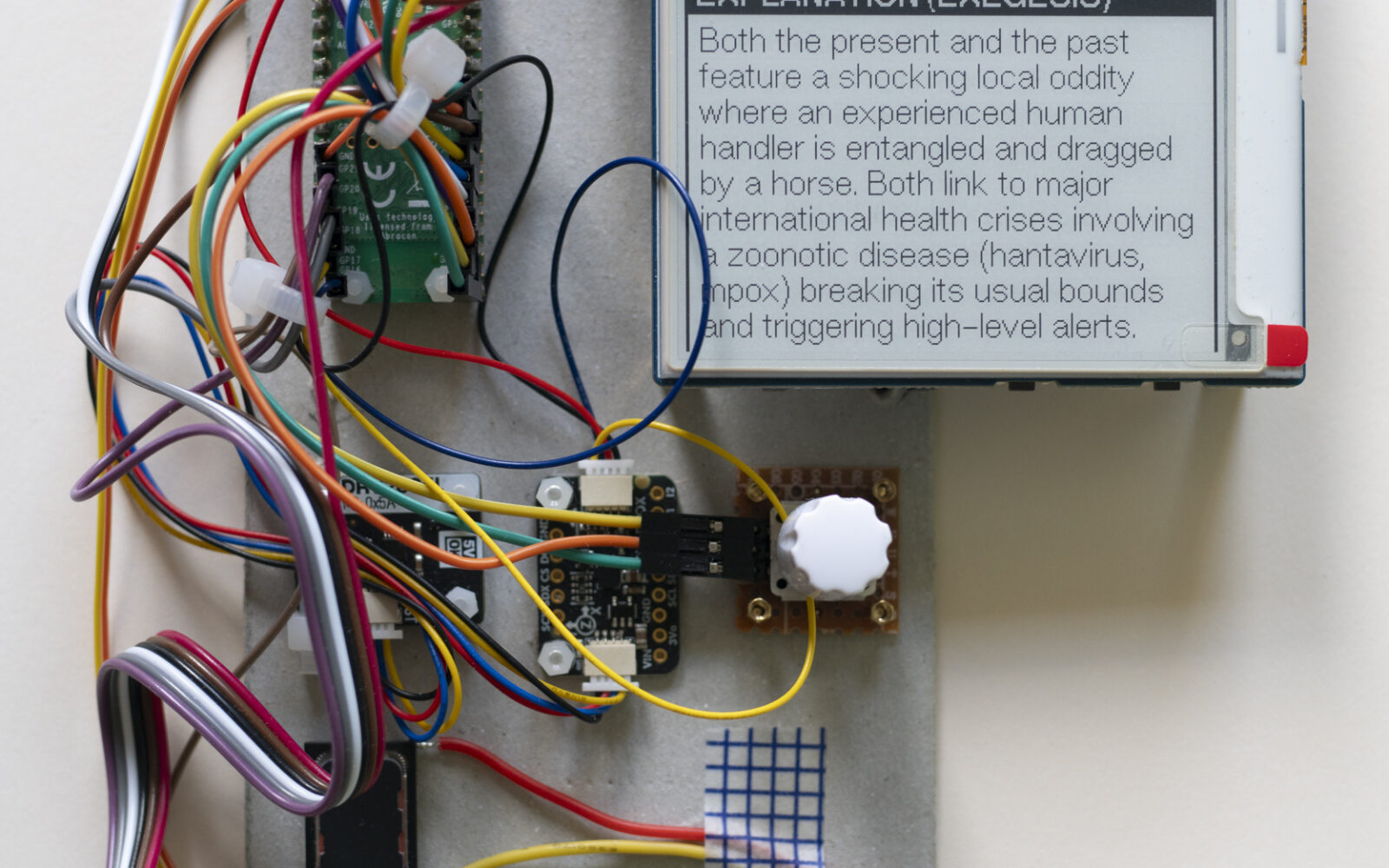
The archive has now grown to more than one hundred omens. I’m building an e-paper controller to extend the work into a physical exhibition object, to allow visitors to browse and manipulate the archive away from the browser interface. The current prototype uses haptic feedback and accelerometer-based interaction.
House of IFs forms part of my research into “oracular interfaces”: interactive systems that use divination and magic to make AI strange.
I’m Gaston Welisch, a designer and researcher. I’m currently undertaking a PhD at the university of Bristol, researching AI through magic and divination, alongside my practice in critical AI and creative technology.
House of IFs is a continuously operating interactive web-based system that generates and archives new omens daily from contemporary news.
An agentic pipeline gathers current reporting and identifies two kinds of material: unusual events or faits divers, and larger political, economic or social events. It searches earlier reporting for comparable relationships. It then using these correlative associations with matching dates as the basis for a new IF/THEN omen.
The generated entry contains a protasis (IF), apodosis (THEN), an explanatory exegesis, source material and a counter-action (namburbu) derived from Mesopotamian apotropaic practices. The underlying system builds a growing shared archive as new entries are produced.
Semantic embeddings are used to position the accumulated omens within a spatial archive, so entries concerning related subjects appear near one another. The same archive is available to the Scribe agent, which retrieves and interprets earlier omens in response to visitors’ questions, and has access to a similar archive of translated Mesopotamian omens.
Open-access museum collection images are retrieved and associated semantically with individual omens. These images are part of the interface and archive, alongside the generated text and original news sources.
The browser interface separates each omen into movable and revealable “tablets”. A physical e-paper controller is being developed for exhibition use, with haptic feedback and accelerometer-based interaction for browsing the archive.
Project Page | Gaston Welisch | Instagram
Tools: LLM, semantic embeddings, news/search APIs, JavaScript, HTML/CSS, Flask, e-paper display, Raspberry Pi pico microcontroller, accelerometer, haptic motor.