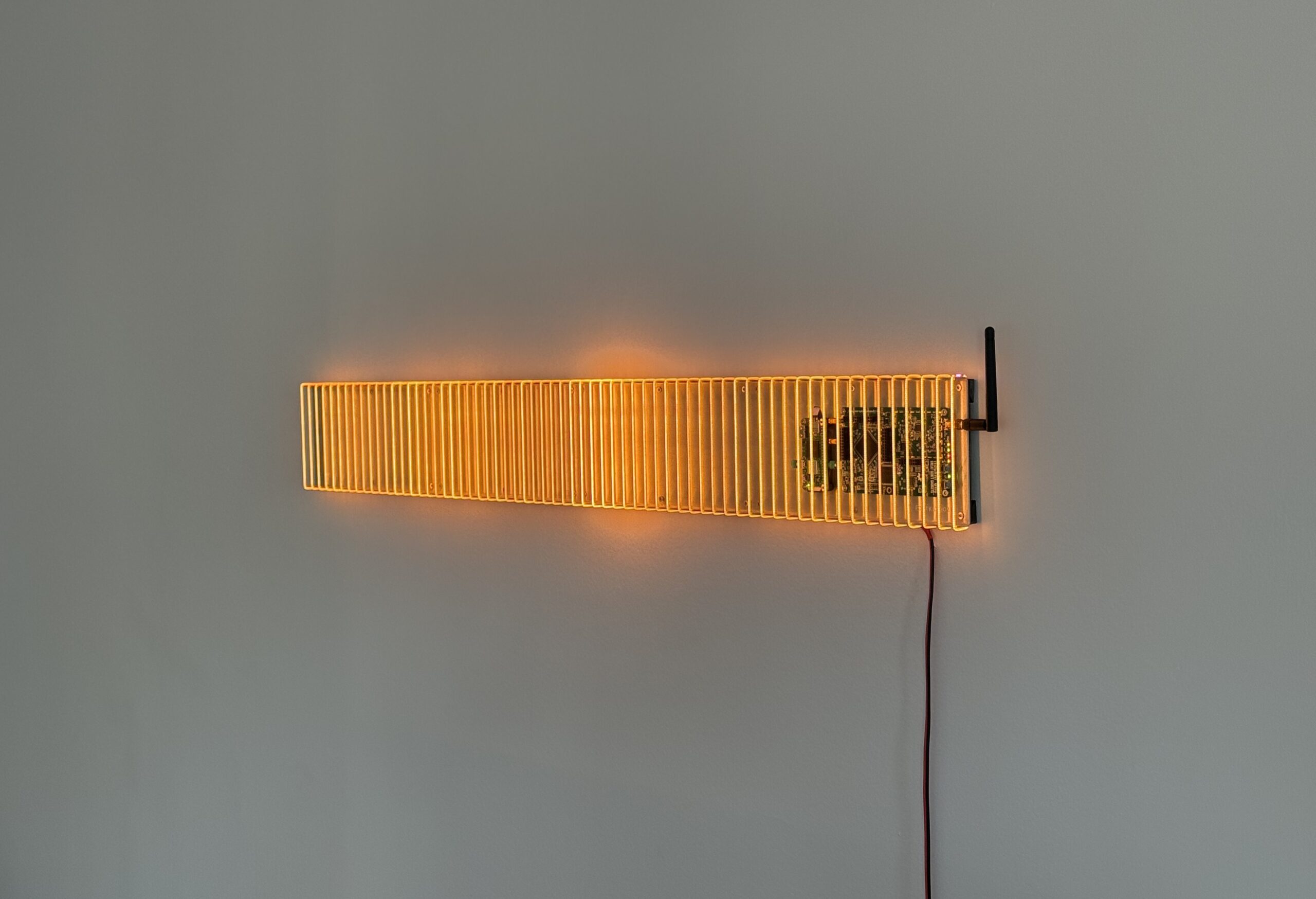
To the naked eye, the space around us appears calm, quiet, almost inert. Light rests on surfaces, air feels empty, and nothing seems to move. Yet this stillness is an illusion shaped by the narrow limits of human perception. Beyond visible light lies a dense and restless world: an invisible storm of radio waves generated by our devices, our infrastructures, and our habits. Spectrum Slit is an attempt to render this hidden violence visible.
The artwork translates the electromagnetic activity that fills contemporary interiors into light. It listens to the radio frequencies used daily by Wi-Fi, Bluetooth, and connected devices (the 2.4GHz and 5Ghz bands), and converts this otherwise imperceptible flow into a physical, luminous presence. In doing so, the piece exposes the constant tension and saturation of the spectrum we inhabit, a space that is never silent, never still, and never neutral.
The installation takes the form of a long metallic structure. Across it stretches a dense array of luminous LED filaments, suspended like a slit cut into space. Each filament corresponds to a specific range of radio frequencies within the bands used by consumer technologies. Together, they form a continuous reading of the spectrum. The brightness of each filament is directly driven by the intensity of activity in its assigned frequency range, allowing the invisible fluctuations of the radio environment to become immediately perceptible.
Every digital action leaves a trace. A website loading, a message being sent, an application refreshing, a video starting to play, each of these data requests appears on the piece as a sudden burst of light. Short, sharp spikes reveal momentary exchanges, while sustained bands of brightness emerge when high volumes of data are transmitted, such as during video streaming. Over the course of a day, the work breathes with the rhythms of its surroundings: subdued during quiet hours, increasingly saturated as human presence and device usage intensify.
As the light grows stronger, it can become overwhelming, even blinding. This excess is deliberate. The work confronts the viewer with the sheer density of activity required to sustain the conveniences of modern digital life. What feels frictionless and immaterial on a screen is, in reality, supported by continuous, aggressive occupation of the electromagnetic spectrum.
The piece also produces sound, an unintended but revealing byproduct. As the lights respond to rapid changes in signal intensity, subtle vibrations emerge, forming a low, harmonic texture. This auditory layer reinforces the sense that the space is alive with motion and tension, even when nothing visible appears to be happening.
Spectrum Slit invites viewers to reconsider their relationship with the invisible systems that surround them. By making radio waves tangible, it reframes the digital world not as abstract or virtual, but as something physical, energetic, and invasive. Ultimately, it confronts the viewer with a simple but unsettling realization: we inhabit a world crowded with signals we cannot see, shaped by infrastructures we rarely perceive. Surrounded by “ghosts of our own making”.
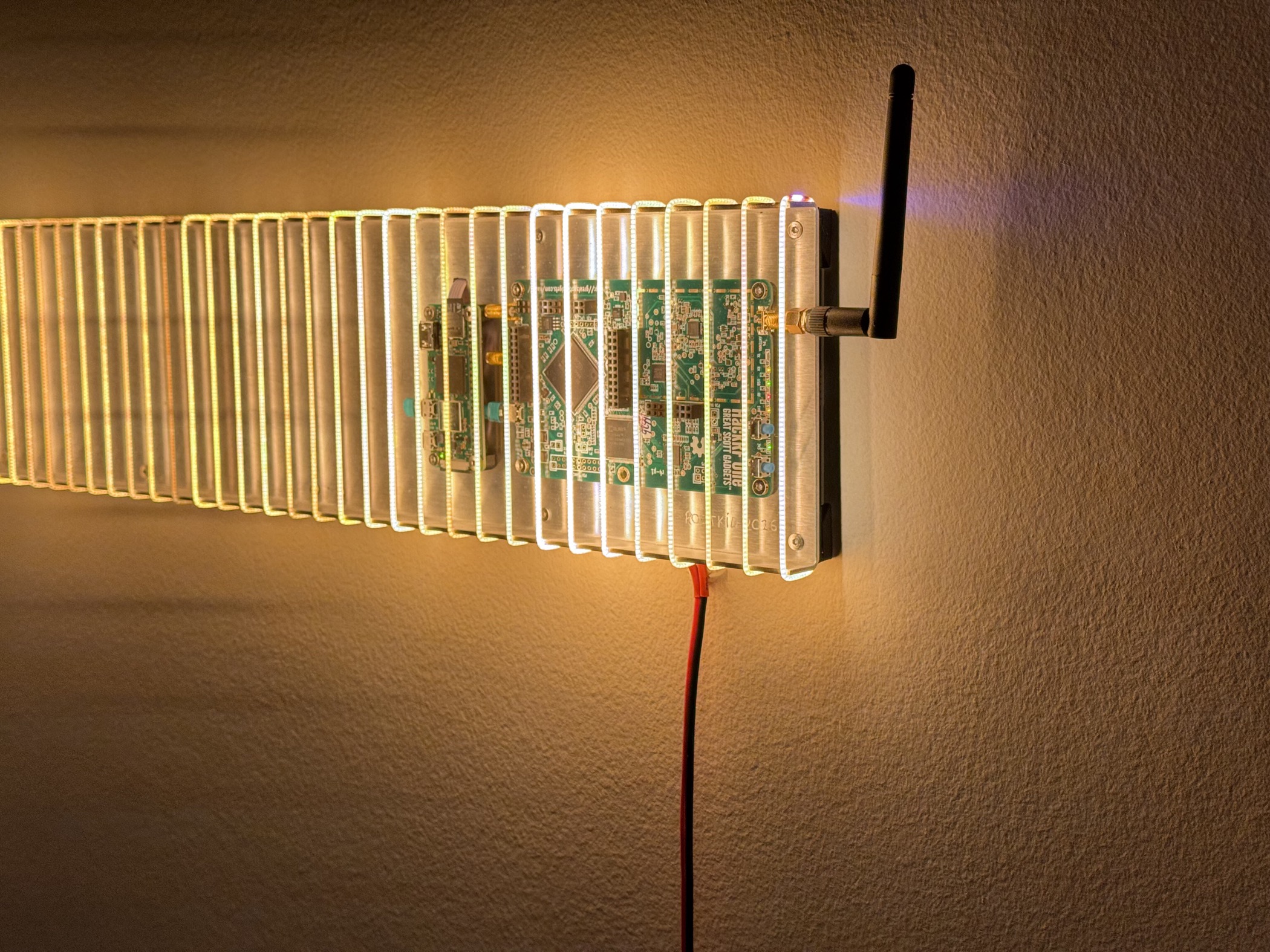
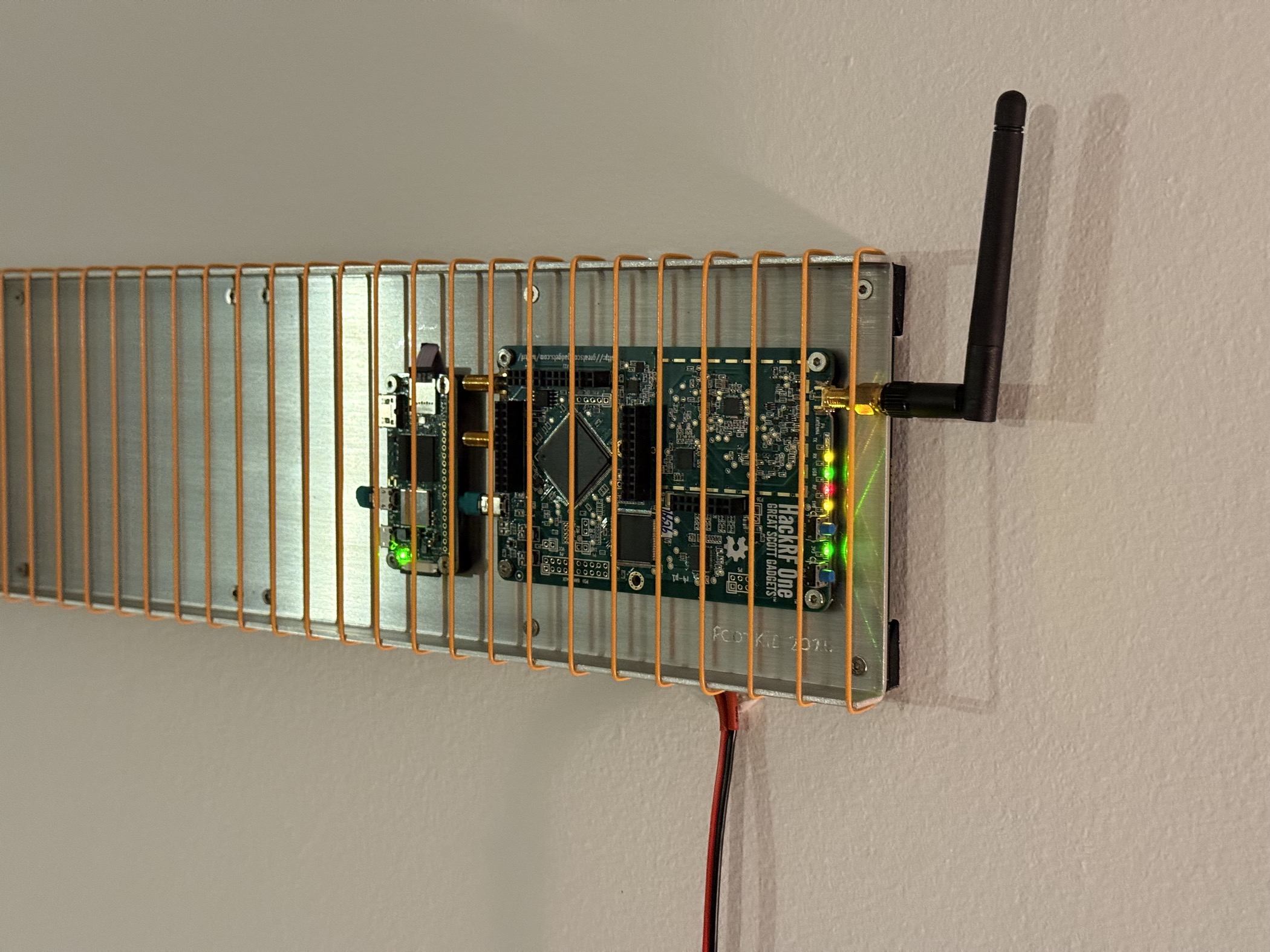
Spectrum Slit is a real-time electromagnetic spectrum visualization system combining radio frequency sensing, embedded computing, and custom lighting hardware. The installation continuously measures radio activity in the frequency bands commonly used by consumer wireless technologies and translates this data into light and sound.
At the core of the system is a HackRF One software-defined radio, used to scan a wide range of radio frequencies in the gigahertz spectrum. The SDR captures raw signal strength data from the surrounding environment without connecting to or decoding any specific network. This data is processed locally by a Raspberry Pi Zero 2 W running custom software written in Python. The software samples the spectrum, aggregates signal intensity across defined frequency ranges, and updates the visual output in real time at a high refresh rate.
The lighting system consists of 64 flexible LED filaments mounted across a custom metal chassis. Each filament corresponds to a specific frequency range and reacts proportionally to the measured signal intensity in that range. The filaments are rated at 2 W each and operate at 9 V. They are driven by constant-current channels to ensure stable brightness and precise control.
A set of custom-designed printed circuit boards sits behind the chassis and handles LED driving and power distribution. The Raspberry Pi communicates with these boards over an I2C bus, allowing individual control of each filament’s brightness. The modular PCB architecture enables multiple channels to be chained together while maintaining synchronized updates across the entire installation.
The combination of software-defined radio, embedded Linux computing, and custom constant-current LED hardware allows Spectrum Slit to function as a fully autonomous, site-responsive instrument. The piece reacts solely to the electromagnetic conditions of its environment, translating invisible radio activity into a continuously evolving physical experience of light and sound.