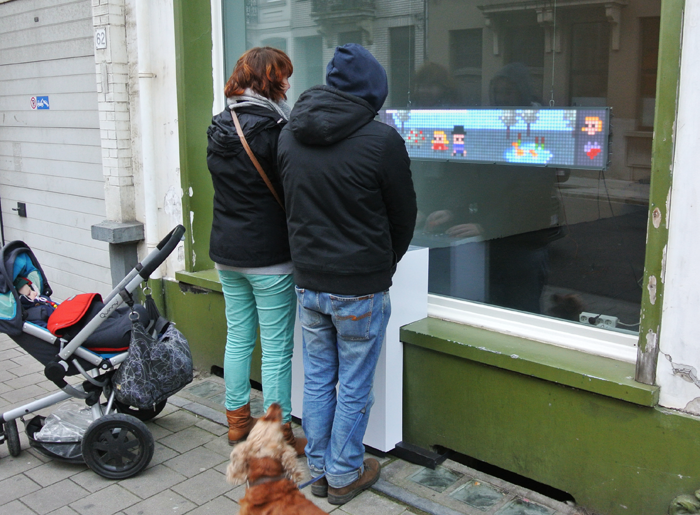
Kris Temmerman’s house/office has a store window that he tries to make use of as much as possible. In the past he built projections but really wanted to make something interactive. Since the area has a lot of loitering youth and many people passing by he thought it would be nice to make an old fashion arcade box anyone can play.
To make it a little bit more challenging, he set out to run the hole thing on an Arduino without without an external computer – just to see how much power it actually has. If this was not enough, he also wanted to try to make everything himself – from his own led screen, with his own “display driver” and display list, a 8-bit sound library, and of course the game itself. The only thing someone else made was the music for the game, composed by Annegreet Sledsens.
The game is cross developed as a Cinder c++ app and an Arduino app, so he didn’t have to upload the whole thing on an Arduino every time he wanted to test something. There is no external memory, everything is stored on the Arduino. He made a small app that generates c++ classes from bitmaps with some gamma correction for the led screen. He used indexed colours to save some of that precious SRAM. For driving the leds, he modified the Adafruit neopixel lib, to support alpha-blending and make it a little bit faster for his specific case. The full source code and game assets on Github.

 The hardware includes strips of WS2812 LEDs, which are individually-addressable RGB LEDs. The lay in a 16*90 grid (=1440 leds). Beneath the leds is the main Arduino Duo and the power source. This is the Arduino that drives the display and runs the game. Since leds use a lot of power he had to add a 60A 5V power supply. The screen/main arduino is connected with the arcade box through a simple tx-rx serial line, which was fast enough to send the button commands. The Arduino in the arcade box generates the sound and music and handles the raw button/joystick input.
For more detailed information including schematics see the full post on neuroproductions.be