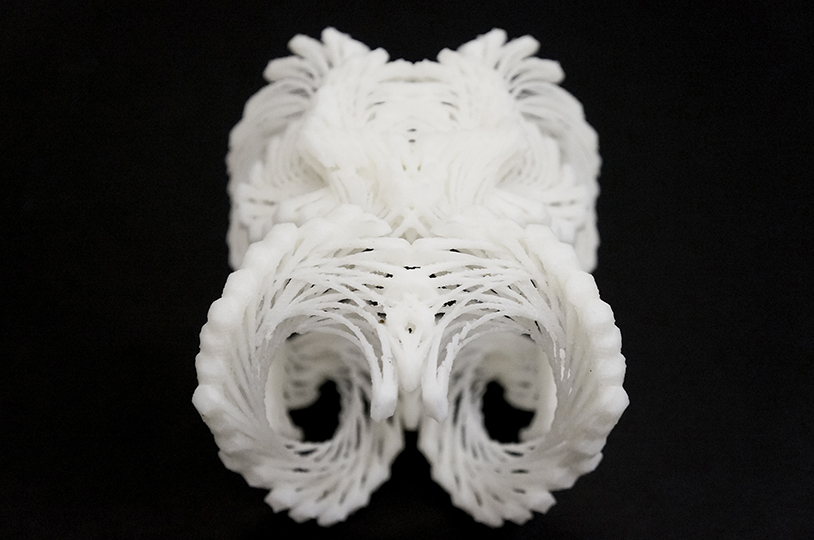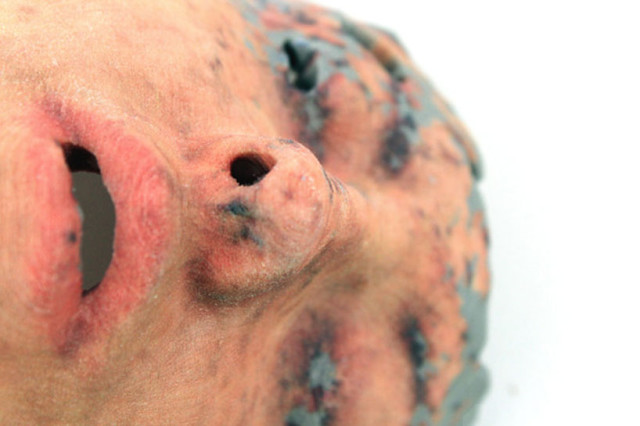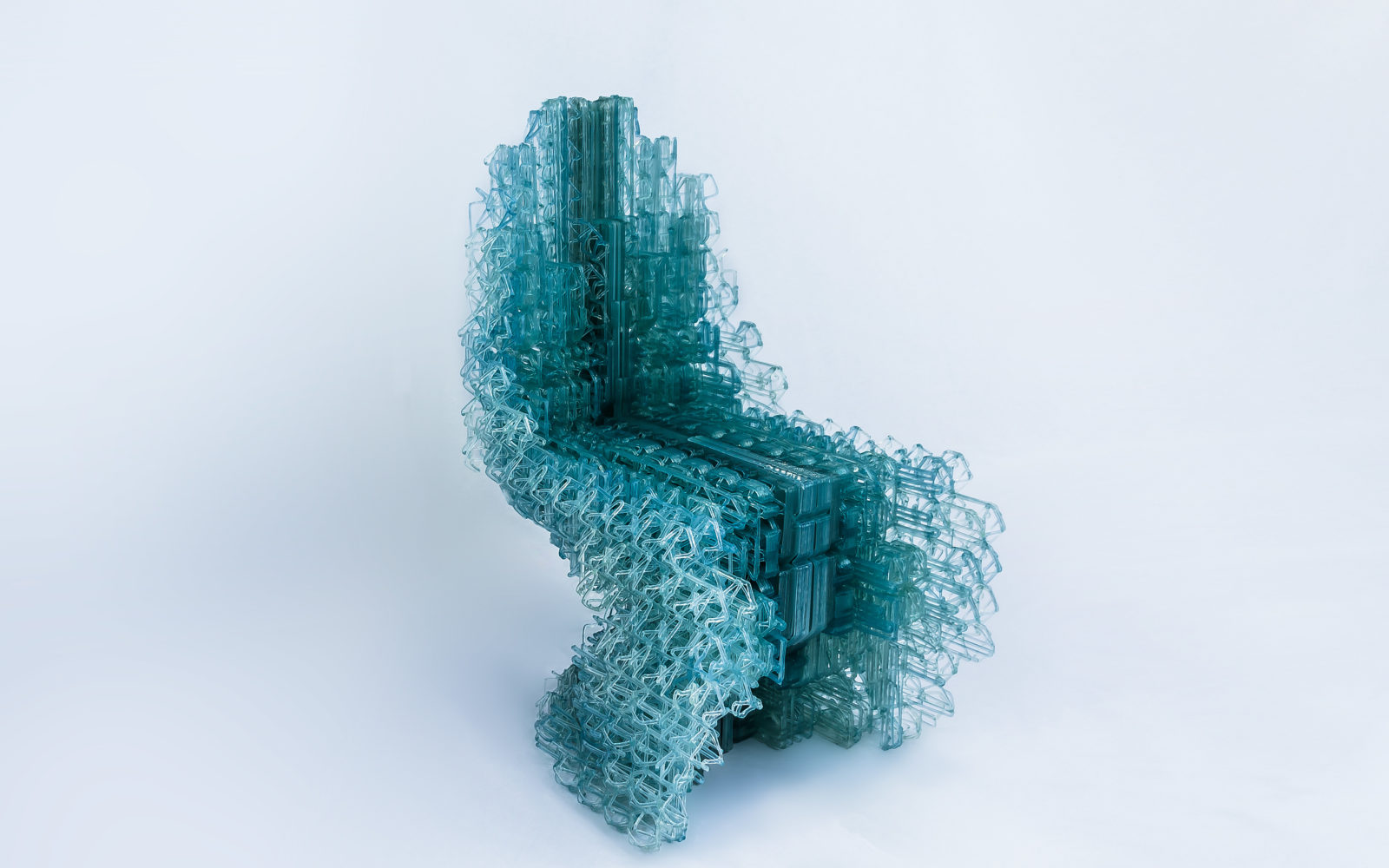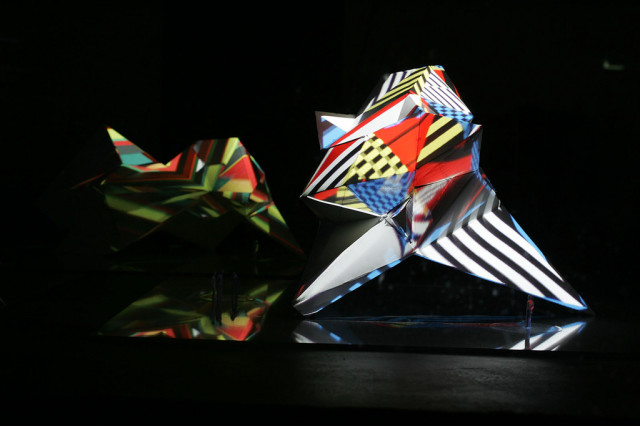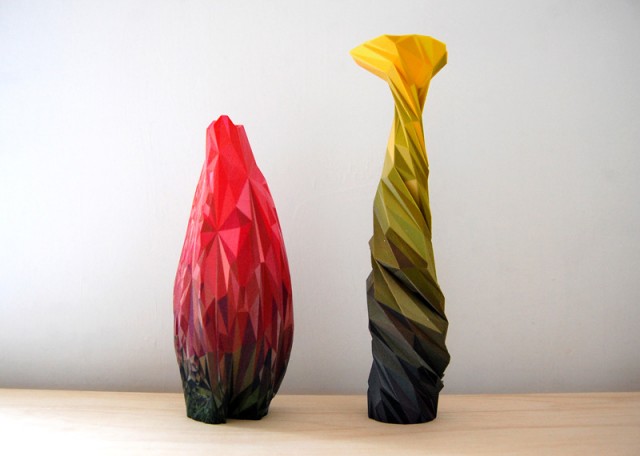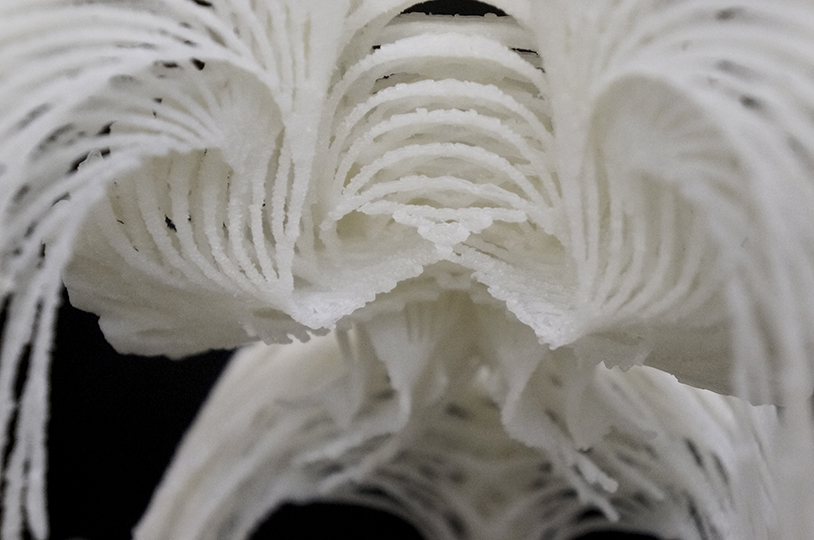
Created by Madeline Gannon, a doctoral student studying generative fabrication and computational design in the CMU School of Architecture, Reverberating Across the Divide project aims to reconnect digital and physical contexts through a custom chronomorphologic modeling environment.
The process includes a three phase workflow (3D scanning, 3D modeling, and 3D printing) to enable a designer to craft intricate digital geometries around pre-existing physical contexts. Using Processing and Toxiclibs, Madeline designed a virtual agent, resembling a squid like form, which through interaction with Kinect is pulled through space and time leaving traces to create intricate geometries. These complex geometries can be then exported and finally 3d printed.
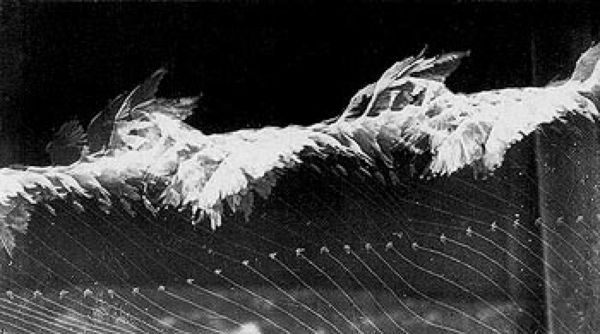
Chronomorphology –– like its nineteenth-century counterpart chronophotography –– is a composite recording of an object’s movement. Instead of a photograph, however, the recording medium here is a full three-dimensional model of the object — a virtual creature simulated within a digital environment. This virtual creature exists as a 3D printable module; it is constructed as a closed mesh, with a spring skeleton that prevents self-intersections. The composite, chronomorphologic model (of the virtual creature over time) retains these printable properties at each time-step. Therefore, no matter how intricate or complex, the digital geometry will always be exported as a valid, 3D printable mesh.
Although processes like these have difficulty escaping the “shape making” classification in the architectural discourse, nonetheless it’s interesting to observe how tools are changing the design production, questioning the effects of generative design workflow, shifting between virtual and analog.
Project Page | CMU School of Architecture’s MADLAB
More Architecture projects on CAN