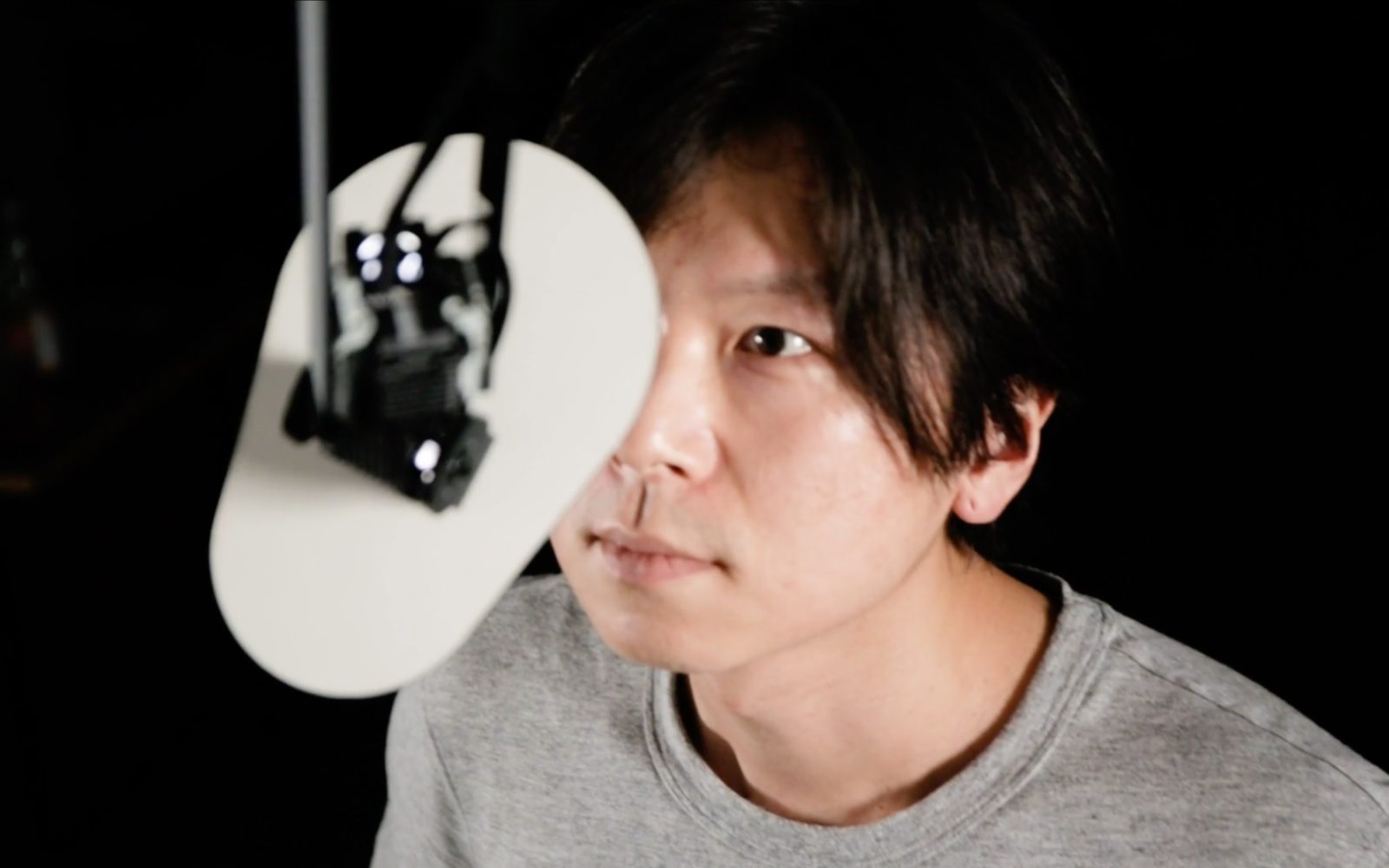
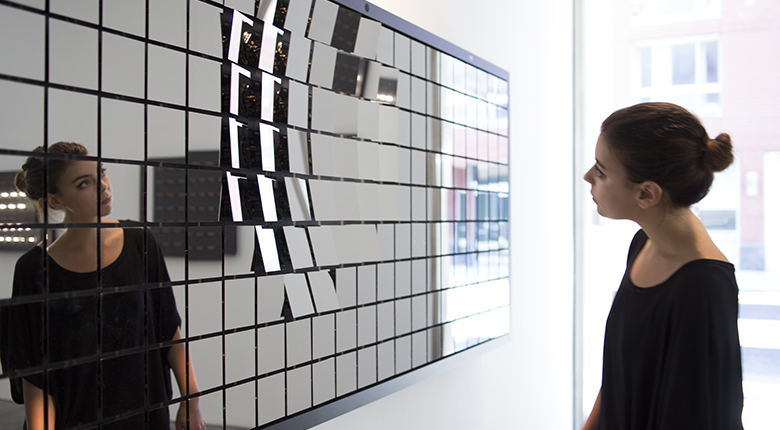
Submirror is a body of work by Atelier Lozano-Hemmer that explores the tension between self-perception, loss of control, and digital puppetry. These mirrors are recalcitrant, they do not reflect faithfully; they act with intention, manipulating the viewer’s image to reveal a version of the self that is no longer entirely their own.
In Recurrent Waiting, the mirror replicates the viewer’s image, but the reflection blinks erratically, accompanied by faint signalling sounds. This blinking follows a timed sequence that transmits Lucky’s monologue from Samuel Beckett’s Waiting for Godot in Morse code. The result is a fragmented, involuntary form of communication—technically generated by the viewer’s presence, yet entirely outside their conscious intent. The experience is uncanny: your reflection blinks compulsively, as if trying to convey something urgent from behind the glass.
Drawing on Beckett’s themes of absurdity and existential dislocation, the work transforms the mirror into a stage where the viewer becomes both puppet and performer, animated by a script they neither authored nor control. As with other pieces in the Submirror series, “Recurrent Waiting” questions the stability of self-image under automated observation. It asks what happens when technology doesn’t just observe us—but represents us, poorly, poetically, and without consent.


This piece will be shown at Untitled Art Houston at Bitforms gallery, Booth B47.
In Recurrent Kafka, the mirror replicates the viewer’s image, but the reflected image—the virtual subject—gazes relentlessly at a teleprompter text that scrolls across the mirror and displays the collected works of Franz Kafka. The piece uses AI to create a live “rigged” clone of the viewer, controlling the direction of the eyes, the pose of the head, and the speed of movement. The viewer is disoriented —at once, reading Kafka’s writings while also watching their own face fixed on the ceaseless flow of words.
This real-time distortion is resonant with Kafka’s body of work, which is often marked by a protagonist embarking upon a deeply serious, potentially senseless, ambiguous task that is both forced upon them and impossible to complete. As with other pieces in the Submirror series, “Recurrent Kafka” questions the stability of self-image under automated observation. It asks what happens when technology doesn’t just observe us—but represents us, poorly, poetically, and without consent.


Programmed by David Robert using TouchDesigner to composite the final output, the generative engine is a Python application that detects faces, applies expression ‘weights’, and decodes it back into an RGB image. The hardware is a garden variety Apple Studio Display using the camera built into the frame. The trick to make the submirrors effective is that the program corrects the pose of the virtual head and the location of the eyes in realtime. This way it seems like the camera is perfectly centered and 2/3 up on the mirror. The virtual view sustains a reasonable eye contact with the participant at all times, even if they are close to or far away from the camera. The computer uses an RTX 5070Ti as NVIDIA’s TensorRT inference optimization.