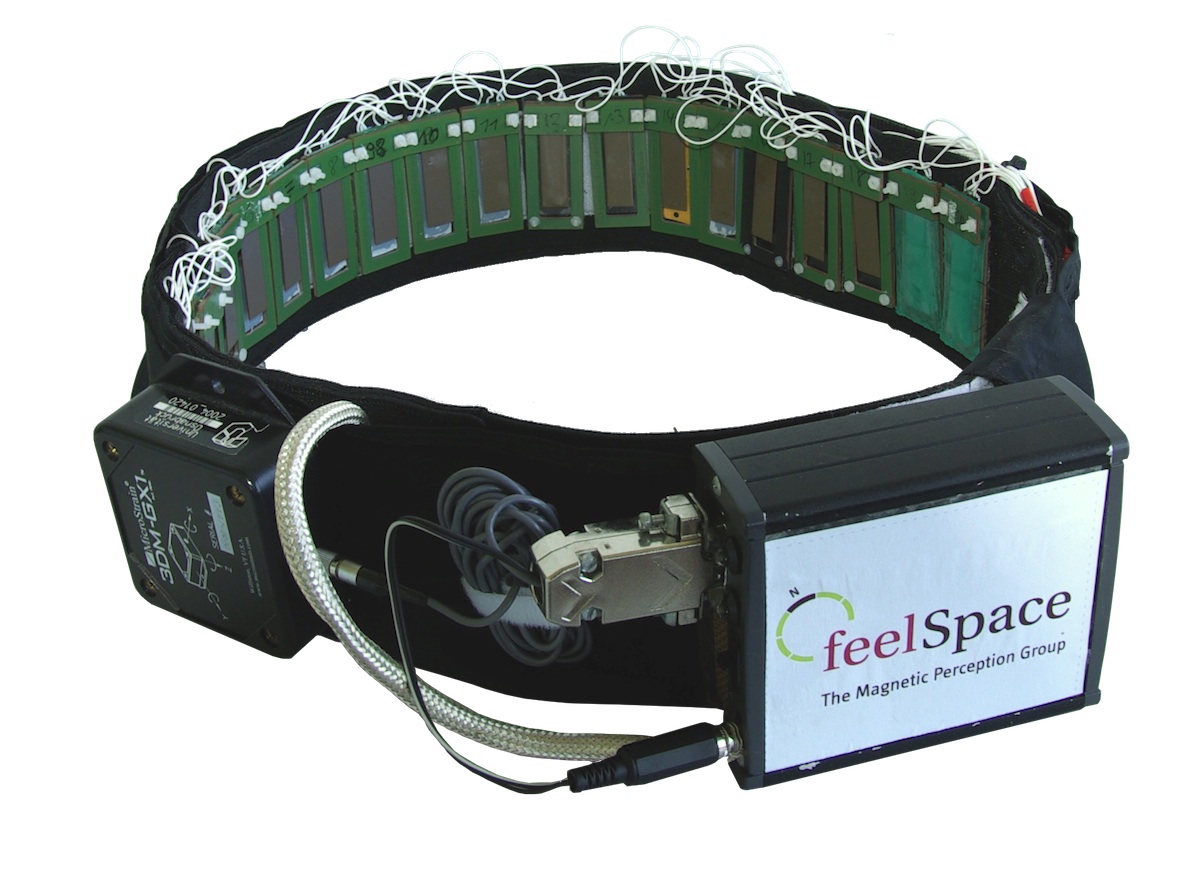
feelSpace is a research project undertaken by students at the University of Osnabrück’s Institute of Cognitive Science, supervised by Prof.Dr. Peter König. The project is based on the fascinating notion that the human brain is flexible enough to ‘learn’ a new sense.
The work conducted by the team at Osnabrück relies on the familiarity gained by long-term exposure to an artificial stimulus. To become assimilated into perceptual experience, the sensations provided by this stimulus need to relate in some way to the way we engage with our environment. For their experiments, they therefore chose to focus on navigation and in particular the orientation of the body with respect to the Earth’s magnetic field.

As recently featured in the BBCs Horizon documentary ‘Is Seeing Believing’ (see below), the “feelSpace” scientists created a belt that contained an array of vibration devices similar to those used in mobile phones. A built-in electronic compass identifies north and triggers the vibrator which is facing in the appropriate direction. In this way the person wearing the belt is provided with a constant tactile sense of the direction in which they are facing.
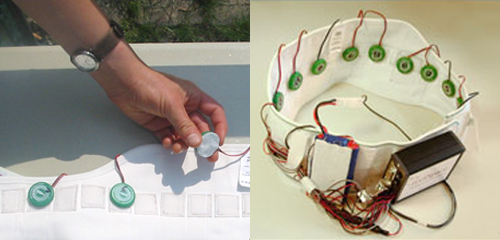
Udo Wächter, who wore the belt for six weeks, reported a shift in his perception and found that he began to intuitively navigate by this artificial sense. The implication is that given an appropriate device we might develop the ability to sense all kinds of environmental data currently outside our experience. We might, as Sunny Bains describes it, ”feel electromagnetic fields or hear ultrasound.”
See also…
Dr Saski Nagel, ‘Beyond sensory substitution—learning the sixth sense’, Journal of Neural Engineering, Vol.2, No.4
Sunny Bains, ‘Mixed Feelings’, Wired Magazine, March 2007