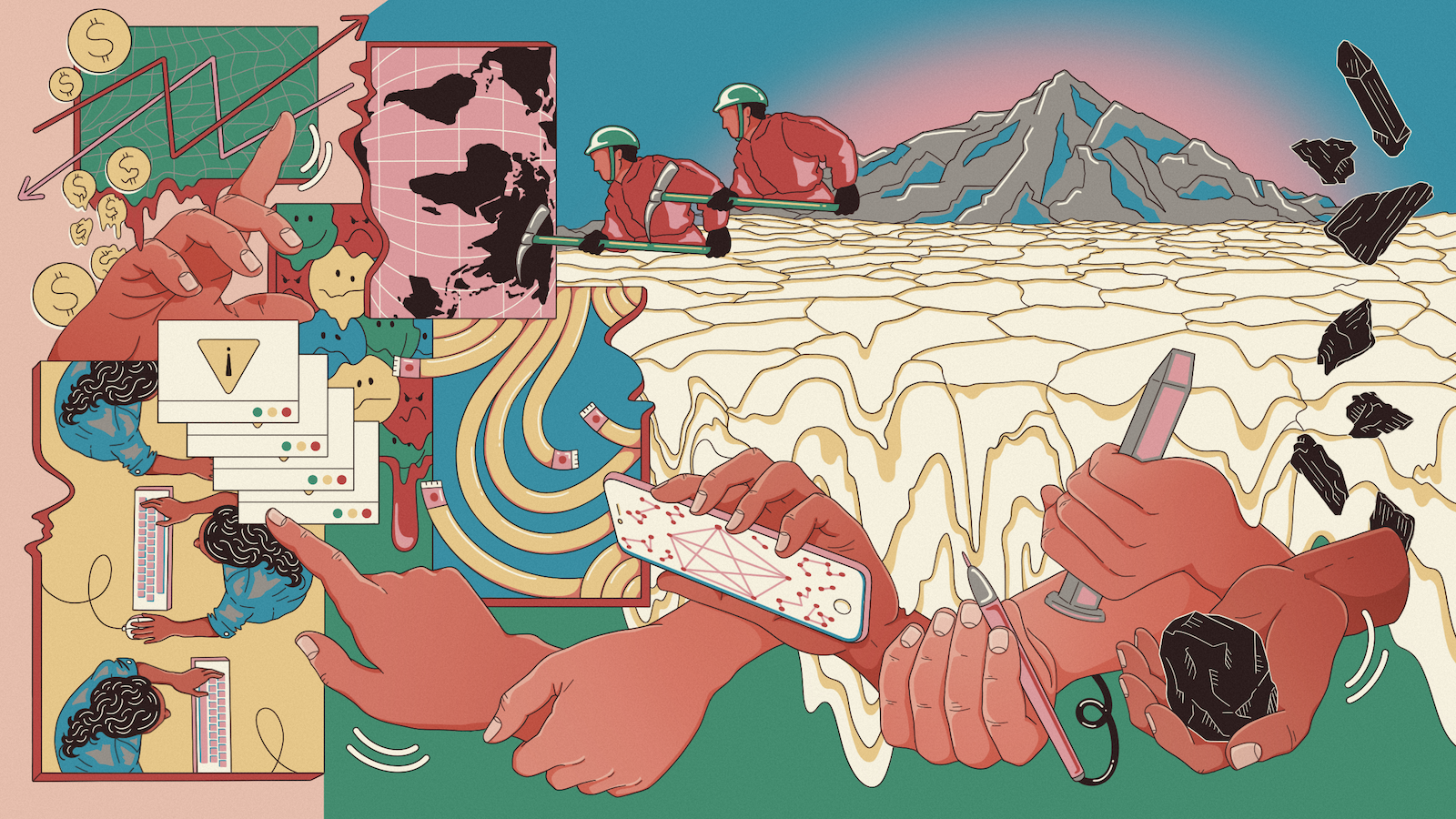
What I am trying to achieve is a means for transformation of one media that is manipulative of one’s attention in order to instil dogma, to another that is manipulative of one’s attention in order to encourage introspection.
Mark Webster – Hypertype
This brief article is an edited version of a text written in 2022 and which is intended to give some context to the artistic project Hypertype – a generative art project that was exhibited in London, November 2022 with Verse Works. The article accompanies the pre-release of a future book, Hyper & Cosmic to be released in June with Vetro Editions. The book documents as well as presents two of my recent artistic works that revolve around language and will include essays by Adrian Shaughnessy, Rémi Forte, Simon Renaud and myself.
In a nutshell, Hypertype uses text emotion and sentiment analysis data as its main content. This content is given form through the organisation of words, typographic signs, letters and symbols. It is first and foremost a textual artwork that attempts to draw our attention to a particular use of AI and the concept of computers automating humans. The project emerged from a fundamental question: How can machines analyse and classify emotional content in text? That was the beginning of what became a long and sustained interest in a particular field of artificial intelligence, what is called natural language understanding. I am not a computational linguist and I have no deep understanding of the algorithms used in this area. However, language is a strong undercurrent to a lot of my thinking. Indeed, language, in its most widely considered sense, has shaped my thinking in many ways, so when I started to tinker with computational language, I became particularly fascinated with this idea of machines producing content on which we humans project concepts and eventually meaning.


While current machine learning models like recursive neural tensor networks (RNTN) and LSTM can extract semantic relationships from text and there are a plethora of academic papers that delve into the technicalities of how these systems work, I actually became intrigued by the more biological nature of emotion itself and perhaps a more pertinent question: What is emotion? A human emotion that is.
Drawing inspiration from researchers such as Dr. Lisa Feldman Barrett, Antonio Damasio and Robert Sapolsky, I came across a number of arguments and explanations that challenged the more traditional views on emotions. Barrett argues that “Emotions are not reactions to the world. They are constructions of the world.” Emotions are learned, culturally specific constructs that we create through experience, association, and memory. What Sapolsky and Damasio added to this understanding of emotion was that emotions were not just tied to the brain, rather that the body had an essential role in how we experience and construct our emotions. Damasio has written extensively on the subject matter and digs deep into the various mechanisms of feelings, emotions, thoughts and indeed their role in culture. What I learned from these various insights, was that the computational inference of emotion, by which a machine is claimed to be able to detect and measure human emotion, began to look more and more suspect. Indeed, from my point of view, the so-called science driving the belief of such a capacity clearly did not add up.

The artistic approach for Hypertype was deliberately unconventional. Two key constraints guided its creation: first, the visual representation would be entirely textual, using words and typographic elements from research materials. Second, the composition would be driven by data but not strictly as a means to visualise it. The program generates visual compositions by positioning words, typographic signs, and symbols within a defined space, creating compositions that are both intentional and unpredictable. The result is a work that suggests rather than explicitly communicates, inviting viewer interpretation.


There are two main things I really like about the work. Firstly, on a purely formal level there is a visual interaction between the typographic elements. When some letters align perfectly on the grid, the overlap of the words and signs produce the effect of another language. This brings me back to text as a material. There are also moments when the signs accentuate the serif character of the letters, break the geometry or cover completely certain letters. Patterns form which give both rhythm and direction to the overall composition of the work. It brings me back to this idea of something textual and also this idea of patterns as meaning.
The other aspect that I like is that there is a communicative dimension. The text tells us something and yet the text is not a coherent arrangement of sentences, rather they are single words, names, concepts and occasionally phrases. The work orientates us towards a topic at hand – AI – yet there is room for interpretation, possibilities to engage with the work and read into the text to create one’s own narrative. The intention is clear here. Hypertype is purposefully open. There is visual content based on a language system and there is visual context based on a subject matter – computers automating humans.
Hyper & Cosmic is currently available for pre-order via Vetro Editions. The book will be released in June 2025. CAN Members can save 10% –– see our Discord for details.
Project Page | Vetro Editions | Mark Webster