FILE FESTIVAL returns for a another year, this time curated by Clarissa Vidotto, Paula Perisinotto and Ricardo Barreto exploring topics of synthetic technologies, algorithms and immersive realities as new aesthetic experiences.
Unlike Hegel, who called the set of ideas of a given era the “spirit of the times” (Zeitgeist), we could call our era “Zeitsynthetik” (the time of the synthetic). In the classical period, art was inseparable from religion, whose essence was spirituality; in modernity, spirituality was replaced by the ideologies of grand narratives (capitalism and socialism). The classical arts invented poetics and aesthetics: the beautiful and the sublime. Modern art invented the avant-garde, which proposed itself as revolutionary; its driving force was the dialectic of the new without the old, while postmodernists, on the other hand, mixed everything with everything, including the old with the new. Today we live in the age of synthetic technologies, the age of disruptive technologies. In which the new of modernity is no longer sufficient or surprising. Syntheticity is the new vector: synthetic algorithms; synthetic virtual realities; synthetic intelligences. The driving force behind synthetic art is now: 1) the fusion of new artistic expression and technological innovation, and 2) the inter-creativity between the artist and artificial creativity. Prompt engineers strategically simulate personas for AIs to move beyond triviality and thus achieve more creative results. Synthetic intelligences are no longer just instruments, but partners with artists in building a creative and innovative symbiosis.
Ricardo Barreto, Curator and co-founder of FILE, International Electronic Language Festival
Art and culture go through a moment in which creativity ceases to be only human, it becomes artificial; syntheticity thus prospects a post-culture, a new FORM: the form SYNTHETIKA.
SYNTHETIKA: Creative symbiosis
As Ricardo Barreto proposed, if Hegel defined the “spirit of the times” as Zeitgeist, today we live under the sign of Zeitsynthetik—the time of the synthetic. Our era is no longer governed solely by ideologies or spiritualities, but by disruptive technologies that dissolve boundaries between the human and the artificial, the organic and the digital. Art, far from being mere representation or critique, has become a field of creative symbiosis, in which algorithms, artificial intelligence, and biological bodies coexist and co-evolve.
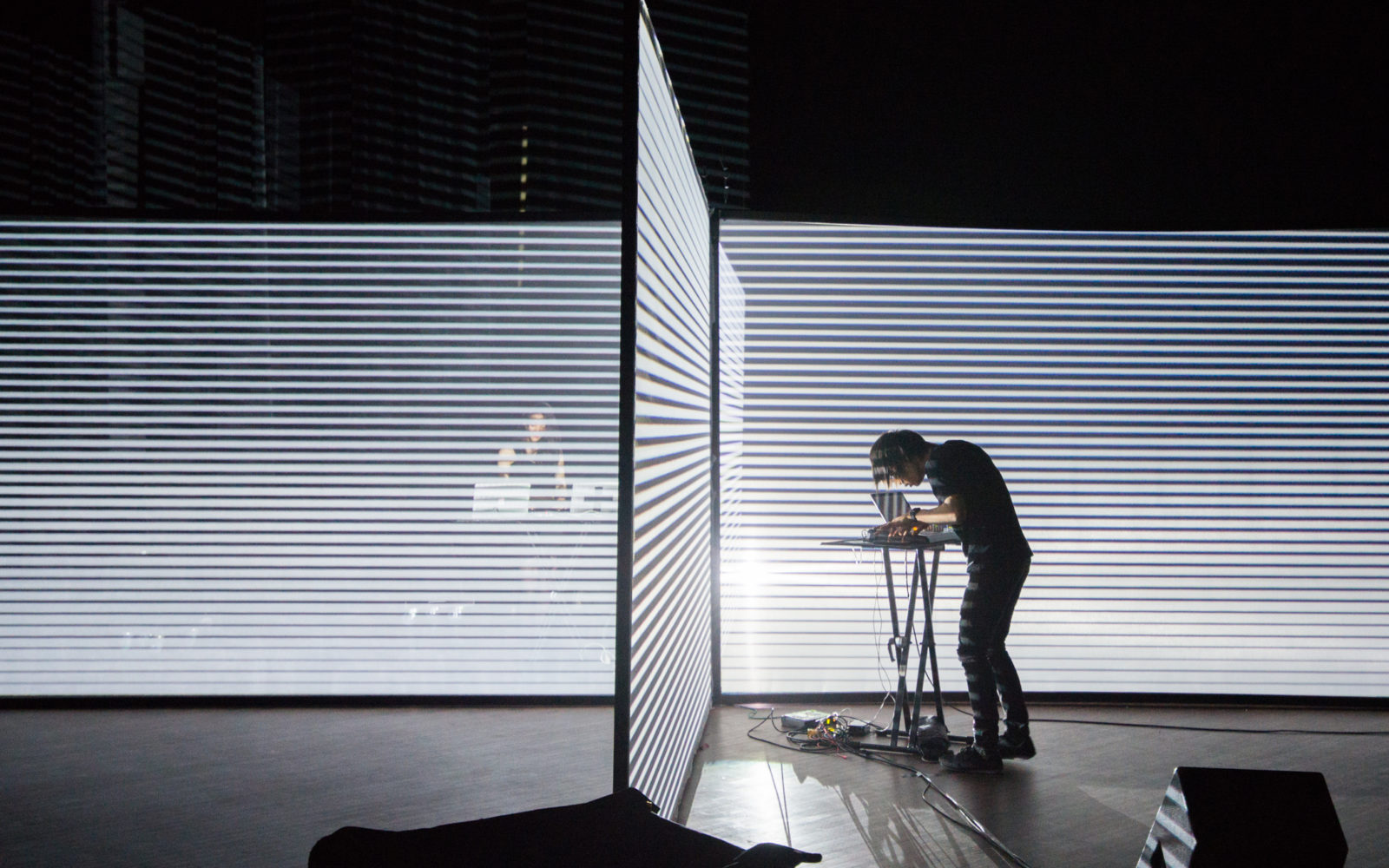
The FILE 2025 exhibition celebrates SYNTHETIKA, an emerging aesthetic that transcends the dichotomies of modernity and postmodern pastiche. Here, creativity is no longer exclusively human: it is a dance between artists and generative systems, between ancestral gestures and neural networks. The selected works reveal the intercreativity developed alongside technological evolution. Within the visual and sound ambience created by AIs in Transformirror (by Daito Manabe and Kyle McDonald), the synthesized past is reinterpreted through the experimentation of a new physicality in which all visual elements are transmutable and generated with each gesture.
AI is not just a tool, but a partner, challenging notions of authorship, originality, and sensitivity. The music videos “The Noise of Art,” “Freeda Beast,” and “Liberation,” developed through generative adversarial networks (by Mario Klingemann), evoke the cutting-edge appropriation of deep learning and its introduction into the artist’s creation. ” I am I ” (by Gioula Papadopoulou and Olga Papadopoulou) presents digital avatars that question existential sentience, and “Aquarela de Íons ” (by Arthur Boeira and Gustavo Milward) translates solar data into sensory landscapes.
In the FILE 2025 SYNTHETIKA exhibition , the sublime is no longer found in nature or machines, but in the in-between space where they merge. Fractalicius (by Julius Horsthuis) transforms mathematical equations into cinematic universes; Deep Paula (by Erika Kassnel-Henneberg) resurrects memories through algorithms, exposing the fragility of perception; the uncomfortable surveillance of new digital bodies in //:Are you observing or being observed? (by Vitória Cribb) warns us about our digital presence and the new limits of materiality; Newton’s Cradle (by Jeff Synthesized) recodes time as a commodity in a dystopian future. Even the fungi of Mycelium (by the collective Ultravioletto) and the posthuman creatures of Meka Talks (by Koral Alvarenga) propose non-human intelligences as models for social and ecological reorganization.
In the face of new ecological paradigms, Spiral of Time (by Edwin van der Heide), Visual Bird Sounds (by Andy Thomas), and OUVIR (by Craca) use documentary records of natural life to simultaneously bring it closer to our sensory perception and deconstruct it to propose new spaces for creative navigation within familiar ecosystems. On the other hand, the critical and prospective perspective of The Hunter and Dog (by Frederik De Wilde) challenges this post-natural and biotechnologically engineered world in which DNA editing (CRISPR) can control biological and technological evolution.
This is a manifesto for a post-anthropocentric art, where syntheticity—the radical hybridization of bodies, data, and environments—redefines the very act of creation. The guessing game between the artist and AI in Scott Allen’s Unreal Pareidolia demonstrates that programming can be a guide that enables an “expanded imagination” for the exploration of creative gaps. If modernity worshipped the new and postmodernity mocked the canon, SYNTHETIKA dissolves both in a continuous flow of algorithmic recombinations. The artist is now an engineer of prompts, a choreographer of systems, a shaman of networks.
Within the fictional boundaries exposed in Boundaries (by Memo Akten and Katie Peyton Hofstadter), we see humanity recognizing itself through the collectivity achieved through data visualization, experiencing a journey of self-perception and macro- and micro-logical interconnection. ReCollection (by Weidi Zhang and Rodger Luo) demonstrates that AI connects languages to reveal that we share the experience of what is human and are moved by similar, collective memories.
The selection of works in this exhibition—from the fractal worlds of Julius Horsthuis to the algorithmic dystopias of Jeff Synthesized—echoes the principle of Zeitsynthetik : an era where technology doesn’t serve art, but merges with it, generating landscapes of unknown beauty. Here, each piece is a node in a larger network, an experiment in how to create when intelligence is collective, distributed, and, above all, artificially wild.
Welcome to the era where art does not imitate life, but synthesizes it.
Paula Perissinotto, Co-Curator and Co-Founder, FILE – International Electronic Language Festival
Clarissa Vidotto, Co-curator of FILE – International Electronic Language Festival
July 16 – September 7, 2025
Terça a Domingo, 10h – 20h
FIESP Cultural Center, São Paulo, Brazil
→ FILE FESTIVAL 2025 – Synthetika
Participants include Daito Manabe & Kyle McDonald, Memo Akten & Katie Peyton Hofstadter, Frederik De Wilde, Arthur Boeira & Gustavo Milward, Craca, Weidi Zhang & Rodger Luo, Scott Allen, Jia-Rey Chang and Andy Thomas. For complete program including exhibition, performances, workshops and screenings, please see → file.org.br/highlight/synthetika-festival