Developed at the Institute for Advanced Architecture of Catalonia, Minibuilders is a research project comprised of a family of small-scale construction robots capable of constructing objects far larger than the robot itself. Each of the robots is designed to perform a diverse task, linked to the different phases of construction, finally working together as a family towards the implementation of a single structural outcome.
Robotics offers great potential towards innovation within the construction industry. However, in their current implementation applied to the architectural field, in particular construction robotics, these systems all share a specific limitation: the objects they produce are linked to and constrained proportionally to the size of the machine. This methodology of production and construction is not scalable. In this sense, to create a house, using current construction robotics, the machine needed must have a work envelope as large as the house itself. Hence, the project here below elaborated aims to address this particular limitation through the creation of a technology that is both scalable and capable of fabricating structures using tools that are independent of the final product’s shape or size.
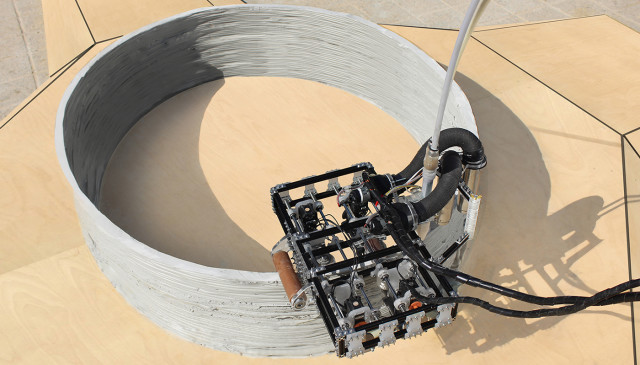
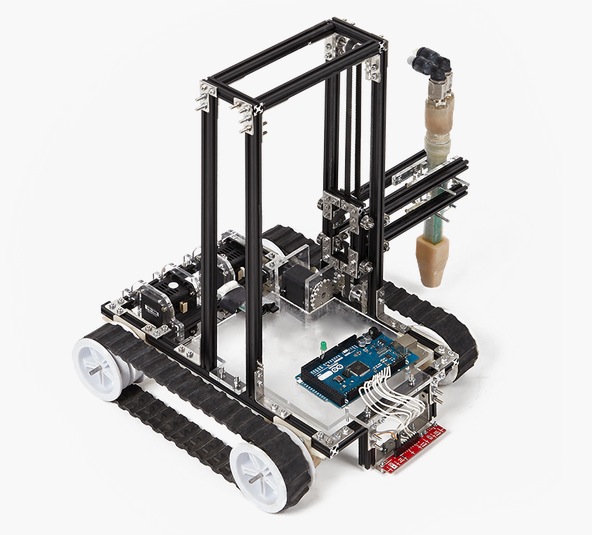
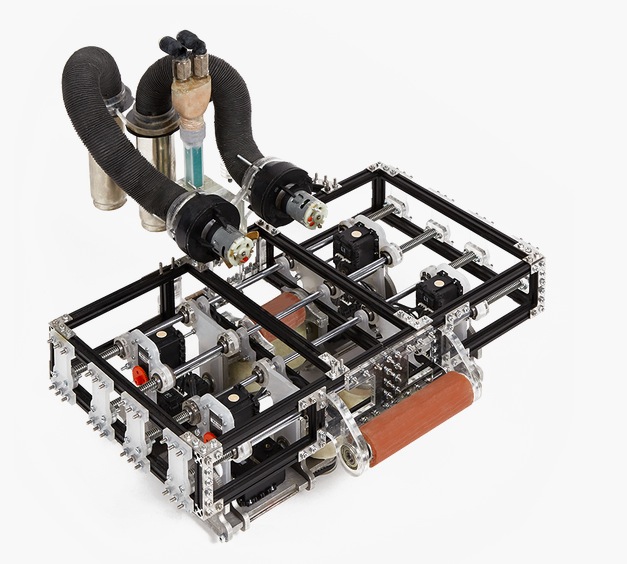
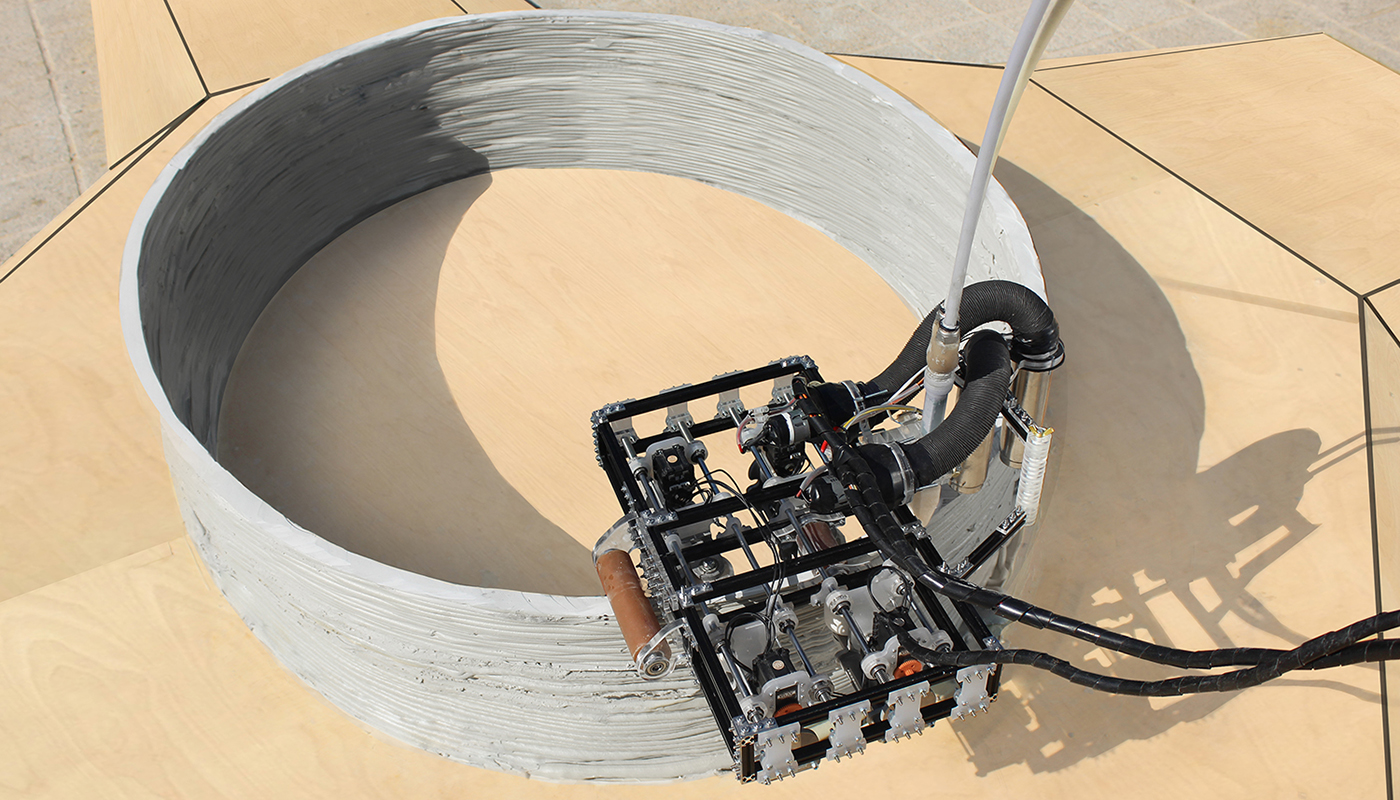
 The first robot, the Base Robot, lays down the first ten layers of material to create a foundation footprint. Sensors mounted inside the robot control direction, following a predefined path. Traveling in a circular path allows for a vertical actuator incrementally adjust the nozzle height for a smooth, continuous, spiraling layer. To create the main shell of the final structure the second robot, the Grip Robot, attaches to the foundation footprint. Its four rollers clamp on to the upper edge of the structure allowing it to move along the previously printed material, depositing more layers. Controlled by custom software the robot follows a predefined path, but can also adjust its path to correct errors within the printing process. Rotational actuators control height above the previous layer to maintain a consistent layer.
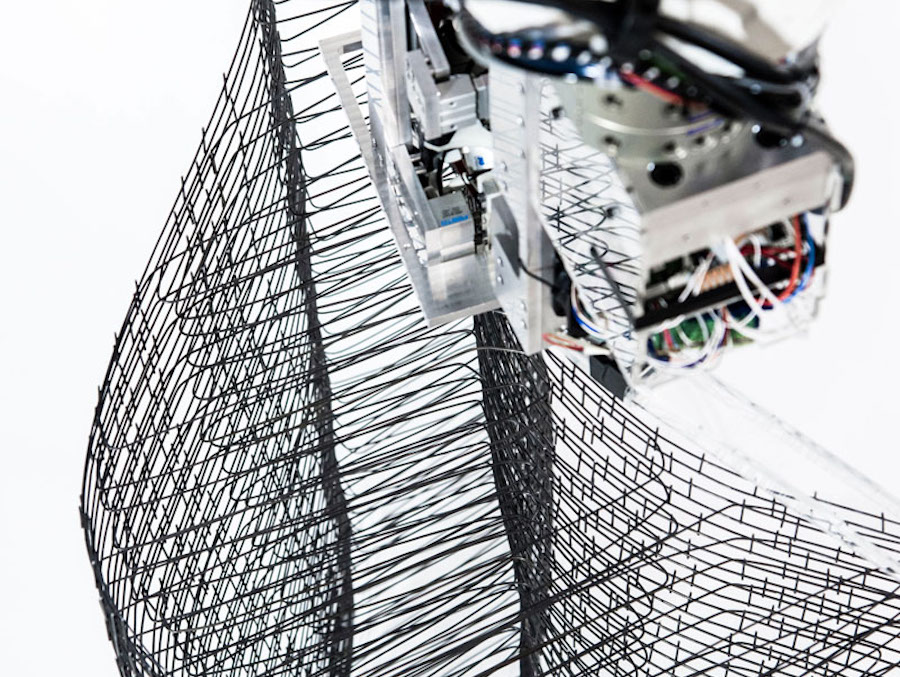
Another major limitation of today’s additive manufacturing techniques is linked to the unidirectionality of layer orientation, creating an inherent weakness. Additive manufacturing allows for heterogeneous optimized distribution of matter. To take advantage of this, and not succumb to this limitation, we used structural optimization tools to create a second layer of material over the shell. The material is also closely aligned with the direction of stress, finally optimizing both orientation and thickness of the shell structure.
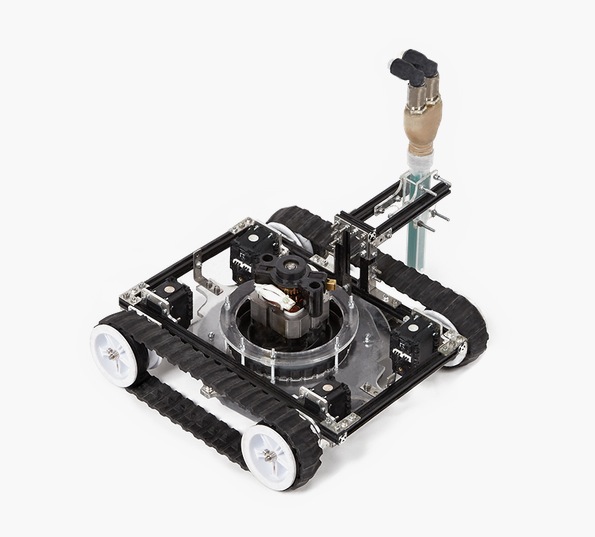
The data derived from the structural analysis is then translated into paths for the third and final robot, the Vacuum Robot. Using a vacuum generator this robot attaches to the surface of the previously printed structure. Moving freely over the first shell on its tracks, depositing material on the surface of the shell, enhancing its structural properties. This task can be performed by one robot, or a swarm of robots working in co-ordination.
The project has taken seven months of research by IAAC, Institute for Advanced Architecture of Catalonia, in the framework of the Open Thesis Fabrication postgraduate program in 2013, specifically by the researchers Shihui Jin, Stuart Maggs, Dori Sadan and Cristina Nan, and led by IAAC faculty Saša Jokić and Petr Novikov. The team have implemented a 1:1 scale prototype, printed by the three robots, and displayed at the Design Museum of Barcelona – DHUB.
Project credits:
Minibuilders is a project of IAAC, Institute for Advanced Architecture of Catalonia, http://www.iaac.net
developed durning Open Thesis Fabrication in 2013 by:
Researchers: Shihui Jin, Stuart Maggs, Dori Sadan and Cristina Nan
Faculty: Saša Jokić and Petr Novikov
Sponsored by: SD Ventures