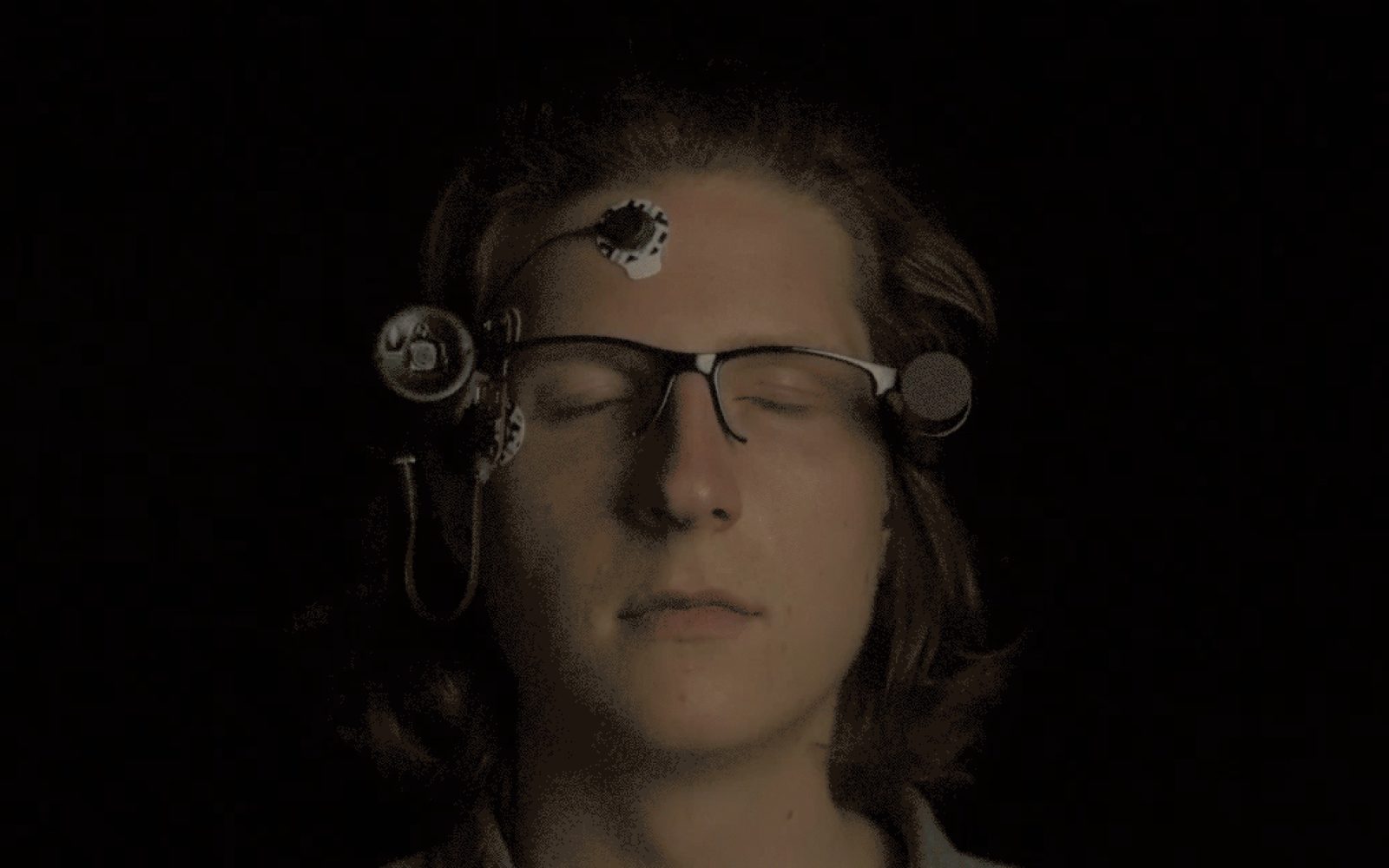
LOW·AI BOX is an AI machine art that includes a transparent machine structure, an AI system, a sensor system, and an IoT system. The installation is placed in the artist’s living space for a long time and continuously collects environmental data such as temperature, humidity, light levels, and eight other aspects. In addition, physiological data such as heartbeat will also be collected through a wearable device of the artist’s design. This data is stored in the LOW·AI BOX and machine learning technology is used to generate AI-powered artist data.


LOW·AI BOX transforms the artist into a collector and provider of data. The project using “open source hardware” and different types of sensors to capture data from all aspects of life. This data is processed by algorithms to create a distinct type of “physical” data. The project creates a ” computational matrix” that can recognize and feedback. This “computational matrix” takes the form of a cube containing various sensors. It uses supervised machine learning to predict the data and transmits the ” Mixing data for AI flesh ” to different artworks through the wireless connection. In the context of machine learning, the “AI flesh ” creates a kind of intelligent meaning for the artist’s body and the natural environment, enabling data to evolve and assume new forms. At the same time, LOW·AI BOX as a matrix that continuously collects and generates new AI data. This data will be the driving force behind the operation of future LOW·AI BOX models.
Organic Element I is a data petri dish, which is a derived data installation of the LOW·AI BOX. A transparent screen system, a non-conductive liquid and a wireless connection system together form the project. The screens and electronic components are immersed in the transparent liquid. The transparent screens display AI-generated images in real time and present real and AI-powered heartbeat data. This data is continuously developed by the ” computational matrix”, which continues to flow through the liquid and drives the movement of the rings on the screen. The speed of the movement of the two rings on the screen converges, symbolizing the convergence between a learning machine and a human being. Through the sensors, the artist achieves self-quantification, overcomes the limits of physical perception and raises the threshold of “perception” This is a continuous process of self-evolution. Organic Element I redefined the form of life by extending the physical interface into a multidimensional space via a fusion of transparent screens and electronic components.


Software: The project was developed using the Arduino framework, Vscode software with PlatformIO plug-in, and Arduino program to collect sensor data. Touch Designer was used to link the Arduino data with the machine learning data model, forming screen display contents and visual effects. Wireless transmission helped in transmitting data for LOW·AI BOX.
Hardware: LOW·AI BOX uses a 3+2 approach to system design. the hardware structure consists of three main parts: the power supply system in the bottom layer, the sliced distribution of the sensor system, and the transparent machine structure. The BOX hardware structure avoids unnecessary visual elements and uses the maker approach. It includes various computer hardware,like CPUs, GPUs, and electronic displays. Formation unit of BOX:The acrylic panels are arranged in slices. There are 9 types of sensors on them. On the one hand, functional partitioning of sensor data is possible, and on the other hand the use of acrylic for assembly makes it easy to add the required components in later iterations.
Creation date: 2021
Technical support: Low Tech Art Lab