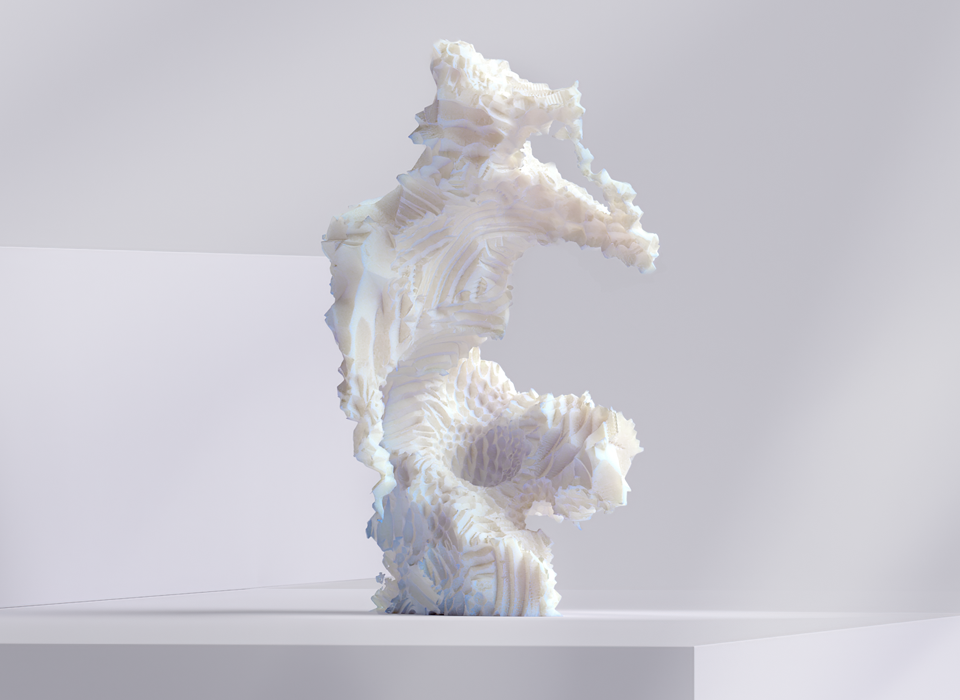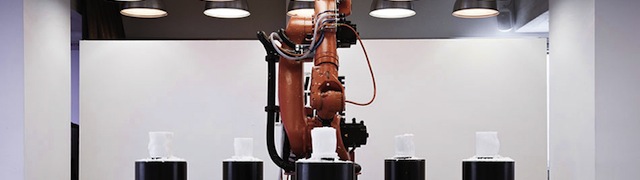

Valse Automatique is a design performance made to illustrate the symbiosis between humans and technology by translating music to form over the use of a kuka industrial robot. Invited to the project by Hermann Weizenegger – Stephan Thiel was responsible for designing the overall interface between the music by composer and violinist miki and the production process of the robot.Hermann’s vision, Stephan writes, consisted of five variations of a musical piece by MIKI represented in five objects. To address this vision, wax was chosen as a base material, since it allowed rapid manufacturing through milling and application of heat as well as a possible further use for casting. Thus, the performance was conceptualized as a two stages production process showing MIKI and a pianist along the robot manufacturing the objects. In a pre-performance process, the wax base shapes were milled to reflect the musical atmosphere, in the second process the robot finalized the objects with the use of a Bunsen burner in reaction to MIKI’s play.


To work on the product design and related manufacturing processes, Stephan teamed up with Steffen Fiedler to create a formal concept that will work in the timeframe they had. The initial design process happened in Java/Processing with the help of Chris Jeffs’s analysis tools made in SuperCollider, but it was soon realised that they would need an entirely different toolset to create data for such a high performance manufacturing process. Thus, the formal concept to match the requirements of the short timeframe for milling was implemented in Rhino/Grasshopper. The concept consisted of a fluent terrain being distorted according to the music. The terrain was chosen to provide the greatest flexibility for how the robot would manufacture it. This translation process is also shown in a minimal dynamic visualization Stephan created in Processing mainly for the audience to understand the process. The large scale renderings for the exhibition were made in sunflow.
Project Page on Stephan’s Site
Team includes: Stephan Thiel, Chris Jeffs, Wolf Deiss & Roman Kühnert of artis GmbH, Steffen Fiedler, Hermann August Weizenegger, Mihalj »MIKI« Kekenj, KUKA Roboter GmbH and MADE