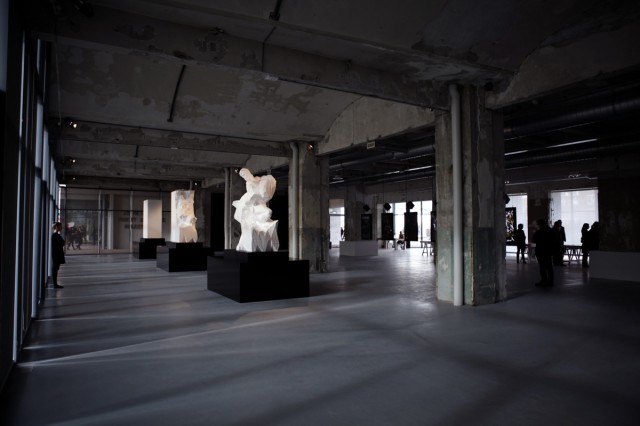
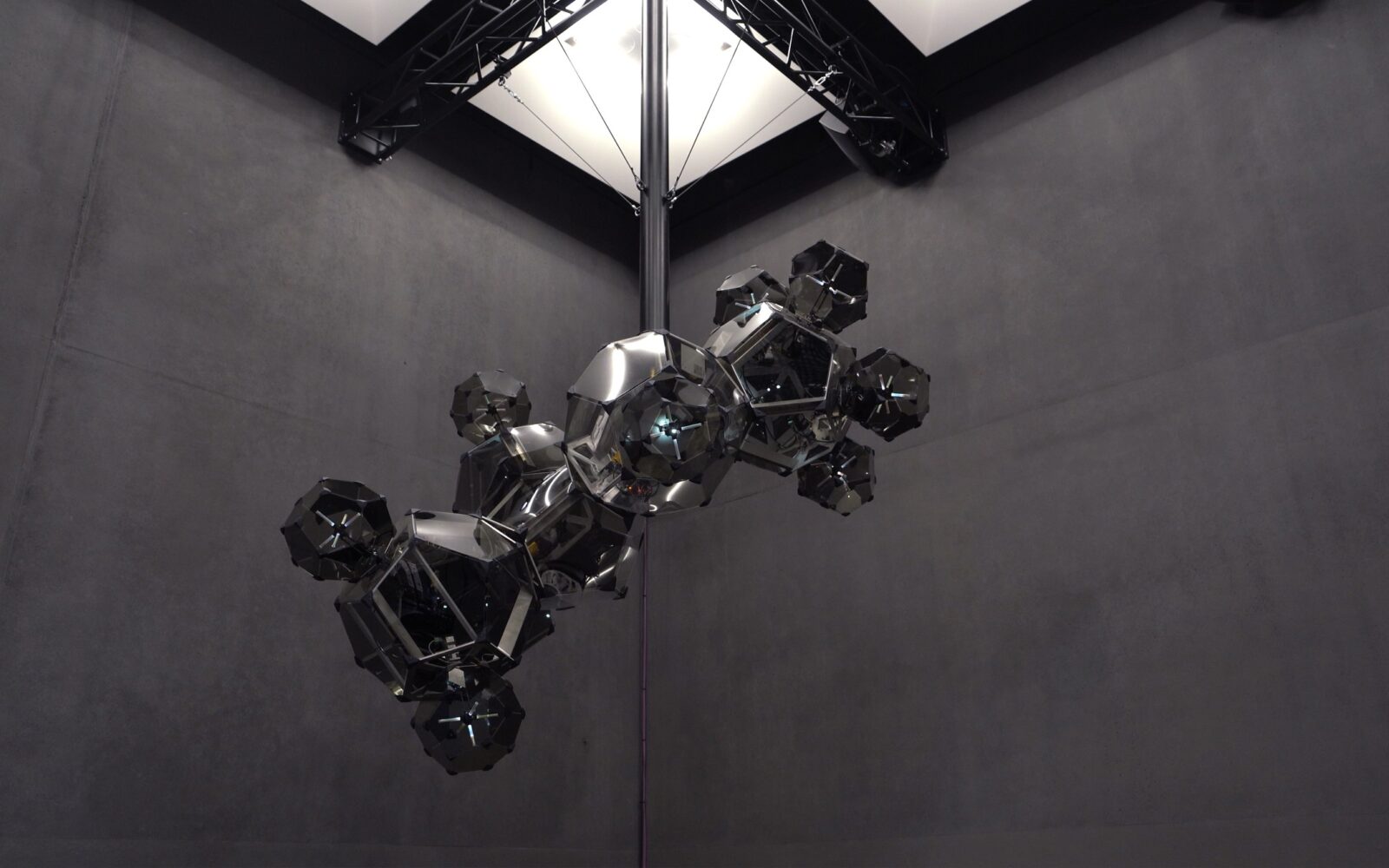
Created as a collaboration between Solid Objectives Idenburg Liu (SO-IL), Mariana Popescu and TheGreenEyl, Necto explores the theme of Intelligens through an immersive and computationally derived membrane structure that speculates on the future of temporary structures—lightweight, flexible and efficient, and embedded with latent intelligence.
Braced against the Arsenale’s columns at this years architecture biennale in Venice (2025), Necto’s anticlastic surface adapts fluidly, suspended from above. The majority of materials are lightweight and portable, transported to the Arsenale as luggage via vehicle, commercial passenger flight, and vaporetto without crates or excess waste (38.5kg total weight). The stone footings were sourced from second-choice slabs and delivered by vehicle from nearby Vicenza. At the exhibition’s end, Necto will dissolve, leaving no trace—its surface flattened and packed.

The geometry is form-found accounting for internal stress distribution, fabrication constraints, and material properties. It is developed through computational structural design and fabricated using CNC knitting machines (40 hours to knit) with natural fibers. The two principle stress directions are materialised as flax fibre inlays in one direction and density variations within the knit architecture in the other. The entire patterning is computationally controlled through fabrication pipelines that generates code for the industrial knitting machines to produce. The textile’s water-soluble bio-based coating contains digital information encoded on synthetic DNA, borrowing from the expertise of 4 billion years of evolution. The data includes a material passport for all components used and machine instructions to produce the textile. Due to the nature of the DNA, this information will stay intact and part of the structure for its entire lifecycle, ensuring future traceability and accountability.
LED strips (x23) thread within the textile and follow selected stress pathways. The generative light and sound animations that span across the surface express the lightness of the structure, speculating on the tensions between craft and algorithm.
Necto is on display at the 19th International Architecture Biennale in Venice, 10 May – 23 November 2025.
Project Page | SO-IL | Mariana Popescu | TheGreenEyl
Design:
SO – IL: Florian Idenburg, Jing Liu, Marlena Fauer, Demetri Lampris
Tailored Materiality Research (TU Delft/incoming MIT): Mariana Popescu, TheGreenEyl: Richard The
Membrane design and engineering:
Tailored Materiality Research (TU Delft/incoming MIT): Valentin Lorenzen da Silva, Niclas Brandt, Nikoletta Christidi, Mariana Popescu
Experience design:
TheGreenEyl: Richard The, Noah Feehan, Ben Bojko, Saralee Sittigaroon, Arden Schager
Structural Engineering:
Professorship of Structural Design (TUM): Anass Kariouh, Pierluigi D’Acunto
Membrane fabrication and construction:
Tailored Materiality Research (TU Delft/incoming MIT):Mariana Popescu, Nikoletta Christidi
Steiger Participation S.A: Jean-Luc Lepieszko, Jean-Francois Cochez
Bio-coating and DNA data embedding and error correction:
Shaping Matter Lab (TU Delft): Kunal Masania, Jasper Groen
Functional Materials Laboratory (ETH): Robert Grass, Francesca Granito
Professorship of Machine Learning (TUM): Reinhard Heckel, Maria Abu Sini
Sound Design – Marian Mentrup
Furniture – Tim Teven Studio
Opening Performance – Riley Watts