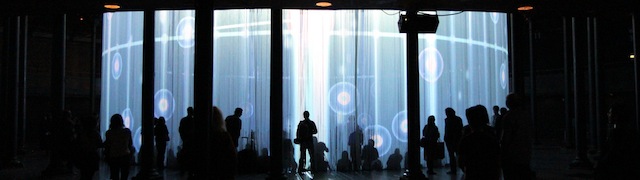

Simple Harmonic Motion is an ongoing research and series of projects by Memo Akten exploring the nature of complex patterns created from the interaction of multilayered rhythms. Shown at Ron Arads Curtain Call at the Roundhouse last friday, this ultra wide video is mapped around the 18m wide, 8m tall cylindrical display made from 5,600 silicon rods, allowing the audience to view from inside and outside. I have been following project’s development for few weeks now and having seen the “final” result at the Roundhouse, I am very sorry to have missed it. Read on for project background..
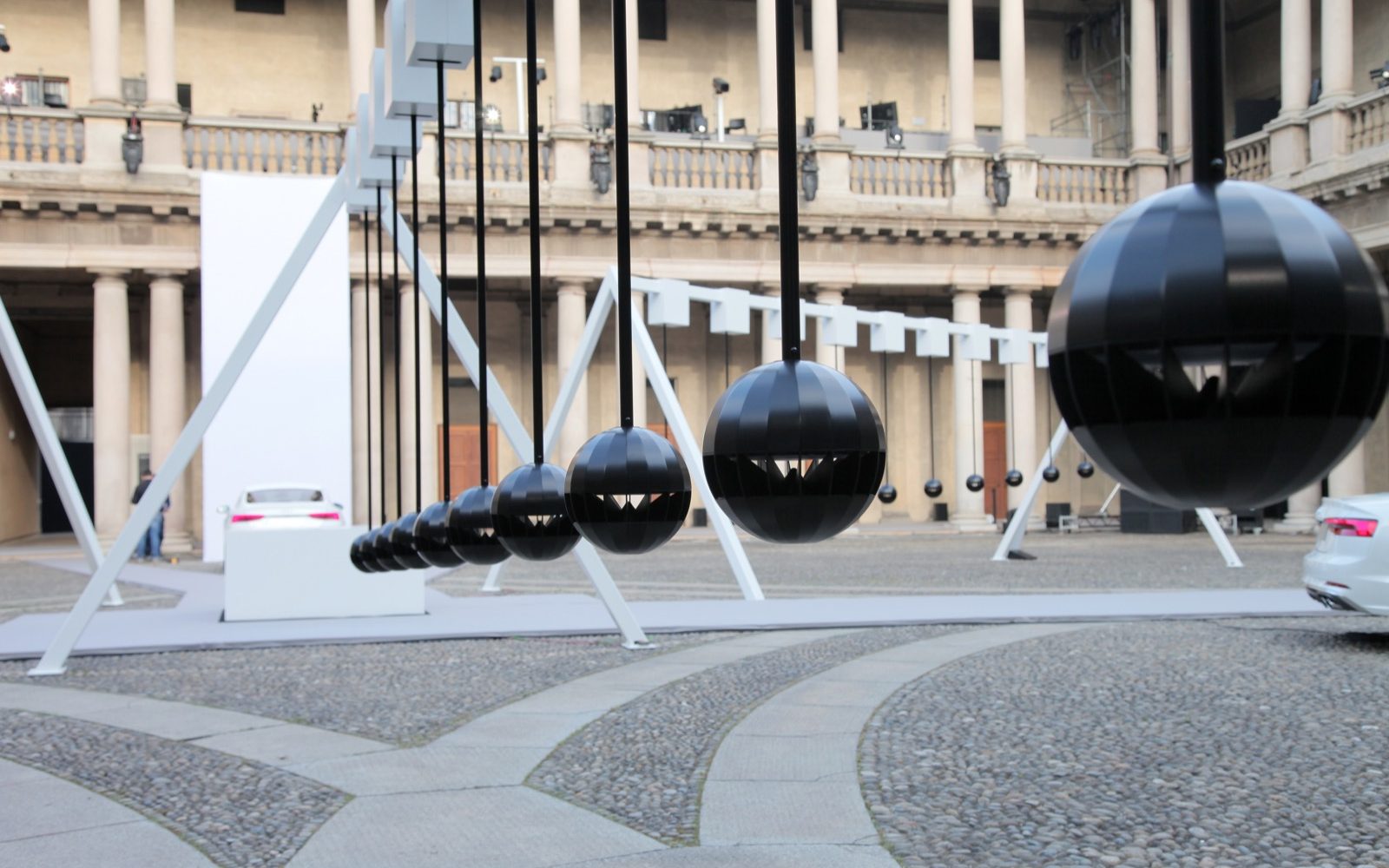
Back in May, Memo came across this video, fifteen pendulums, all with precisely calculated string lengths so they all start at the same time, slowly go out of sync, create beautiful complex rhythmic patterns, and exactly 60 seconds later come back into sync again to repeat the cycle. Memo writes about these techniques of creating complex patterns from the interaction of multilayered rhythms as explored by composers such as Steve Reich, Gyorgi Ligeti, Brian Eno and many others; but as the patterns in the video seemed simple yet complex, Memo wondered what they would sound like.
Memo started with Processing, code that can be found at openprocessing. He also started playing with supercollider, and trying to re-create the demo in supercollider fitting the code under 140 characters so he could tweet it:
{o=0; 15.do{|i| o=o+LFTri.ar(138.59*(1.0595**(3*i)), 0, LFPulse.kr((51+i)/60, 0, 0.05, 0.1))}; o;}.play;
The sounds in the video above are NOT from supercollider. They are triggered from the processing sketch as midi notes sent to Ableton Live. The notes in the processing sketch are selected from a pentatonic scale. I wanted the supercollider code to fit in single tweet ( less than 140 chars), so I omitted the scale and instead pick notes which are spaced at minor 3rd intervals, creating a diminished 7th arpeggio. The base note is C#. Toccata and fugue in d minor anyone?
Later experiments few weeks ago show 30 nodes oscillating with fixed periods in simple harmonic motion, with each node having a slightly different frequency. The total loop cycle duration is exactly 120 seconds (60s for the audio). Specific information about this particular simulation and audio at 0_29_bpm. Visuals were made with openFrameworks, audio with SuperCollider.
Memo continued to experiment, creating 3D compositions in Cinema4D + COFFEE (a C-like scripting language for C4D) and again using audio with SuperCollider which you can see here. Even with the sophisticated rendering capabilities of Cinema4D, memo preferred the look, sound and behaviour of the previous tests (above) created using openFrameworks, settling for those as the basis for the visual look of the “final” piece shown at the Roundhouse.
The final pieces you see below combine beautiful visuals, changing over time, back to the beginning, as a response to the sound patter behaviour and wonderfully occupying the 360 degree projection – watch the movie below full screen at HD.
—
Links: Ron Arads Curtain Call at the Roundhouse + memo.tv/simple_harmonic_motion
(Happy Birthday Memo!)


Memo Akten is a visual artist, musician and engineer working at the intersection of art and technology. Driven by the urge to make the seemingly impossible, possible; and awaken our childlike instincts to explore and discover new forms of interaction and expression; he invents new ways of creating and performing images and sound. With a focus on creating emotional and memorable experiences, his work ranges from live music/dance/theatre performances, large-scale immersive interactive installations, music videos; to online works and mobile applications. He has given talks and workshops around the world and is currently on the selection committee of Siggraph. Also an open-source advocate, his experiments and source-code are documented on his blog www.memo.tv. In 2007 he founded The Mega Super Awesome Visuals Company – a network of artists, designers, musicians, engineers, hackers and tinkerers.