Created by Jasmine Nackash, War is a near real-time, physical manifestation of the language of conflict. It delivers quotes from news coverage of wars around the world, stripping away context and narrative to present war as it is: familiar, messy, and contradicting.
The project collects and displays quotes – words spoken or written in news articles covering wars from around the world. These quotes are delivered as-is, in near real-time, to a set of hand-held devices that resemble pagers, devices historically used for urgent communication. In a recent massive attack, these pagers intended for militant communication were transformed into explosive devices – turning a means of communication into a weapon. Here, the pager is reimagined as a device that still delivers updates, but of a different kind: not instructions or warnings, but the language through which war is experienced and expressed.
Receiving a new update is an intentional act. A new quote appears only when a device is returned to the shared docking station, suggesting a ritual of engagement and reflection. By stripping away all context except the language itself, “War” invites viewers to confront the reality of conflict as it is spoken. The installation does not offer answers or a single narrative; instead, it attempts to embody the ongoing, unresolved presence of war, allowing the language of those living through it to accumulate, overlap, and resonate.
Jasmine Nackash
This project began as a personal response to witnessing war from afar – reading news from multiple sources and searching for meaning in the language used to describe unfolding events. Jasmine’s background as the IDF spokesperson unit during a previous war gave her firsthand insight into how this kind of language is used not only to inform, but also to obscure, shape, minimize, or dismiss inconvenient facts; to reconstruct data, or twist it to fit a particular narrative.


The research revealed that quotes – especially those from civilians – often retained their impact, even when they were embedded within conflicting narratives. This observation led to experiments in quote extraction and decontextualization, showing that certain expressions can maintain their emotional resonance even when separated from their original context. When many such quotes are grouped together, they begin to create a new context of their own – one that often echoes with unsettling familiarity.
Jasmine Nackash
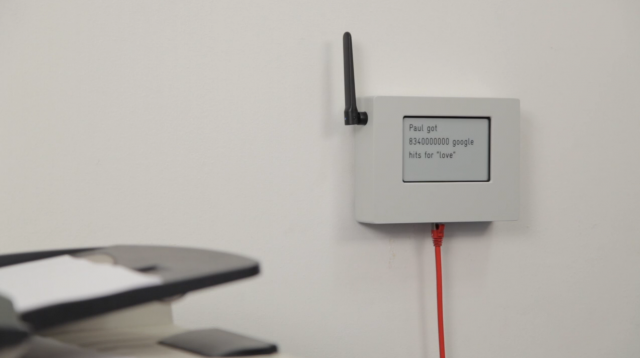
The devices rely on Python-based web scraping scripts that extract quotes from a wide range of news sources across the political spectrum covering current conflicts around the world. Each quote is evaluated and filtered by a fine-tuned language model (using OpenAI API) using three metrics: Emotional Weight, Interpretative Space, and Memorability. The system prioritizes civilian voices and filters out formal, institutional, or overly specific language. The quotes are stored in a Firebase database and distributed to nine custom-built devices via a fully automated pipeline (using Google’s Cloud Run functions). All devices are powered and managed from a single, hand-fabricated aluminum docking station, which houses the microcontrollers and serves as the point for receiving new updates. Each docking spot features an RGB LED that changes color to indicate whether a new quote is loading, fully loaded, or if the device is out of the dock. The enclosures are SLS 3D-printed, and each device features an e-paper display – chosen for its physical presence and tactile quality, which felt more appropriate than traditional screens or paper for presenting these kinds of quotes.
Arduino libraries: GxEPD2_BW, Adafruit_GFX, SPI, WiFi, HTTPClient, ArduinoJson.
Python libraries: firebase-admin, openai, python-dotenv, requests, beautifulsoup4.
Project Page | Jasmine Nackash
War is Jasmine Nackash’s thesis project at the Interactive Telecommunications Program, New York University, May 2025. The full thesis presentation is available on vimeo.